Machinery Regulation 2027: What Changes for Manufacturers
Machinery Regulation (EU) 2023/1230 from 20 January 2027: the deadline, key changes for manufacturers, the status of standards and the end of the Machinery Directive.
In this article9
- Where can I find the Machinery Regulation?
- What examples are there of substantial modifications to machinery?
- What does the Machinery Directive 2006/42/EC say?
- Which standards exist for machinery safety?
- What are the substantial changes introduced by the new Machinery Regulation?
- What is the deadline for the new Machinery Regulation?
- When is the Machinery Directive replaced?
- Frequently asked questions
- Sources
Where can I find the Machinery Regulation?
You can find the Machinery Regulation free of charge on the EUR-Lex portal: its official title is Regulation (EU) 2023/1230 of the European Parliament and of the Council of 14 June 2023 on machinery. It was published in the Official Journal of the European Union (L 165, p. 1) on 29 June 2023 and entered into force on 19 July 2023, twenty days later. EUR-Lex provides the text in all official languages and as a consolidated version. The most recent consolidated version (as of 27 July 2026) contains the corrections of 4 July 2023 and 1 April 2025 as well as the amending regulations (EU) 2024/2748 and (EU) 2026/1744.[1] For declarations of conformity and technical documentation, this consolidated version is the most reliable working basis; the legally binding text remains the one published in the Official Journal.[2][1]
Legally, this is an EU regulation, not a directive. It therefore applies directly in all member states and does not need to be transposed into national law. In Germany, the Ninth Ordinance on the Product Safety Act (9. ProdSV) has so far implemented the Machinery Directive 2006/42/EC; it ceases to apply with the end of 19 January 2027.[3] Because the 9.[4] ProdSV also carries the name "Maschinenverordnung" (Machinery Ordinance), this article always uses the term to mean the EU Regulation (EU) 2023/1230.
- The consolidated version of Regulation (EU) 2023/1230 is available on EUR-Lex free of charge and without registration.
- For verbatim quotations in legal documents, the first publication in the Official Journal of the EU is authoritative (L 165 of 29 June 2023).
- The BAuA offers an overview of the 9. ProdSV and of the national classification of machinery safety in Germany.
- The guides published by the chambers of commerce (IHKs) summarise the transition rules in practical terms, expressly without legal binding effect.
In technical documentation, the regulation should be cited with its full title. The short form "Machinery Regulation" is common in practice, but does not appear in the title of the legal act.[2] Especially in declarations of conformity that cover several legal acts, only the exact designation shows which legal status has been demonstrated.
What examples are there of substantial modifications to machinery?
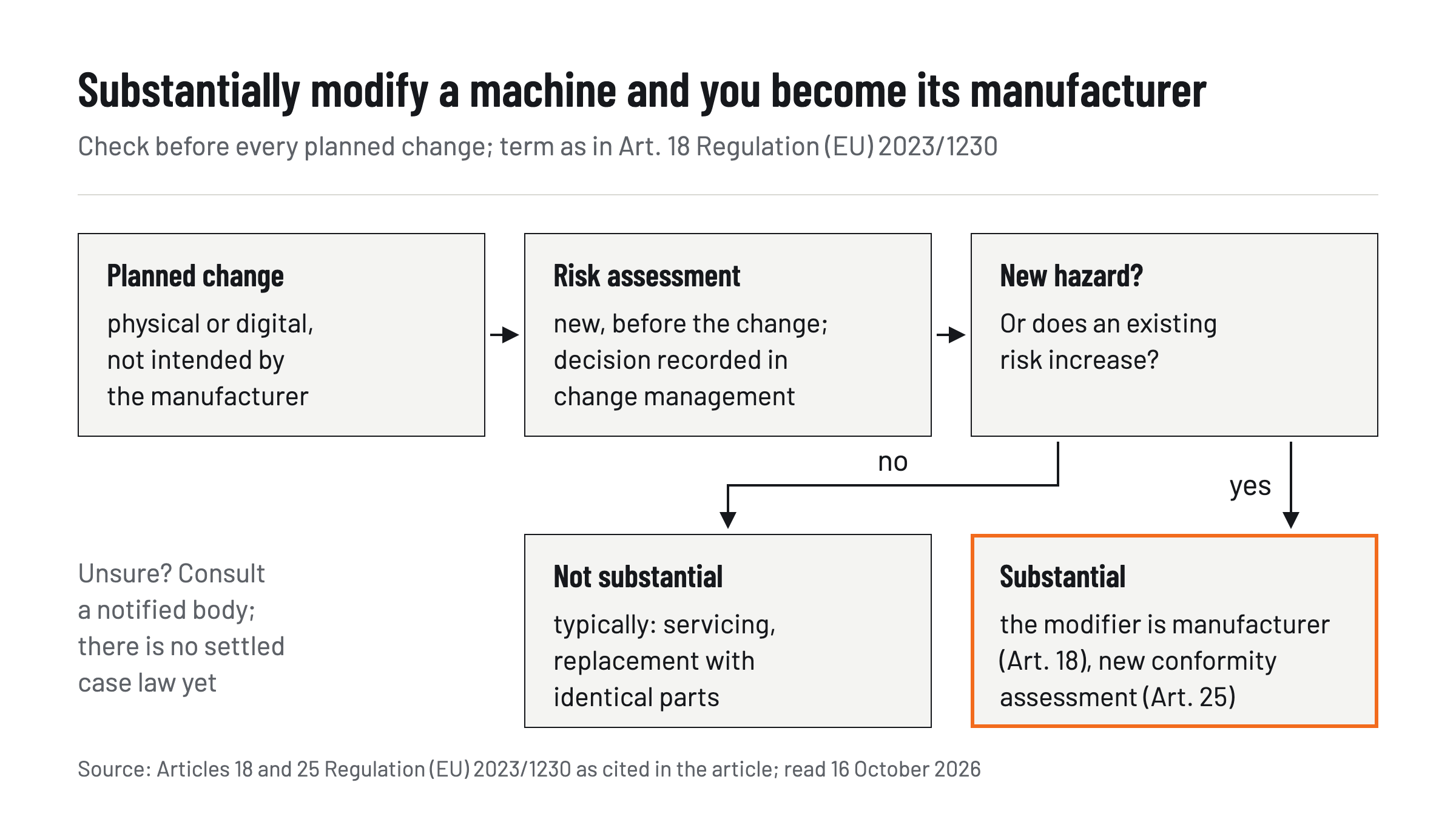
Under the Machinery Regulation, a substantial modification is a physical or digital change to a machine or a related product, made after placing on the market or commissioning, that was not intended or planned by the manufacturer and that impairs safety because a new hazard arises or an existing risk increases.[5] The Regulation introduces this term for the first time EU-wide (Article 18). What matters, therefore, is not the scale of the modification but its effect on safety. If a substantial modification exists, the conformity assessment procedure for the machine must be carried out in full again under Article 25.[5]
Whoever carries out the substantial modification is deemed the manufacturer under Article 18 and assumes the manufacturer's obligations under Article 10.[1] For operators, this means: after a retrofit or a far-reaching software intervention, they can legally become the manufacturer themselves. Not every change falls under the term. Maintenance and the replacement of parts with identical ones generally do not meet the definition, because neither a new hazard arises nor does an existing risk increase. Whether a modification is substantial remains a case-by-case engineering judgement.
- Installing additional components, for example an extra drive that enables new movements and thus new hazards.
- Installing new software that changes safety or motion functions.
- Converting to collaborative operation with collaborative robots (cobots) without re-evaluating the requirements for human-machine interaction.
- Connecting the machine to other installations or networks where this can create new dangerous situations, for example through manipulation via the interface.
- Increasing speed, lifting force or cycle rate beyond the limits of the original risk assessment where this raises an existing risk.
For maintenance and engineering, the consequence is: every planned machine modification requires a new risk assessment and a documented decision on whether it is substantial before implementation. This decision belongs in change management, not solely in the knowledge of individual technicians. A first point of orientation is the manufacturer's instructions for use, because they define the limits of intended use; in cases of doubt, coordination with a notified body — a conformity assessment body designated by a member state — helps. Interpretation of the new term is still young; there is no settled case law so far. Projects should factor this uncertainty in from the outset.
What does the Machinery Directive 2006/42/EC say?
The Machinery Directive 2006/42/EC governs the safety requirements under which new machines may be placed on the EU market. It has applied since 29 December 2009 and replaced Directive 98/37/EC. In Germany it is implemented through the Product Safety Act in conjunction with the 9th ProdSV. It applies to machinery, interchangeable equipment, safety components, lifting accessories, chains, ropes and webbing, removable drive shafts and partly completed machinery.[3][3]
At its core, the Directive requires that a machine meets the essential health and safety requirements, starting from a risk assessment carried out by the manufacturer. This is demonstrated through a multi-stage conformity assessment procedure that begins in the design phase and takes the machine's life cycle into account. The technical documentation can run to several hundred pages. Most of it remains with the manufacturer as internal evidence, while operators receive the instructions for use, the declaration of conformity and additional safety information.
| Element | Role in the procedure |
|---|---|
| Risk assessment | Methodical starting point; derives protective measures and the applicable assessment procedure |
| Essential requirements | Protection goals in Annex I of the Directive, to be implemented in the design |
| Harmonised standards | Voluntary application; triggers the presumption of conformity when the listed reference is used |
| Technical documentation | Internal evidence held by the manufacturer, to be presented on request by authorities |
| Declaration of conformity and CE marking | The declaration confirms compliance with all requirements; the CE mark must be legible and permanently affixed to the machine |
This structure has proven itself since 2009, but it captures newer risks only incompletely. According to the European Agency for Safety and Health at Work, EU-OSHA, the regulation is intended to better address new technologies, such as autonomous mobile machines (robots), connected devices in the Internet of Things, and artificial intelligence whose learning modules take over safety functions.[6] This is where the new regulation comes in, without replacing the building blocks of risk assessment, standards and conformity assessment.
Which standards exist for machinery safety?
Machinery safety is covered by harmonised A, B and C standards: European standards developed by CEN, CENELEC and ETSI on behalf of the European Commission, which translate the essential health and safety requirements into technical specifications. Their application is voluntary. However, anyone who applies them can rely on the presumption of conformity: once the reference of the standard is published in the Official Journal of the European Union, it is presumed that the product meets the requirements covered by that standard. Without the application of standards, the burden of proof lies entirely with the manufacturer.[7]
| Standard type | Content | Examples |
|---|---|---|
| A standards | Basic concepts, design principles and risk assessment, applicable to all types of machinery | EN ISO 12100 |
| B standards | Cross-cutting safety aspects (B1) and protective devices (B2) | [7]EN ISO 13849-1 (safety-related parts of control systems), EN ISO 13857 (safety distances), EN 60204-1 (electrical equipment) |
| C standards | Detailed requirements for specific machine types, taking precedence over A and B standards | EN ISO 10218-1/-2 (industrial robots), EN 415 series (packaging machinery) |
The following sequence has proven effective: first check whether a C standard exists for the machine type, then select the B standards according to the hazards identified, and always apply the methodology of the A standard.[7] Reasonably foreseeable misuse must also be taken into account, such as climbing over protective fences that are too low or tampering with protective devices; EN ISO 13857 specifies minimum distances, heights and design measures for this purpose.
With the switch to the regulation, the status of the standards changes, not their systematics. According to CE-Copilot (2025), no references had yet been published under the Machinery Regulation; standards from the directive list can continue to be applied as the state of the art, but they do not establish a presumption of conformity under Article 20 for machines covered by the regulation.[7] In January 2025, the Commission issued the standardisation mandate M/605 to CEN and CENELEC, and it can in future also issue technical specifications that likewise trigger a presumption of conformity.[8] Design and documentation teams should therefore actively track the harmonisation status of the standards they apply and record the verified status in the technical documentation.
What are the substantial changes introduced by the new Machinery Regulation?
The substantial changes of the new Machinery Regulation mainly concern digital technologies; the system of risk assessment, conformity assessment and CE marking remains in place. The EU names as its objectives adapting the safety requirements to the state of the art, covering new risks from digital technologies, re-evaluating machines with particular risks, and reducing paper-based documentation.[9]
- Cybersecurity and protection against corruption (Annex III, point 1.1.9): Connection to, or communication with, other equipment must not trigger a hazardous situation. Safety-related hardware must be protected against unintentional or deliberate tampering, the machine must collect evidence of interventions, and safety-critical software and data must be labelled and protected.[5] For operators, this also affects the plant's OT security.
- Safety and reliability of control systems (Annex III, point 1.2.1): Control systems must withstand even malicious interference by third parties, safety functions must not be alterable beyond the limits defined in the risk assessment, and with wireless controls a communication failure must not create a hazard. Logs and software versions must remain accessible to market surveillance authorities on request for up to five years, and data on safety-related decisions for one year after recording.[5]
- Learning systems: Safety components with self-evolving behaviour based on machine learning, and machines with corresponding embedded systems, fall under Annex I. The risk assessment must also include risks that only emerge after placing on the market as a result of the evolving behaviour. Only AI relevant to machinery safety is addressed; the remaining AI questions are governed by Regulation (EU) 2024/1689 (the AI Act).[5] Since the amending regulation (EU) 2026/1744 of 8 July 2026, the Commission may add requirements for high-risk AI systems to Annex III; such delegated acts apply from 2 August 2028.[1]
- Digital instructions for use and declaration of conformity (Article 10, paragraph 7): Both may be provided digitally. The manufacturer must state on the machine how access works, provide a format for printing, downloading and storing the documents, and keep them available online for the expected lifetime, at least ten years. If the user requests it at the time of purchase, the instructions for use must be supplied free of charge in paper form within one month; safety information for non-professional users remains in paper form.[5]
- An expanded circle of economic operators: In addition to manufacturers, importers, (online) distributors and authorised representatives are now explicitly addressed for the first time, including used machinery dealers. Importers and distributors face extended obligations, including stricter reporting requirements to the authorities.[5][10]
- Reassessment of Annex I: The catalogue of machinery with particular risk is divided into Part A and Part B. Part A requires a conformity assessment procedure involving a notified body; in Part B, internal production control suffices where harmonised standards are applied.[5] Since 20 July 2024, the Commission may amend Annex I by delegated act (Articles 6 and 47).[1]
Beyond the technical requirements, the regulation sharpens the demands on human-machine interaction (Annex III, point 1.1.6): Under intended use, nuisance, fatigue and physical and mental strain on operators must be reduced to the minimum possible level. Newly taken into account is also the coexistence of humans and machines in a shared space without direct collaboration — for example, when vehicles and people share the same area.[5]
For manufacturers, the transition shifts effort into documentation and IT. The technical documentation grows to include the new digital evidence, and the ten-year online availability of digital documents requires an infrastructure that survives outages. In the event of damage, the manufacturer bears the burden of proof that access was available; the IHK Lippe zu Detmold additionally points to the risks of economic espionage, in particular through automated analysis using AI tools.[5] Further EU initiatives are running in parallel: the Ecodesign Regulation ESPR has applied since 2024, and according to industrie.de (April 2026) the digital product passport will become mandatory from 2027, initially for industrial and vehicle batteries, and will be extended step by step to more than 30 product groups.[11] Anyone who consolidates their documentation and data processes now is preparing for both initiatives at once.
What is the deadline for the new Machinery Regulation?
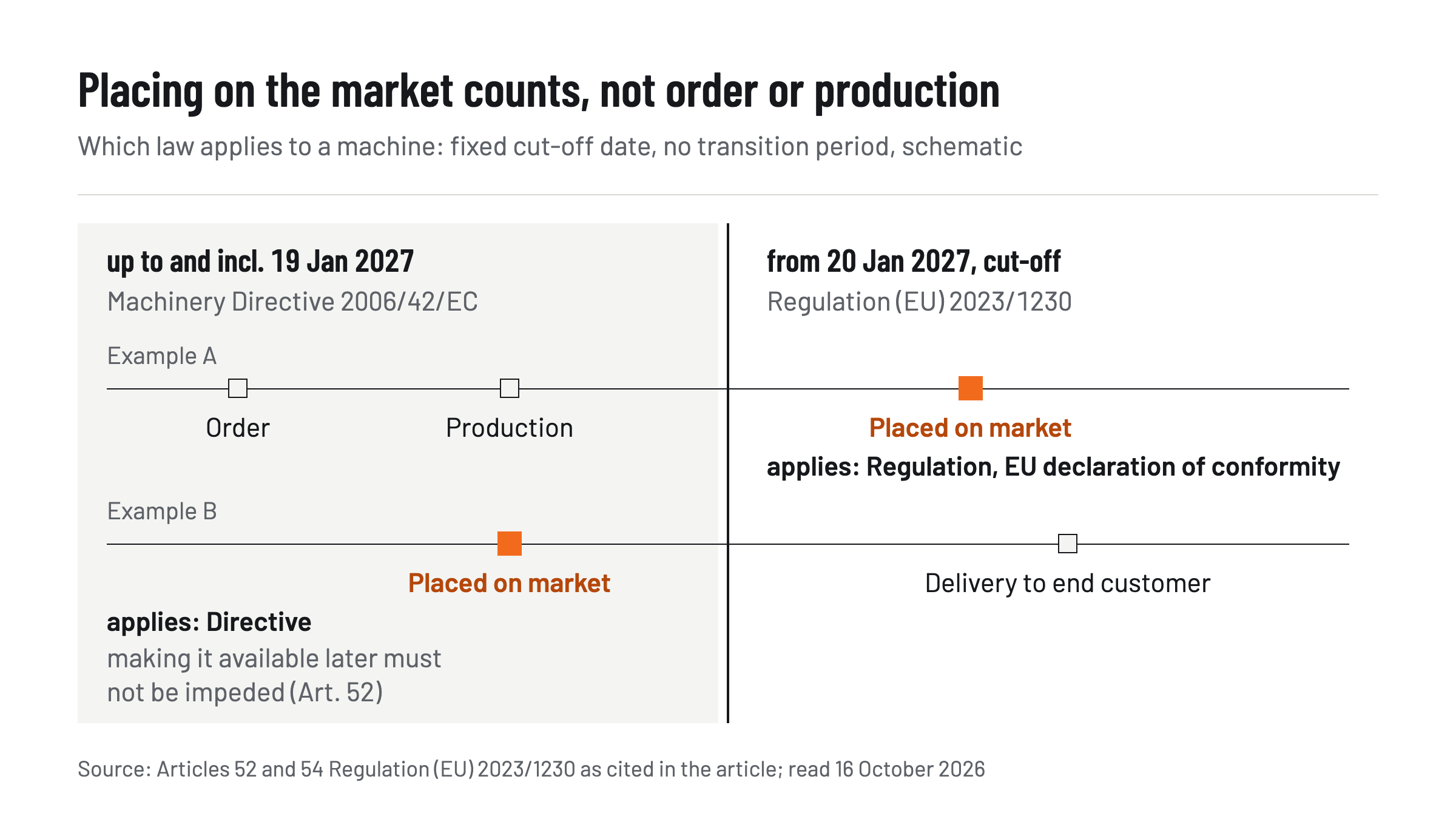
The deadline for the new Machinery Regulation is 20 January 2027: from that date it applies in full in all EU member states. The decisive factor is the point in time of placing on the market, i.e.[5] the first time a product is made available on the Union market. It is not the receipt of the order, production or delivery to the end customer that matters, but this first market access.[5]
There is no transition period in which manufacturers could choose between the old and the new law. Machinery placed on the market up to and including 19 January 2027 follows the Directive and is delivered with a declaration of conformity under the Machinery Directive; from 20 January 2027, machinery must meet the requirements of the Regulation and carry an EU declaration of conformity. Member states may not hinder the making available of products placed on the market under the Directive before the cut-off date; EC type-examination certificates and approvals remain valid until they expire (Article 52).[5][5]
| Date | What applies | Legal basis |
|---|---|---|
| 19 July 2023 | [1]Entry into force of the Regulation, twenty days after publication in the Official Journal of the European Union; Articles 6(7), 48 and 52 apply | Article 54 |
| 20 January 2024 | [1]Notification of conformity assessment bodies (Chapter V, Articles 26 to 42) | Article 54(a) |
| 20 July 2024 | [1]Commission's power to amend Annex I by delegated act | Articles 6, 47 |
| 24 July 2026 | [1]Amending Regulation (EU) 2026/1744 in the Official Journal: basis for AI requirements in Annex III | Articles 8, 47 |
| 20 October 2026 | [1]Article 50(1) applies: the member states lay down penalties | Article 50 |
| 20 January 2027 | [4]Full application of the Regulation; the 9th ProdSV ceases to apply at the end of 19 January 2027 | Article 54 |
| 2 August 2028 | [1]Earliest date of application of delegated acts on high-risk AI systems | Article 8(3) |
The table summarises the application dates from Article 54 of the consolidated version. For series production, this creates a grey area: whether a specific machine is placed on the market before or after the cut-off date can often not be determined exactly for ongoing projects. Preparation is therefore worthwhile now: extend risk assessments to include digital hazards, review documentation and provision processes, and clarify whether your own products fall under the new categories of Annex I.
When is the Machinery Directive replaced?
The Machinery Directive 2006/42/EC is replaced on 20 January 2027: it applies up to and including 19 January 2027, after which Regulation (EU) 2023/1230 fully supersedes it. In Germany, the 9th ProdSV, which had transposed the Directive nationally, ceases to apply at the same time.[5][4]
- Until 19 January 2027: declaration of conformity under Machinery Directive 2006/42/EC.
- From 20 January 2027: EU declaration of conformity under Regulation (EU) 2023/1230, digital provision permitted.
- In both cases: a combined EC/EU declaration of conformity is possible if all requirements of the Regulation are met.
For the series-production transition, the European Commission enabled the combined EC/EU declaration of conformity in July 2024, as described by IHK Lippe zu Detmold: manufacturers may state in it that the machine, where applicable, also complies with the Machinery Regulation (EU) 2023/1230.[5] The precondition is that all requirements of the Regulation are met. The combined declaration does not replace missing conformity; it only documents that both legal regimes are covered. Anyone delivering around the cut-off date saves effort, because a single declaration covers both cases.
Operators should treat the cut-off date primarily as a planning parameter: new purchases from 2027 come with an EU declaration of conformity and digital documents, existing machines remain unchanged in ongoing operation, and modifications to existing machines must be checked in advance for a substantial modification. Manufacturers are best advised to incorporate the Regulation's requirements, such as those on cybersecurity, into ongoing developments now rather than deferring them to the cut-off date.[5]
The GoMaschine editorial team follows this transition through industry analyses, comparisons and technical explainer articles, with disclosed criteria, sources and system boundaries instead of vendor advertising. You can find further context in the Industry section of GoMaschine, for example on standards, conformity and maintenance under machinery safety.
Frequently asked questions
When does the new Machinery Regulation enter into force?
The Machinery Regulation entered into force on 19 July 2023 and applies mandatorily in all EU member states from 20 January 2027. Until 19 January 2027, the Machinery Directive 2006/42/EC continues to apply.
May the instructions for use be provided digitally in the future?
Yes, the instructions for use and the declaration of conformity may be provided digitally. The manufacturer must keep them accessible online for at least ten years and, on request at the time of purchase, supply a paper version free of charge within one month; safety information for non-professional users remains in paper form.
What is a substantial modification of a machine?
A substantial modification is a physical or digital alteration not intended by the manufacturer that creates a new hazard or increases an existing risk. Whoever carries it out is deemed the manufacturer and must repeat the conformity assessment.
Is there a transition period after 2027?
No, a fixed cut-off date applies. From 20 January 2027, new machines may only be placed on the market in accordance with the requirements of Machinery Regulation (EU) 2023/1230.
What role does cybersecurity play in the new regulation?
Cybersecurity becomes an essential health and safety requirement through the protection against corruption (Annex III, point 1.1.9). Control systems must withstand foreseeable malicious attempts by third parties, and safety-relevant software and hardware interfaces must be protected against tampering.