Steel Price Development: What Buyers Should Budget for 2026 and 2027
Steel prices 2025 to 2027: current prices per tonne and per kilo, the drivers in Germany and dated forecasts with sources for budget planning.
In this article8
What is the current steel price?
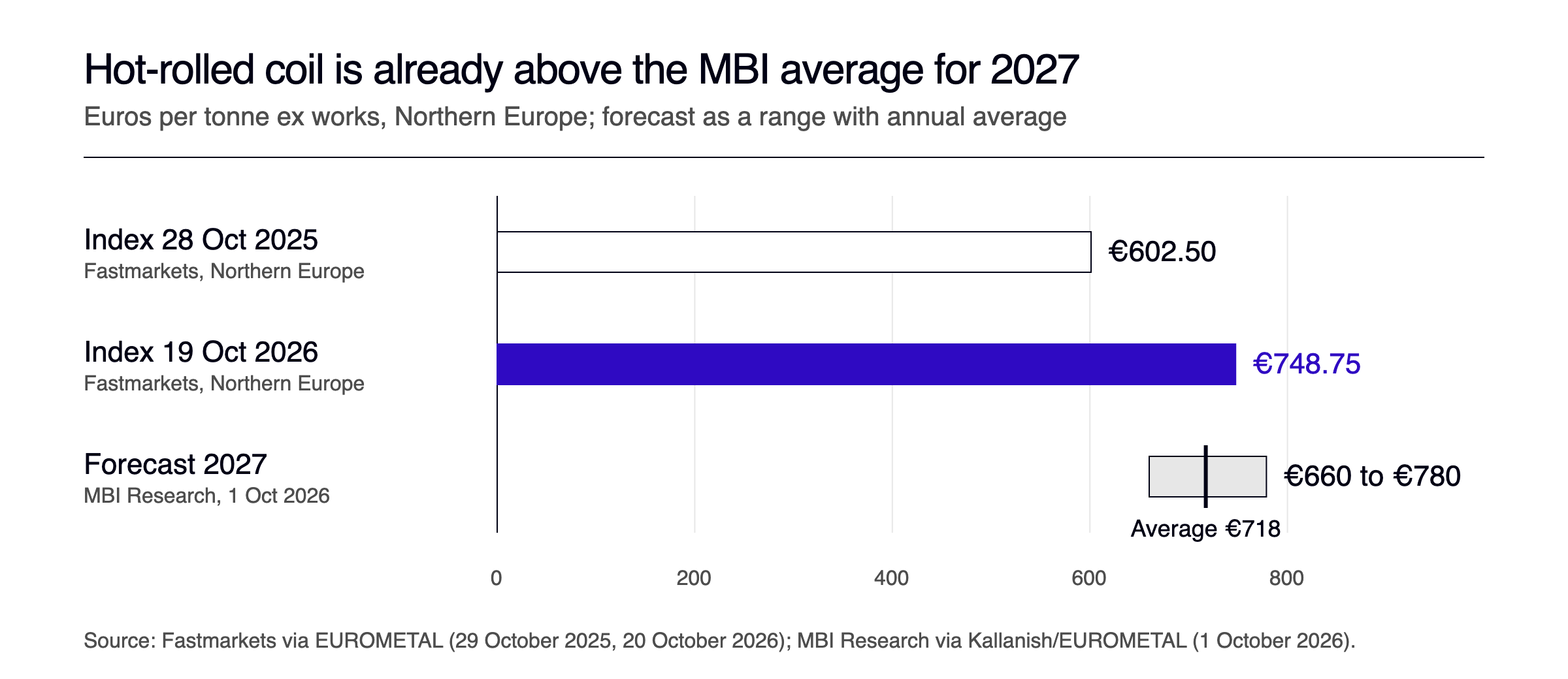
Steel price development in October 2026 is at a high level: hot-rolled coil (HRC), the feedstock for many sheet and tube products, cost 748.75 euros per tonne ex-works in Northern Europe on 19 October 2026. This is the daily index of the price service Fastmarkets, published by EUROMETAL on 20 October 2026; it stood 11.25 euros above the value one month earlier.[1] Buyers accordingly reported offers of around 750 euros per tonne delivered in Germany, while German mills were aiming for 770 euros per tonne delivered.
For context in Germany, official statistics are the second reference. According to the Federal Statistical Office, pig iron, steel and ferroalloys in September 2026 were 8.4 percent more expensive than in September 2025, and rebar 7.0 percent.[2] Overall producer prices rose by 6.7 percent over the same period, driven mainly by energy with an increase of 14.9 percent. Destatis publishes index changes, not euro prices per tonne.
How has the steel price developed since 2025?
Steel price development since autumn 2025 shows a marked increase. On 28 October 2025, the same Fastmarkets index for hot-rolled coil stood at 602.50 euros per tonne ex-works. By 19 October 2026, 146.25 euros per tonne had been added, an increase of just over 24 percent (own calculation from the two index values).[3] Prices have therefore risen faster than demand: the European steel association EUROFER expects visible steel consumption in the EU to grow by only 0.1 percent in 2026.[4]
| Key figure | Value | As of | Source |
|---|---|---|---|
| Hot-rolled coil Northern Europe, ex-works | 748.75 €/t | 19 Oct 2026 | Fastmarkets via EUROMETAL |
| Hot-rolled coil Northern Europe, ex-works | 602.50 €/t | 28 Oct 2025 | Fastmarkets via EUROMETAL |
| Rebar Germany, delivered incl. dimension surcharge | approx. 685 €/t | 9 Oct 2026 | GMK Center |
| Producer prices pig iron, steel, ferroalloys | +8.4 % year-on-year | September 2026 | Destatis |
| Producer prices rebar | +7.0 % year-on-year | September 2026 | Destatis |
Will steel become more expensive in 2026?
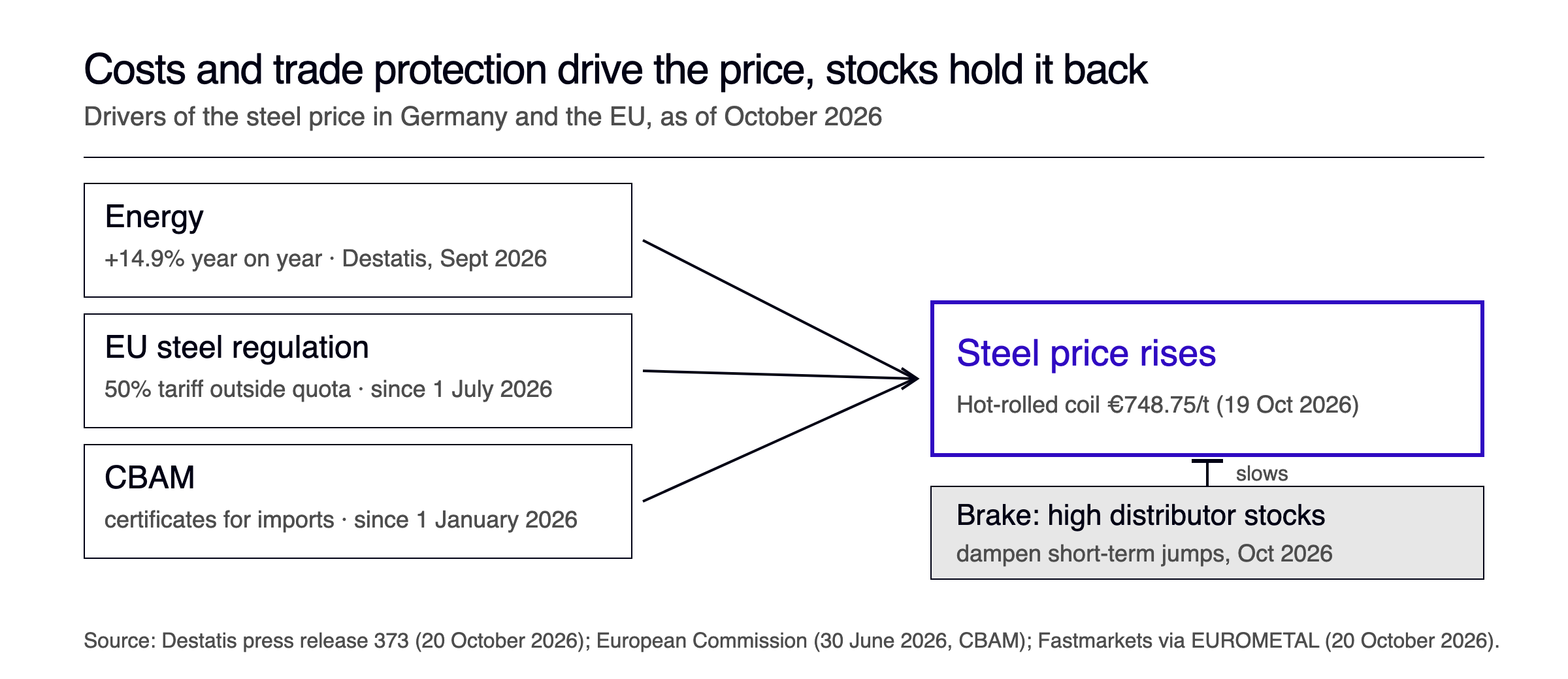
Steel has already become more expensive in 2026, and the increases are carrying over into the annual contracts for 2027. Three factors explain the rise even though demand in the EU is barely growing.
Energy costs have the strongest effect: according to Destatis, energy in September 2026 was 14.9 percent above the same month last year, making it the main driver of producer prices.[2] The International Monetary Fund also points out that buyers have built up stocks of energy-intensive goods such as steel, produced in Germany, because of the conflict in the Gulf region.[5]
Added to this is external protection: Since 1 July 2026, EU Regulation 2026/1384 has been in force, replacing the previous safeguard measures for steel. According to the European Commission, the tariff-free quotas fall by around 47 percent compared with the 2024 system, and imports outside the quotas carry a 50 percent tariff.[6] Importers must also document in which country the steel was melted. As a result, cheap imports constrain the prices of European mills less than before.
The carbon border adjustment also has an effect: The Carbon Border Adjustment Mechanism (CBAM) has been in its definitive phase since 1 January 2026 and covers, among other goods, iron and steel. Importers must purchase and surrender CBAM certificates in line with the embedded emissions, which makes imported steel more expensive still.[7]
For the mills, another factor is that distributor inventories are high. For October 2026, Fastmarkets reports large stocks that are dampening demand, and prices in Italy and Germany that barely moved for two weeks.[1] In the short term, this points more to sideways movement than to another jump.
What does 1 tonne of construction steel cost at present?
In October 2026, one tonne of construction steel at mill level costs between roughly 685 and 770 euros depending on the product, before distributor margins, processing, freight in the small-quantity business and value-added tax are added. In common usage, "construction steel" refers to two different products with different price references:
- Rebar (reinforcing steel B500) for construction: According to GMK Center, the base price in Germany on 9 October 2026 was around 420 euros per tonne delivered, or 685 euros per tonne including the dimension surcharge. In August, Kallanish had reported German base prices just above 400 euros per tonne.[8][9]
- Flat steel and plate from hot-rolled coil (HRC) for mechanical engineering and steel construction: Here the Fastmarkets index mentioned above applies; German mills were targeting 770 euros per tonne delivered on 19 October 2026.
The difference between base price and final price is decisive for cost calculations. The German rebar market works with a base price plus surcharges for dimensions and quantity; comparing quotations only works if both sides contain the same components. Anyone receiving distributor prices for small quantities, bent bars or mats will naturally sit well above these mill references.
What is the outlook for the steel price?
The forecasts for 2027 point to a further, moderate rise with a wide range. According to a Kallanish report of 1 October 2026, Peter Fertig, analyst at MBI Research, expects an annual average of 718 euros per tonne ex-works for hot-rolled coil (HRC) in 2027, with peaks around 780 and lows around 660 euros. According to MBI, that is 40 to 50 euros per tonne above the 2026 level.[10] For rebar, MBI gives a base scenario of 678 euros per tonne ex-works (630 to 715 euros), and for cold-rolled coil 796 euros per tonne (735 to 835 euros).
Two caveats belong with these figures. Fertig himself described the previous year's forecast as too pessimistic: the base scenario for hot-rolled coil (HRC) was 595 euros per tonne at the time. And he had to adjust his models because of new trade measures and CBAM. Moreover, the current index value is already above the MBI annual average for 2027; an average figure therefore does not rule out months with higher prices.
The market is sending similar signals. Kallanish reported on 21 October 2026 that mills are aiming for significant increases over 2026 in the 2027 annual contracts; one buyer-side market observer spoke of "100 euros per tonne more from every direction". These are demands in negotiations, not concluded prices.[11] On the demand side, EUROFER expects steel consumption to rise by 2.3 percent in 2027, but consumption would still remain around 7 million tonnes below the 2019 level. For Germany, the IMF expects economic growth of 1.1 percent in 2027.[4][5]
Worked example: budget for 500 tonnes of coil demand in 2027
A demand of 500 tonnes of hot-rolled coil (HRC) will cost between 330,000 and 390,000 euros in 2027, depending on the MBI scenario. The example is illustrative; the assumptions: 500 tonnes of hot-rolled coil for 2027, ex-works prices without freight, surcharges and VAT, scenarios from the MBI forecast of 1 October 2026 and the Fastmarkets index of 19 October 2026.
| Scenario | Price per tonne | Budget for 500 t |
|---|---|---|
| MBI low point 2027 | €660 | €330,000 |
| MBI annual average 2027 | €718 | €359,000 |
| Index 19 Oct 2026 | €748.75 | €374,375 |
| MBI high point 2027 | €780 | €390,000 |
The spread between the low and high point is 60,000 euros. If you set the budget at the annual average, you should declare the 31,000-euro gap to the high point as a risk buffer or hedge it through contract duration and price fixing in the supply contract. A second qualified source of supply, as described in dual sourci[12]ng in procurement, additionally improves your negotiating position.
What is the price per kg of construction steel?
At mill level, the price per kilogram of construction steel stood at around 0.69 to 0.77 euros in October 2026. The conversion is simple: divide the tonne price by 1,000. From 685 euros per tonne of rebar including the dimension surcharge (GMK Center, 9 October 2026), that yields 0.685 euros per kilogram; from the Fastmarkets value for hot-rolled coil of 19 October 2026, just under 0.75 euros per kilogram; and from the mill target of 770 euros delivered, 0.77 euros per kilogram.
For practical purposes, these values are a lower bound. Per-kilogram prices in trade include warehousing, cutting, bending, small-quantity surcharges and VAT, and are therefore considerably higher. For a fair comparison, you should record with every quotation whether the price is ex-works or delivered, which surcharges are included, and which grade and dimension it is based on. Further fundamentals on materials can be found in the Steels section.
How much does a kilo of copper cost in 2026?
On 20 October 2026, a kilogram of copper cost 13.27 to 13.30 euros according to the Westmetall quotation. The WM notation is published in euros per 100 kilograms and stood between 1,327.21 and 1,330.15 euros on that day.[13] On the London Metal Exchange (LME), copper traded at 14,540 US dollars per tonne in the spot market. Copper has thus become more expensive than steel: Destatis reports an increase of 31.4 percent year-on-year for copper and semi-finished copper products in September 2026.[2]
For buyers of motors, cables and windings, the copper price increase was therefore almost four times as strong as for pig iron, steel and ferroalloys. Forecasts and consequences for individual components are a topic of their own; the Raw material prices section is a starti[14]ng point. Further analysis of prices, supply chains and the economic cycle can be found in the Industry section on GoMaschine.
Frequently asked questions
Where can I find the current steel price for Germany?
The Federal Statistical Office publishes official rates of change monthly as the producer price index. Euro prices per tonne are provided by price services such as Fastmarkets, Kallanish or OPIS, whose values are regularly quoted by trade media such as EUROMETAL.
Did the steel price fall or rise in 2025?
In autumn 2025, hot-rolled coil in Northern Europe was still at around 600 euros per tonne ex-works. The sharp rise to around 750 euros occurred mostly in 2026.
Should I buy steel now as a stockpile?
That depends on warehousing costs, tied-up capital and your price fixing. The market reports of October 2026 mention high distributor inventories, which dampen short-term price jumps.
What do ex-works and delivered mean in steel pricing?
Ex-works means the buyer bears freight and transport risk themselves. Delivered includes shipping to the recipient and is correspondingly higher.
Sources
Related reading
All Supply chains →Dual Sourcing: Strategy, Advantages and Disadvantages in Procurement
Dual sourcing explained: definition, advantages and disadvantages, when a second source pays off, and how it differs from single, multiple and modular sourcing.
Supply Chain Act update: What applies to suppliers with fewer than 1,000 employees?
Supply Chain Act update (October 2026): what applies to suppliers with fewer than 1,000 employees, what the amendment changes and when the 5,000 threshold comes.