Dual Sourcing: Strategy, Advantages and Disadvantages in Procurement
Dual sourcing explained: definition, advantages and disadvantages, when a second source pays off, and how it differs from single, multiple and modular sourcing.
In this article10
- What is dual sourcing?
- What are the advantages and disadvantages of single sourcing?
- What is modular sourcing?
- Which procurement strategies are there?
- What does "domestic sourcing" mean?
- Which types of sourcing are there?
- What does multiple sourcing mean?
- What examples are there of procurement strategies?
- Frequently asked questions
- Sources
What is dual sourcing?
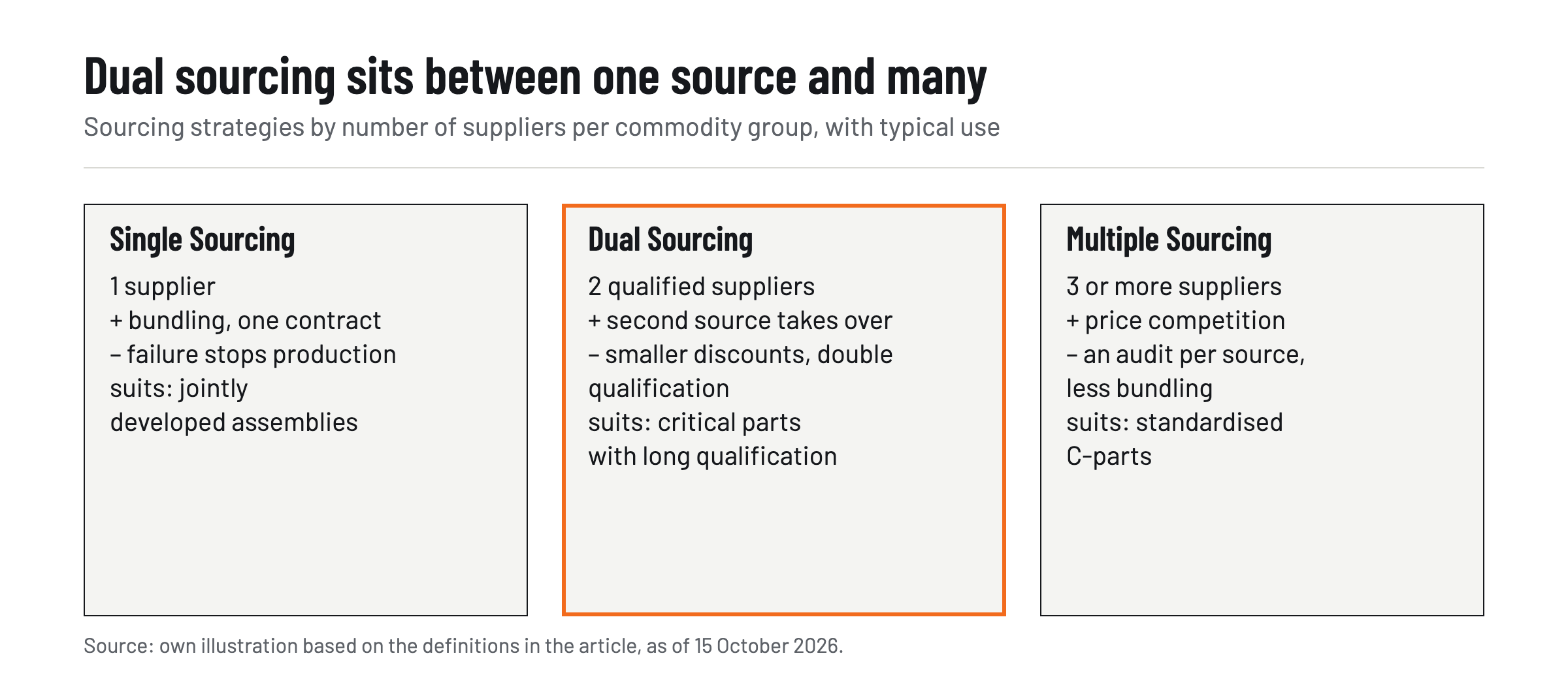
Dual sourcing is a procurement strategy in which a company procures the same component or the same commodity group from two qualified suppliers. Often the main supplier carries the larger share of the volume, while the second source is qualified and delivers smaller quantities so that it can step in in an emergency. Dual sourcing therefore sits between single sourcing with one source and multiple sourcing with three or more sources. The economists Thomas Gehrig and Rune Stenbacka describe dual sourcing in the Atlantic Economic Journal (2023) as insurance against future opportunism: investments in a second source limit the abuse of market power by the active supplier, even if the second source is never actually used.[1]
Advantages of dual sourcing
- Supply resilience: if a supplier fails, for example through insolvency, export restrictions or quality problems, the second can take over supply at least in part.
- Negotiating position: a qualified alternative limits price dictates and opportunism by the main supplier.
- Comparability: two ongoing supply relationships make price, quality and delivery reliability directly comparable.
- Manageable effort: two suppliers are considerably easier to manage than a broad multiple-sourcing portfolio.
Disadvantages of dual sourcing
- Less bundling: the volume is spread across two suppliers, so volume discounts are smaller.
- Doubled qualification effort: first-article inspection, audits, tooling and test equipment are incurred for both suppliers.
- Coordination on drawing parts: every change must be implemented at both sources so that tolerances and processes do not drift apart.
- False security: if both suppliers source critical upstream products from the same source or region, the second source offers little protection.
When is dual sourcing worthwhile?
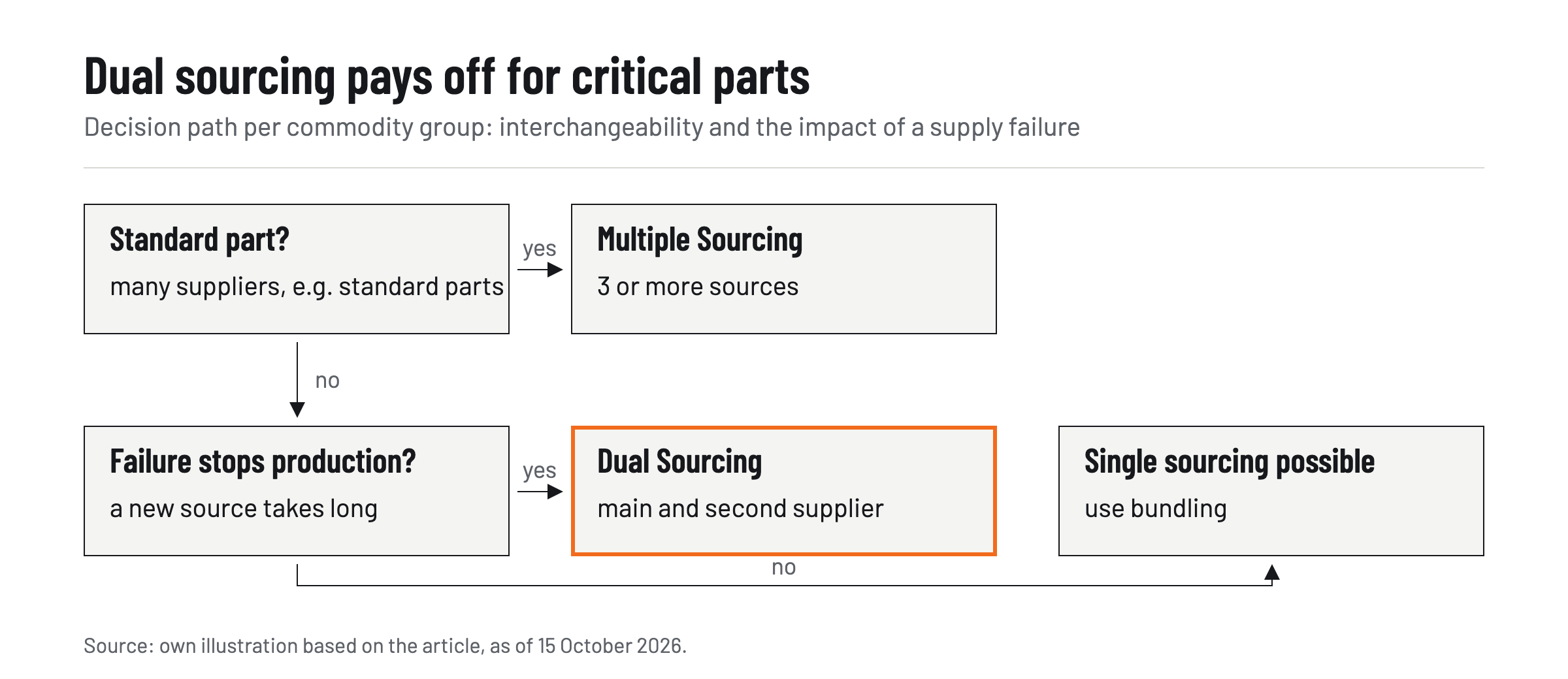
Dual sourcing is worthwhile when the failure of a component would stop your own production and qualifying a new supplier would take a long time, for example with electronic components, castings or coatings. For standardized C-parts with many suppliers, multiple sourcing is usually sufficient; for assemblies developed closely with one partner, single sourcing is often the only option. The decision is therefore made per commodity group, not across the board for the entire procurement function.
What are the advantages and disadvantages of single sourcing?
In single sourcing, a company deliberately concentrates procurement of a commodity group on a single supplier. This focus is rarely a matter of convenience; it is usually the result of a technical or economic logic: tool-specific processes, released drawing parts or close development partnerships can only be transferred to a second supplier at considerable effort. Anyone who has designed an assembly together with a supplier also buys its manufacturing competence, and that cannot be duplicated by framework agreement. Anyone who additionally evaluates supplier relationships under regulatory obligations such as the German Supply Chain Act should factor the compliance requirements into the sourcing decision early.
Advantages: bundling creates leverage
- Volume bundling: Higher purchase volumes from a single supplier typically improve terms and reduce unit costs.
- Less supplier management effort: One qualification, one audit, one framework agreement instead of several parallel relationships.
- Deeper partnership: The supplier knows the component, the tolerances and the process chain; changes can be implemented jointly and more quickly.
- Clear responsibility: When quality problems arise, there is exactly one point of contact, with no turf disputes between parallel sources.
Disadvantages: dependence on a single supplier
- Failure risk: If the sole supplier fails, the affected production line stands still until a new source has been qualified.
- Pricing power: Without an alternative, procurement lacks leverage in negotiations.
- Switching costs: Tools, approvals and process knowledge sit with the supplier, making a change expensive and slow.
What is modular sourcing?
With modular sourcing, a company no longer procures individual parts but complete assemblies or modules from a system supplier: for example, a finished hydraulic unit, a gearbox module or a populated sensor board. Procurement thus shifts from the part level to the module level, which reduces the number of procurement objects and interfaces within the company. The price of this bundling is a significantly higher dependence on the system supplier, who holds the know-how for the entire function; switching suppliers is technically more demanding than with standardized individual parts. The boundary to outsourcing is also fluid: outsourcing moves entire processes or services to external providers, while modular sourcing changes the manufacturing depth of the assembly.
Which procurement strategies are there?
Procurement strategies can be organized along two dimensions: the number of supply sources (one, two or many) and the geographic scope (domestic, European or global). Added to this are forms such as modular sourcing, which changes the procurement level, and outsourcing, which moves entire process steps to external providers. What matters for the choice is less the terminology than the operating conditions: How critical is the component to your own production, how technically interchangeable is the supplier, and which regulatory changes — such as chromium(VI) coatings — force a switch away from established processes? Anyone who answers these questions per commodity group usually ends up with a mix of several strategies rather than a single one.
What does "domestic sourcing" mean?
Domestic sourcing means procuring goods and pre-products from suppliers in your own country — in the German context, within Germany. Typical motives are short transport routes, lower logistics costs, a shared language and legal system, easier audits and shorter response times when quality problems arise. These advantages are not guaranteed, however; they depend on conditions: legal certainty only helps if contracts are governed by German law, and short routes are of little use if the domestic supplier itself relies on imported pre-products. In the German electronics industry, the share of foreign value added was 45.2 percent according to an IW report by Galina Kolev and Thomas Obst (2020), based on 2015 data — so even domestic sources are rarely fully independent.[2] Global sourcing, by contrast, opens up worldwide markets and can offer lower prices or available capacity, but it increases transport times, currency risks and geopolitical dependencies. Many companies therefore deliberately combine both approaches, for example with a domestic main supplier and a second source in nearby European countries.
Which types of sourcing are there?
Beyond the number of supply sources and the geographic scope, buyers distinguish sourcing types mainly by procurement level and use case. Key forms at a glance: single sourcing (one source per commodity group), dual sourcing (two qualified sources), multiple sourcing (three or more sources), modular sourcing (complete assemblies instead of individual parts), domestic sourcing (domestic suppliers), nearshoring (suppliers in neighbouring countries) and global sourcing (worldwide procurement). Additional terms include local sourcing for regional procurement at the site, and insourcing as the counter-movement in which previously outsourced services are brought back in-house. In practice, what matters is less the variety of terms than the assignment per commodity group.
What does multiple sourcing mean?
Multiple sourcing distributes the procurement of a commodity group across three or more suppliers. The approach is best suited to standardized C-parts such as screws, seals or standard fasteners, where many suppliers deliver comparable quality and price competition is the main factor. Security does not automatically rise with the number of sources: every additional supplier means another audit, another framework agreement and further quality inspections, and with low purchase volumes per source the volume-bundling advantages shrink. For complex, customer-specific components, the technical coordination and administrative effort across many partners is usually too high; here the compromise between economies of scale and redundancy lies with dual sourcing. As with dual sourcing, each additional source also acts as a safeguard against the market power of individual suppliers.
What examples are there of procurement strategies?
Concrete cases show how companies combine sourcing strategies. In December 2024, defence electronics manufacturer Hensoldt announced with its "North Star" strategy that it would expand production capacity and optimise supply chains; according to the company, revenue was to rise to around 5 billion euros by 2030.[3] In May 2025, Hensoldt raised this target to 6 billion euros, citing rising European defence spending.[4] Another example is regulatory upheaval: chromium(VI) compounds, on which classical electroplating processes rely, are subject to authorisation under REACH, and ECHA is considering an EU-wide restriction of 13 chromium(VI) compounds whose public consultation ended on 17 August 2026. Anyone who therefore awards a coating process to a single new coater swaps one single-source risk for the next.[5] Gehrig and Stenbacka (2023) apply the same logic to the European gas market: LNG terminals can limit the market power of the pipeline supplier, even if pipeline gas is more efficient in normal operation. For procurement — for example, of electronic components — the conclusion is: redundancy is not merely a cost item, but insurance against failures and price dictation.[1]
Frequently asked questions
When is dual sourcing better than single sourcing?
Dual sourcing is superior when the failure risk of a single supplier would threaten the company's own production, for example with critical electronic components. The redundancy safeguards industrial supply chains, even though maximum volume discounts shrink and inspection effort increases.
What risks does modular sourcing involve?
With modular sourcing, the company procures complete assemblies instead of individual parts. This significantly increases dependence on the system supplier, since that supplier bundles the know-how for the entire functionality. Switching suppliers is technically far more complex than with standardised individual parts.
What is the difference between domestic sourcing and global sourcing?
Domestic sourcing buys within the home country and shortens distances and response times; global sourcing buys worldwide and gains price or capacity advantages at the cost of longer transport routes and geopolitical risks. Many operations combine both.
Is multiple sourcing suitable for all commodity groups?
No. It pays off mainly for standard fasteners with many equivalent suppliers; for drawing-defined parts, the effort quickly outweighs the benefit with each additional supplier.
How dependent is the electronics industry on foreign pre-products?
Strongly: in the German electronics industry, the share of foreign value added was 45.2 percent in 2015. A second domestic source therefore only protects if it does not depend on the same imported pre-products.
For implementation in your own operation, it is also worth looking at the investment side: anyone consolidating suppliers or procuring machines for in-house production of C-parts will find an assessment of the relevant purchase criteria for SMEs in the article on the CNC milling machine for metal. Further assessments in the Industry section on GoMaschine round out the picture with quality control and automation.
Sources
Related reading
All Supply chains →Steel Price Development: What Buyers Should Budget for 2026 and 2027
Steel prices 2025 to 2027: current prices per tonne and per kilo, the drivers in Germany and dated forecasts with sources for budget planning.
Supply Chain Act update: What applies to suppliers with fewer than 1,000 employees?
Supply Chain Act update (October 2026): what applies to suppliers with fewer than 1,000 employees, what the amendment changes and when the 5,000 threshold comes.