Buying a PLC: Siemens, Beckhoff and Alternatives
Buying a PLC: what Siemens S7, Beckhoff CX and alternatives cost, which options exist, and what courses and PLC programmers charge.
In this article9
What is a PLC system?
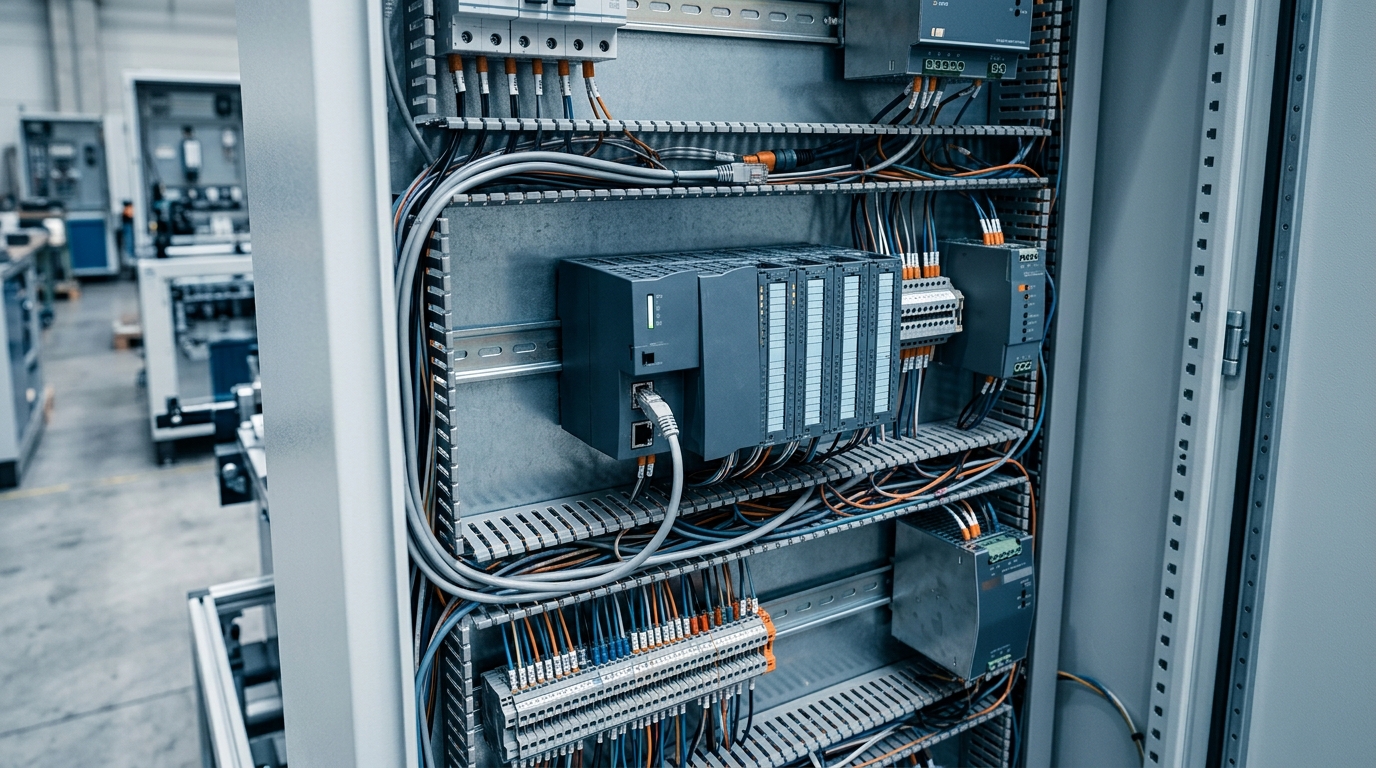
A programmable logic controller, abbreviated PLC (in German: SPS for speicherprogrammierbare Steuerung), is a digitally operating electronic system designed for use in industrial environments. It contains a programmable memory in which the control instructions for a machine or plant are stored. Via its inputs, the PLC receives signals from sensors such as limit switches, pressure switches or temperature probes, and via its outputs it controls actuators such as motors, valves and contactors. The Controllers section places these components in the context of the wider automation landscape.
How it works: the cycle
Technically, a PLC operates cyclically. The sequence is always the same and, in simplified form, reads as follows:
- First, the PLC reads in the state of all sensors and stores it in the process image of the inputs.
- The user program then combines the input information with timer, counter and arithmetic functions and calculates the output states.
- Finally, the PLC outputs the results to the actuators, after which the next cycle begins.
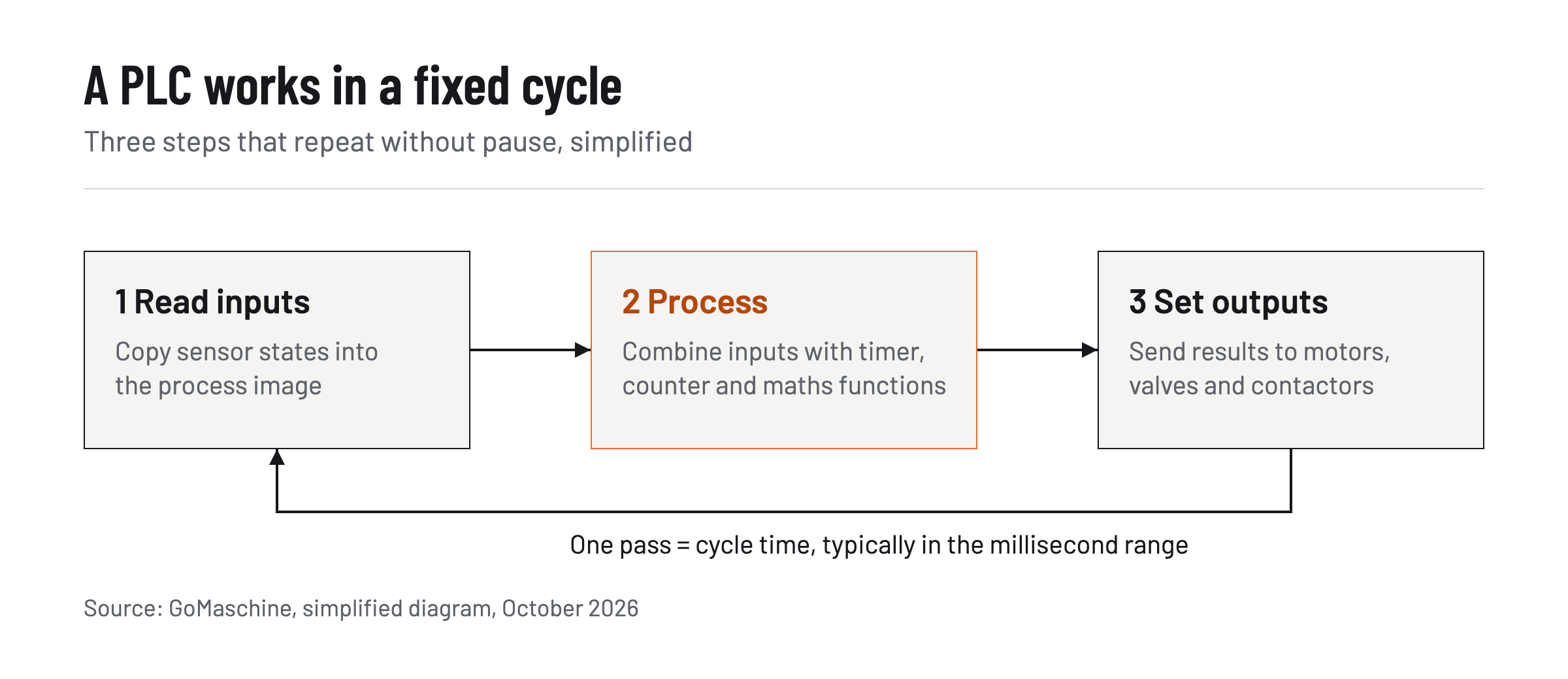
The cycle time is typically in the millisecond range and determines how quickly the controller reacts to process changes. Important for buyers: in many machines, safety functions run directly on the standard PLC. A study by the Institute of Machine Components at the University of Stuttgart, conducted within the research association of the VDW, examined 578 multi-spindle automatic lathes with a total of 3,951 spindles and, using data going back to 1992, found more than 93 million machine operating hours without a single safety-relevant accident.[1] The Performance Levels b and c required by ISO 23125 for the workpiece clamping safety function were met.[1] The requirements that functional safety under ISO 13849-1 places on such a design are covered in the Machine Safety topic. The limit of the PLC lies less in the technology than in the economics: for very small plants, a small controller may suffice, while large plants require additional systems for control-loop tasks and data acquisition.
How much does a PLC course cost?
The price range for PLC training extends from short online fundamentals courses to certified further training with an IHK (Chamber of Industry and Commerce) qualification. One example from the upper end: the PLC Specialist (IHK) further training programme offered by the Gottfried Institut comprises 480 teaching units over 12 weeks full-time and regularly costs 6,705.60 euros for self-funders.[2]
| Format | Scope and qualification | Costs |
|---|---|---|
| Certified IHK further training (PLC Specialist), full-time | 480 teaching units, 12 weeks, IHK certificate | 6,705.60 euros (self-funded) |
| The same further training with a training voucher | Identical scope, funded via the Federal Employment Agency or Jobcenter | 0 euros personal contribution for job seekers |
| The same further training for employees, part-time | Around six months in evening classes, funded under the Qualification Opportunities Act | [3]Funding level depends on company size, application via the employer |
| Short online fundamentals courses | Less scope, no IHK certificate | Low three-digit range |
Short online fundamentals courses without a certificate are considerably cheaper, but usually only provide an entry point. For workforce planning, the course price matters less than the question of whether the team can afterwards cover maintenance and commissioning itself or still has to buy in external programming hours.
What is control technology?
Control technology is the discipline of automation concerned with the targeted influencing of machines and systems. It covers logic control, in which outputs depend logically on inputs, and sequence control, which executes steps in a fixed order, supplemented by timer, counter and arithmetic functions. The system architecture and the programming languages are standardised in the IEC 61131 series, part 3 of which defines the programming languages.
- Ladder diagram (LD) and function block diagram (FBD) for logic operations, close to the electrical circuit diagram
- Sequential function charts for sequence control with branches
- High-level languages such as SCL (Structured Control Language) for compute-intensive and object-oriented tasks
How tightly networked PLC systems are today is shown by the market study SPS-Systeme by Fraunhofer IOSB: 98 percent of the machine builders surveyed connect their PLC systems via Ethernet, 75 percent use the Profinet protocol, and OPC UA is used by almost one in four machine builders.[4] For data evaluation beyond the machine itself, the connection to an MES plays a growing role.
The practical requirements are high: for around three in four machine builders, integrated functional safety and integrated machine operation (HMI) are mandatory, and more than every second company wants to use a cloud connection in future, above all for diagnostics, monitoring and data collection.[4] When buying a controller, this means: pure logic performance is rarely the selection criterion — what matters is safety technology, operator interface and networking within the same system.
What does a PLC programmer cost per hour?
For external PLC programming in Germany, the hourly rate for freelance programmers lies between 50 and 95 euros.[5] The range is wide because experience, region and project complexity strongly influence the rate. The type of employment also makes a clear difference: in permanent employment, the hourly wage works out at 18 to 20 euros.[5]
| Type of employment | Typical hourly rate |
|---|---|
| Freelancer in PLC programming | [5]50 to 95 euros |
| Permanent employment (converted) | [5]18 to 20 euros |
Additional qualifications raise the rate but often reduce project risk: experience with HMI design, safety technology according to ISO 13849-1 or special bus systems is scarce and correspondingly in demand. For the overall calculation, the following applies: the hourly rate alone does not determine project costs. A rate at the lower end with a long familiarisation period on an unfamiliar system can end up more expensive than a higher rate with matching system experience. So factor in travel, on-site commissioning, documentation and later change requests, not just the pure programming time.
What are S7 controllers?
SIMATIC S7 is Siemens' PLC family for industrial automation. It ranges from compact CPUs with fixed input/output configuration for smaller tasks to modular systems in which CPU, power supply, communication and signal modules can be freely combined. Programming is done predominantly in the TIA Portal, which also integrates HMIs and drives from the same family.
From S5 to S7: the retrofit trap
The predecessor of the S7 is the S5 family, whose hardware is considered obsolete. When an S5 CPU fails, spare parts can often only be sourced from remaining stock or the used market, and such failures trigger migration or retrofit projects. What such a case looks like in practice is illustrated by a single discussion on the Reddit forum r/PLC: a standstill S5 controller with a faulty input module could only be brought back into operation provisionally by switching to Run mode and replacing the defective module; only a retrofit permanently replaces the system.[6] Whether modernization or a new purchase is more economical depends on the mechanical condition, downtime costs and available documentation; the topic of machine retrofit covers this trade-off in detail.
| Module (price comparison idealo) | Type | Price from |
|---|---|---|
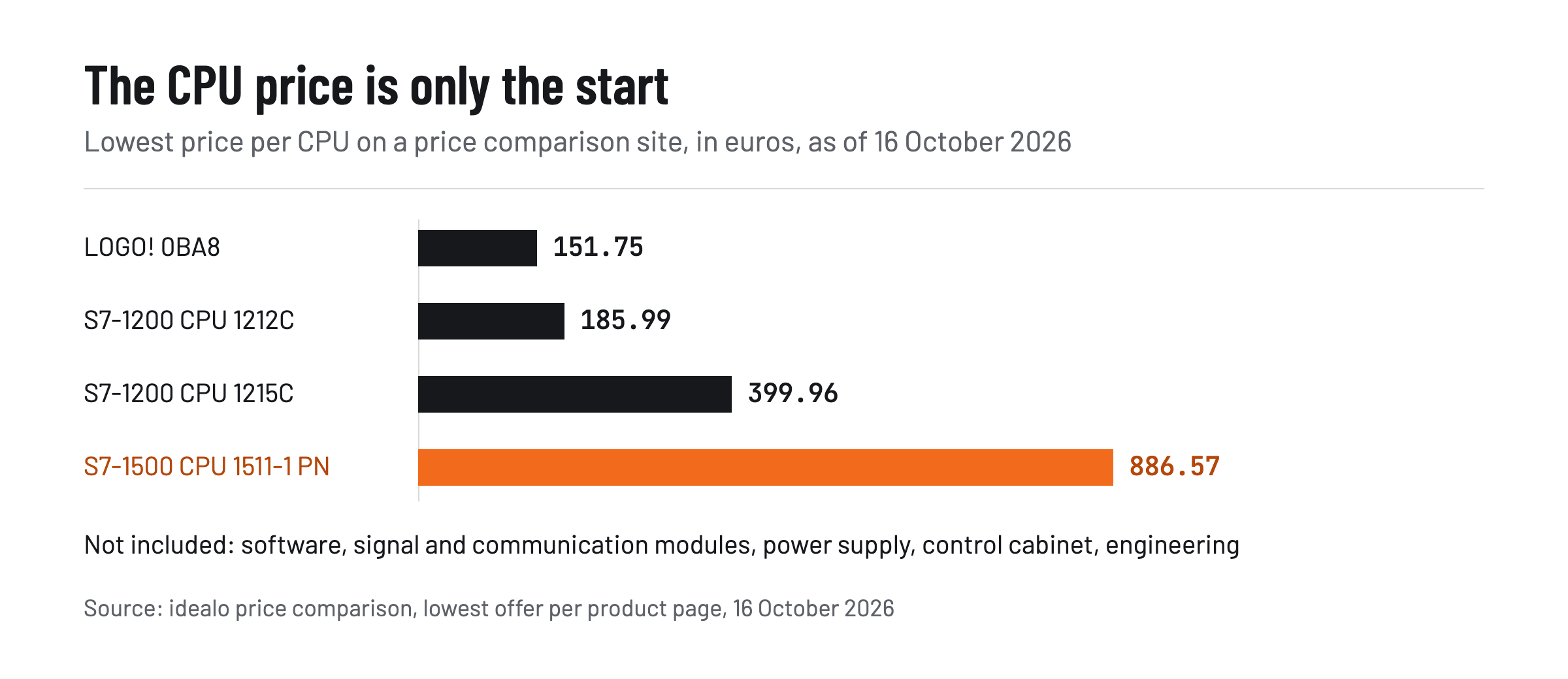
| S7-1200 CPU 1212C (6ES7212-1AE40-0XB0) | Compact CPU | 185.99 euros |
| S7-1200 CPU 1215C (6ES7215-1AG40-0XB0) | Compact CPU, upper performance range | 399.96 euros |
| S7-1500 CPU 1511-1 PN (6ES7511-1AL03-0AB0) | Modular system, entry-level CPU | 886.57 euros |
These prices each apply to the individual CPU in the price comparison at idealo (as of 16 October 2026), not to a ready-to-operate controller.[7][8][9][10] Programming software, signal and communication modules, power supply, control cabinet material and engineering come on top.
Which manufacturers of PLC controllers are there?
The market for PLC systems in Germany is still dominated by Siemens. The company leads both in brand awareness and in purchase share, as the Fraunhofer IOSB market study on PLC systems finds. Second place in awareness is held by Beckhoff, which has gained the most in recent years: awareness was only 6 percent in 2001 and had already reached 60 percent at the time of the study, which has also affected the customer base.[4]
Beckhoff: PC-based control
Technically, Beckhoff pursues the PC-based control approach. The CX7000 embedded PC series is a small controller with an Arm Cortex-M7 processor and integrated inputs and outputs; it is programmed with the TwinCAT 3 software generation via the Ethernet interface. It can be expanded optionally with E-Bus or K-Bus terminals, which the controller detects automatically at startup.[11] For applications with high computing requirements, motion control or close integration with visualization, this approach is often the more suitable choice.
- Rockwell Automation is widespread in Germany mainly in US-influenced production facilities.
- Mitsubishi Electric offers a broad portfolio from small controllers to motion.
- Schneider Electric focuses on modular systems and energy management.
- Omron supplies controllers, sensor technology and robotics from a single source.
For the purchasing decision, what matters alongside the hardware is above all the surrounding environment: available staff with knowledge of the platform, long-term spare parts supply, local support and the question of whether existing systems remain programmable in the same system. Switching manufacturers costs training and engineering, even if the CPU itself is inexpensive.
Which PLC variants does Siemens offer?
Siemens structures its PLC portfolio from the small controller to the modular high-end system. The assignment to application size roughly looks like this:
| Variant | Typical use | Price from (price comparison) |
|---|---|---|
| LOGO! | Simple switching and monitoring tasks, building services and near-machine applications | [10]151.75 euros for a LOGO! 0BA8 base module |
| S7-1200 | Compact CPU for the lower to mid performance range | [8]185.99 euros (CPU 1212C) |
| S7-1500 | Modular system for the mid to high performance range | [7]886.57 euros (CPU 1511-1 PN) |
The F variants are fail-safe CPUs that execute safety programs in parallel with the standard program. According to Siemens, the CPU 1511F-1 PN is designed for standard or safety operation and reaches PL e per ISO 13849-1 as well as SIL 3 per IEC 61508.[12] Whether an F-CPU is required is determined by the machine's risk assessment, not by the datasheet.
Conclusion for procurement: engineering, safety technology, networking and spare parts supply determine the economics, not the CPU price.
Frequently asked questions
What does a Siemens PLC cost?
A compact CPU of the SIMATIC S7-1200 starts at 185.99 euros in price comparisons, a CPU of the S7-1500 at 886.57 euros. The small controller LOGO! is available from 151.75 euros. Input and output modules, power supplies and the engineering software add considerably to the total cost.
What does a PLC programmer cost per hour?
Freelance PLC programmers in Germany charge between 50 and 95 euros per hour; converted, the hourly wage in permanent employment is 18 to 20 euros. Rates can be higher for complex projects and for additional qualifications in HMI visualization, safety technology or bus systems.
Which PLC manufacturers are there besides Siemens and Beckhoff?
Internationally, Rockwell Automation, Mitsubishi Electric, Schneider Electric and Omron are among the major PLC manufacturers. In Germany, Siemens dominates the market for PLC systems; Beckhoff ranks second in brand awareness, having grown from 6 percent in 2001 to 60 percent.
What does a PLC course cost?
Short online fundamentals courses are available in the low three-digit euro range. A certified IHK further training program to become a PLC specialist, with 480 teaching units over 12 weeks full-time, costs 6,705.60 euros for self-funders; with a training voucher from the Federal Employment Agency, the personal contribution is waived, and employees can receive funding under the Qualification Opportunities Act.
What does S7 mean for Siemens controllers?
S7 designates the current family of Siemens SIMATIC programmable logic controllers, which replaced the predecessor S5. The family includes compact CPUs of the S7-1200 for the lower to mid performance range and the modular S7-1500 for more demanding applications. S5 hardware is considered obsolete; defective modules frequently trigger retrofit or migration projects.
Are standard PLCs approved for safety functions?
Yes, under conditions. A study by the Institute of Machine Components at the University of Stuttgart, conducted within the research association of the VDW, examined 578 multi-spindle automatic lathes over more than 93 million machine operating hours and found not a single safety-relevant accident in workpiece clamping executed by a standard PLC. The function met the required performance levels of the standards ISO 23125 and ISO 13849-1.
What role does Profinet play when buying a PLC?
Profinet is the most widely used connection protocol in Germany: 75 percent of machine builders use it, and 98 percent generally connect their PLC systems via Ethernet. When purchasing, the CPU should therefore support the fieldbus interfaces required so that sensors, actuators and peripheral devices can be integrated.
Sources
Related reading
All Automation →Machine Retrofit: When Modernisation Is Cheaper Than Buying New
Machine retrofit explained: definition, practical examples, maintenance to DIN 31051 and when modernising is cheaper than buying new.
Machine Vision in Quality Control
Machine vision in quality control: how vision systems are built, how to choose software, and what costs and limits to expect.