Machine Retrofit: When Modernisation Is Cheaper Than Buying New
Machine retrofit explained: definition, practical examples, maintenance to DIN 31051 and when modernising is cheaper than buying new.
In this article9
- What is a retrofit and how does it work?
- What examples are there for machines?
- What are examples of substantial modifications to machines?
- What does servicing of a machine include?
- What are the 4 maintenance measures?
- How much does servicing cost?
- What types of machines are there?
- Frequently asked questions
- Sources
What is a retrofit and how does it work?
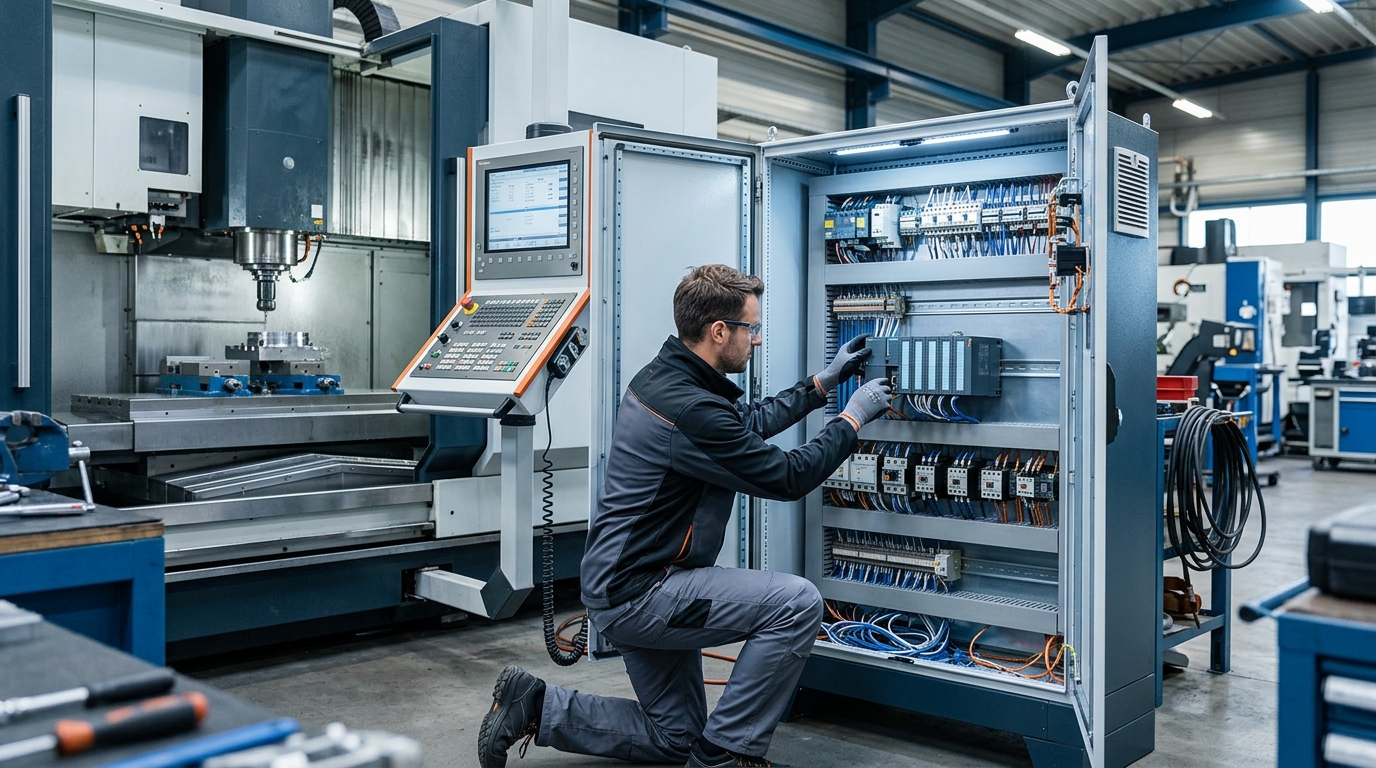
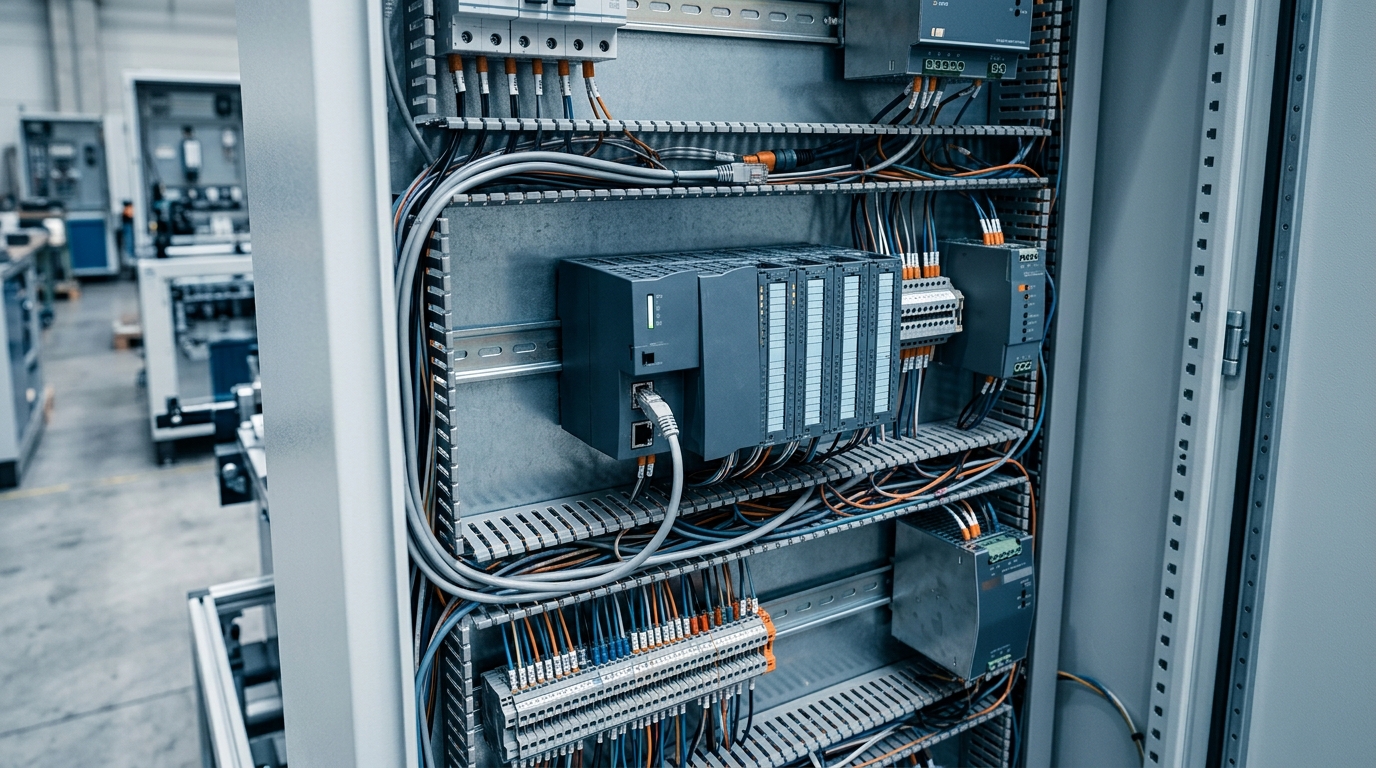
Retrofit refers to the targeted modernization of an existing machine in which the base machine is retained and selected components are renewed: typically the control system, drives, operator devices, sensor technology or communication interfaces. According to the retrofit guide published by the Mittelstand 4.0 competence centres in Hannover and Hamburg, retrofitting extends the service life of existing installations or increases their performance, and is generally less costly than buying new equipment.[1] The objectives range from higher availability and improved safety to securing the spare-parts supply and connecting the machine to data acquisition and production systems.[2]
The economic background: according to a 2016 KfW study, barely one fifth of small and medium-sized enterprises in the manufacturing sector had adopted Industry 4.0, and six out of ten companies cited excessively high investment costs as a barrier. Smaller companies in particular were deterred by the fear of having to purchase expensive modern machinery. Digitalization, however, can be implemented on the basis of existing installations, for example through retrofitted sensor and communication technology.[1]
Distinction from servicing, repair and new procurement
| Approach | Depth of intervention | Typical objective |
|---|---|---|
| Servicing | Maintaining the target condition, no change in functional scope | Delay wear, secure availability |
| Repair | Replacement or repair of defective components | Return to a functional state |
| Retrofit | Renewal of control system, drives and sensor technology while retaining the mechanics | Extend service life, raise performance and level of digitalization |
| New procurement | Complete replacement investment | New technology, new documentation, new integration costs |
A retrofit usually proceeds in two steps: before extensive modernization, a safety assessment of the existing machine is advisable in order to identify risks and technical deficits at an early stage; afterwards, the control system, drives, electrics, safety functions, operator devices and networking are renewed depending on condition and objectives.[2] Full automation is not necessarily the goal; digital upgrades can be applied selectively.[1] One example is a pilot project at Webasto: on a five-year-old automated assembly and laser processing system, OEE data acquisition was integrated within one week; according to Webasto, anomalies are detected early this way and the non-conforming rate drops significantly.[3]
What examples are there for machines?
Typical retrofit examples include digitally connecting a decades-old lathe, replacing discontinued control systems on a packaging machine, and a manufacturer's overhaul of a machine tool. At EMO 2025, retrofit was a focus topic; manufacturers such as Liebherr-Verzahntechnik and Kapp Niles emphasized there that an upgraded existing machine can reach the level of a new machine.[4]
| Example | Machine | Measures |
|---|---|---|
| Digital integration of an existing machine | Lathe, built around 35 years earlier, in the model factory of the Hannover competence centre | [1]Retrofitted sensor and communication technology for capturing machine and process data |
| Control system modernization | Packaging machine, built in 2001, with an outdated PLC and operator devices no longer available | [2]Replacement of the control system, operator panel and safety functions; the base machine is retained |
| Drive and software upgrades | Packaging machines and production systems | [5]Replacement of motors, frequency inverters and drive electronics, supplemented by control system and operator interface upgrades |
| Manufacturer overhaul | Gear flank grinding machines, on average 20 to 25 years old | Complete refurbishment by Liebherr-Verzahntechnik to new-machine level, with a new warranty (manufacturer's specification) |
With older machines, a retrofit often revolves around the PLC control. The most common trigger is the discontinuation of the installed control family: according to furnace manufacturer SECO/WARWICK, Siemens has discontinued repair and spare-parts sales for the SIMATIC S5, so operators must plan a migration, frequently to the SIMATIC S7-1500.[6] There is no blanket answer to the question of the best PLC control for retrofitting old machines, but there are sound recommendations from practice: the official Siemens migration guide for converting S5 projects to the S7-1500 contains the boundary conditions and the procedure for a planned migration of hardware and software, including warranty and liability.[7] The main criteria in favour of a control choice are the availability of spare parts and engineering tools, the transfer of existing user programs, interface compatibility with fieldbuses and operator devices, and long-term support from the manufacturer. Those who do not want to be tied to one manufacturer will also find vendor-neutral PLC retrofit solutions on the market, which use controls from, for example, Siemens or Beckhoff as their basis.[8]
In all these examples, the mechanical base structure is retained because it accounts for the main value of the machine: a new machine would be technically or economically disproportionate if existing mechanics, tools, fixtures and production processes can continue to be used.[2] At the same time, the figures on payback and performance come predominantly from manufacturers and service providers who themselves offer retrofit services. Such figures must be identified as manufacturer specifications and adapted to your own machine condition and operating data before an investment decision.
What are examples of substantial modifications to machines?
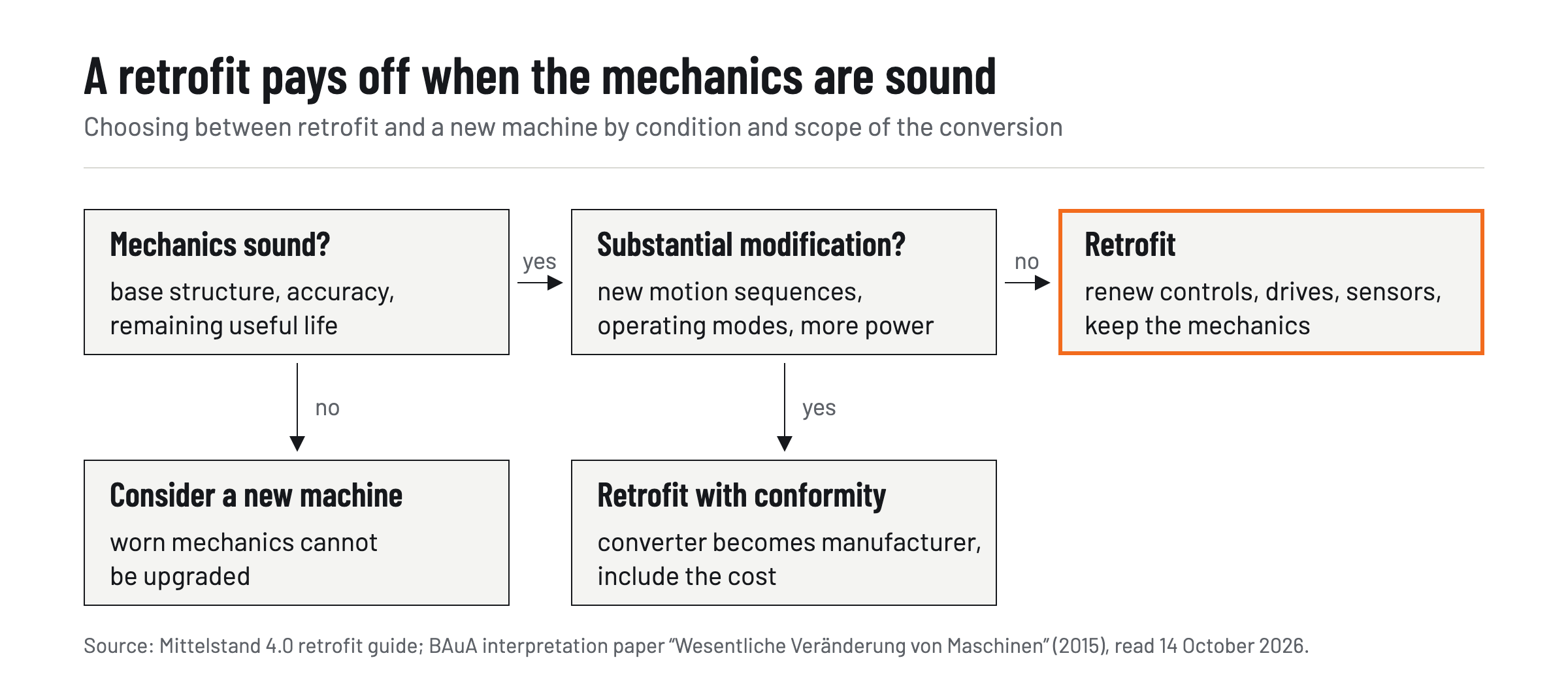
Typical examples of a substantial modification are a new control that changes the motion sequences, new operating modes, safeguards that act differently, and a significantly increased performance. A retrofit therefore has not only an economic but also a legal limit. The interpretation paper "Wesentliche Veränderung von Maschinen" (Substantial Modification of Machinery) was drawn up by a working group led by the Federal Ministry of Labour and Social Affairs (BMAS), with participation from the Federal Institute for Occupational Safety and Health, the federal states, the German Social Accident Insurance and the VDMA. It was published as an official announcement of the BMAS dated 09.04.2015 in the Gemeinsames Ministerialblatt (GMBl 2015 p. 183).[9][9] The core question is: are the modifications so far-reaching that the machine must subsequently be regarded as a new machine?
- A new control changes the motion sequences of the machine.
- The modernisation creates new operating modes.
- After the conversion, the safeguards act differently than before.
- The performance of the machine is significantly increased.
Such conversions are regarded as typical cases in which a retrofit can turn into a substantial modification.[9] The legal consequence is considerable: the modernised machine is then treated like a new machine, the party carrying out the conversion becomes the manufacturer and must perform the corresponding conformity assessment procedures, including new testing and documentation obligations.[9]
The assessment is always made case by case. A retrofit does not automatically constitute a substantial modification; what matters is whether the modifications are so far-reaching that the machine must subsequently be regarded as a new machine and is subject to today's requirements for placing on the market.[9] For the investment decision, this means: possible conformity costs must be included in the economic calculation from the outset.
What does servicing of a machine include?
According to DIN 31051 (current edition 2019-06), servicing of a machine includes all measures to delay the depletion of the existing wear reserve, i.e.[10] to preserve the specified condition of an item under consideration.[11] The standard defines maintenance as a whole as the combination of all technical, administrative and management measures during the life cycle of an item, intended to maintain its functional state or restore it to that state.
- Cleaning the system
- Freeing up moving parts
- Checking settings and setpoints
- Recording measured values
These tasks are regarded as typical contents of servicing under DIN 31051.[11] The distinction matters in practice: if servicing reveals that a component is defective and must be replaced, that component replacement already constitutes a repair, which is no longer part of servicing. Wear and deterioration are the expected consequence of intended operation and are neither a defect nor an indication of poorly executed servicing.[11]
For the retrofit decision, what counts is the classification of servicing as a preventive measure within maintenance over the entire life cycle.[11] A machine whose servicing and inspection history is documented provides exactly the operating data that make a sound statement about its condition — and thus about whether a retrofit makes sense — possible.
What are the 4 maintenance measures?
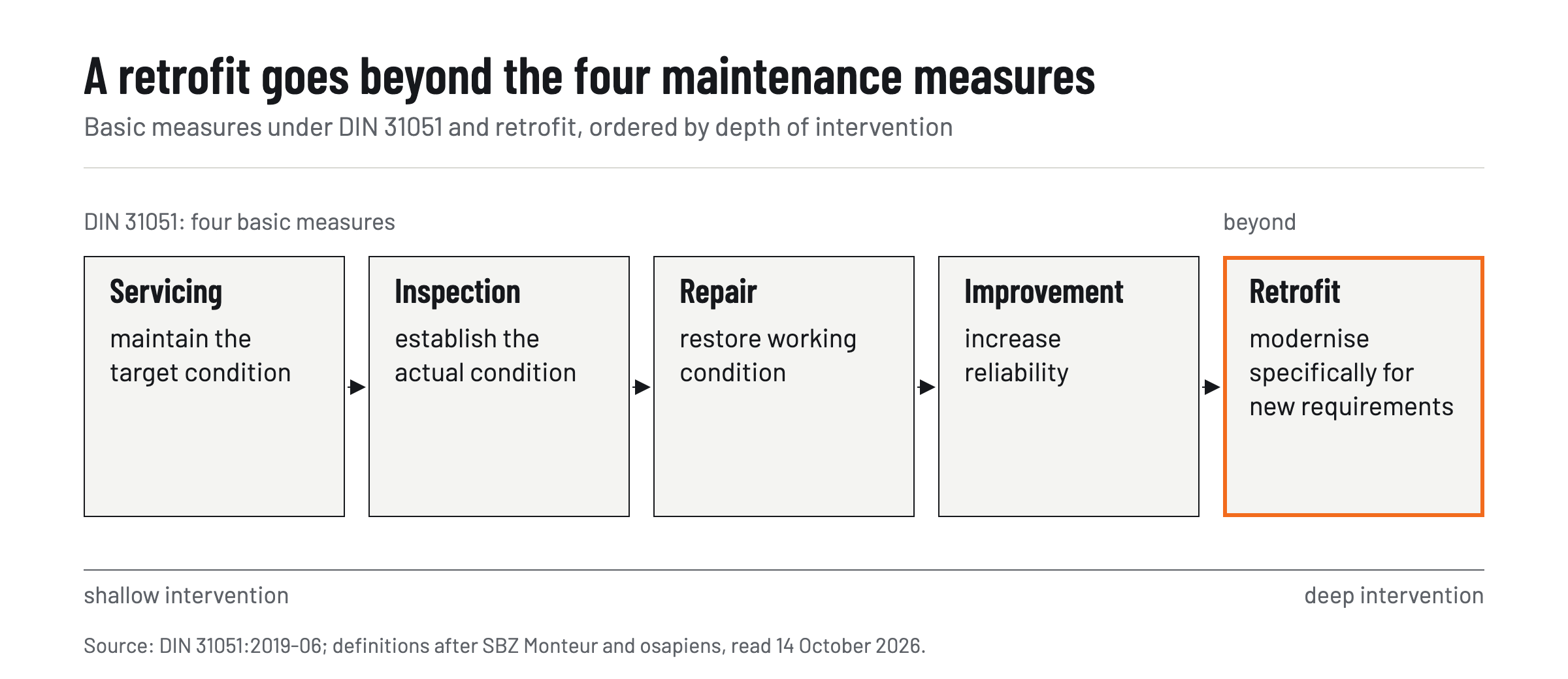
DIN 31051 divides maintenance into four basic measures: servicing, inspection, repair and improvement.[12] They differ in depth of intervention and timing within a machine's life cycle.
| Basic measure | Objective | Typical tasks |
|---|---|---|
| Servicing | Preserve the specified condition, conserve the wear reserve | Cleaning, freeing up moving parts, checking settings, recording measured values |
| Inspection | Determine and assess the actual condition | Checking, measuring, determining the causes of wear, deriving consequences for future use |
| Repair | Return to a functional state | Repair and replacement of defective components, excluding improvements |
| Improvement | Increase reliability beyond the original state | Targeted changes to components or processes to increase reliability |
The definitions follow DIN 31051; a maintenance guide also summarises the four basic measures.[11][12] A retrofit goes beyond all four basic measures because it does not merely preserve or repair, but deliberately modernises. It changes the machine with new requirements in mind instead of securing its previous state. This added value is precisely why the investment can pay off — and also why the legal obligation to assess applies, as described in the previous section.
How much does servicing cost?
The cost of servicing cannot be stated as a flat figure, because the costs depend on the machine type, age, operating profile and the ratio of in-house work to external services. They become comparable via the maintenance cost ratio = annual maintenance costs ÷ replacement value of the system, and via the cost categories. Direct costs include personnel costs for maintenance teams, spare parts and consumables, as well as fees for external service providers. Indirect costs arise as a consequence of disruptions or reduced system performance and are frequently underestimated in practice: production losses due to machine downtime, quality losses from impaired functionality, delivery delays with possible contractual penalties, and increased energy consumption from worn systems.[12]
- Maintenance cost ratio: annual maintenance costs divided by the replacement value of the system. It shows the share of maintenance in the system's value.
- Machine-hour rate: machine-dependent costs divided by running hours. It shows which costs are incurred per operating hour.
Both key figures serve to calculate maintenance costs.[12] The order of magnitude of the risk that a well-thought-out servicing and modernisation strategy limits is shown by a survey: According to the ABB study "Value of Reliability" 2023, for which 3,215 maintenance decision-makers worldwide were surveyed, German companies lose an average of 147,000 euros per hour through unplanned downtime, and 67 percent of industrial operations in Germany experience such failures at least once a month.[13] Nevertheless, 21 percent of the surveyed German companies still rely on reactive maintenance concepts. For the economic calculation of a retrofit this means: The saving compared with a new purchase is only one side; the other is the avoidance of downtime costs, which are particularly difficult to estimate for old, poorly documented machines.
What types of machines are there?
Machine tools are technical devices for shaping or surface treatment of workpieces using tools; these machines are classified in the standards DIN 8580 ff. (processes) and DIN 69651 Part 1 (metalworking).[14] By intended use, a distinction is made between universal machines for single-item and small-batch production, single-purpose machines for a specific workpiece, and machines for several processes and multi-machine systems.[14] For the retrofit decision, this classification helps because the machine type allows conclusions to be drawn about depth of intervention and economic viability.
| Machine group | Examples | Typical retrofit question |
|---|---|---|
| Machine tools | Lathes, milling machines, grinding machines, gear-cutting machines | Renew control system and drives, preserve the mechanical accuracy of the base machine |
| Universal machines | Lathes and milling machines for changing workpiece geometries in single-item and small-batch production | Digital connectivity and operability across a broad range of applications |
| Single-purpose and special-purpose machines | Gear-cutting machines, crankshaft grinding machines, special machines for one workpiece | Spare-parts supply for discontinued components, since a new build is usually uneconomical |
| Processing and packaging machines | Waterjet system for producing rubber seals, packaging machines | [1]Modernise control system, operator panel and safety functions |
| Testing machines | Measuring and testing equipment in quality assurance | Adapt sensors and data interfaces to current requirements |
Whether a retrofit is economically viable depends less on the machine type than on three factors that can be checked for every machine. The first decisive factor is the condition of the mechanical base structure, because worn mechanics cannot be replaced by new control systems. Added to this is the availability of interfaces and spare parts, because discontinued PLC systems and operator devices are a frequent trigger for a retrofit.[2] Finally, the remaining useful life matters in relation to the investment costs, including possible conformity obligations in the event of a substantial modification. Anyone who can answer these three points on the basis of servicing and inspection data makes the decision between modernisation and new procurement on a sound footing. Further assessments of machines, production and maintenance can be found in the Industry section of GoMaschine.
Frequently asked questions
What is a retrofit for machines?
A retrofit is the targeted modernisation of an existing machine in which the base machine is retained and components such as the control system, drives, operator devices, electrics or sensors are renewed. The goals are a longer service life, higher availability, secured spare-parts supply and connection to digital processes, without a complete new purchase.
When is a retrofit worthwhile instead of a new purchase?
Above all, when the mechanical base structure still works reliably but control systems have been discontinued, spare parts are lacking or downtime is increasing. If the mechanics are heavily worn, the machine concept no longer matches the production requirements or significantly higher capacities are needed, a new machine is more likely to be the better choice.
What are the four maintenance measures according to DIN 31051?
Servicing, inspection, repair and improvement. Servicing delays the depletion of the wear reserve, inspection determines and assesses the actual condition, repair returns the item under consideration to a functional state, and improvement increases reliability beyond the original condition.
How much does servicing cost?
No general figure can be given. What matters are direct costs such as personnel, spare parts and external service providers as well as indirect costs such as production downtime. The maintenance cost ratio serves as a key figure: annual maintenance costs divided by the replacement value of the system. Unplanned downtime is the largest cost block.
When does a retrofit become a substantial modification?
When the modernisation creates new hazards or significantly increases existing risks, for example because a new control system changes motion sequences, new operating modes arise or the performance is significantly increased. In that case the machine is legally considered a new machine, and whoever carries out the conversion becomes the manufacturer with a new conformity assessment procedure.
Is a retrofit cheaper than a new purchase?
As a rule, yes, as long as the mechanical base structure is intact. The Mittelstand 4.0 guide of the competence centres in Hannover and Hamburg states that upgrading is generally more cost-effective than a new purchase. The condition of the machine, the goals of the modernisation and the required safety measures remain decisive.
Does a retrofit have to be documented?
Yes. Changes to the control system, electrics, operation, safety functions and technical components should be documented in a traceable way, including circuit diagrams, software versions, tests and safety assessments. This also applies to the assessment of whether the retrofit constitutes a substantial modification.
Sources
Related reading
All Automation →Buying a PLC: Siemens, Beckhoff and Alternatives
Buying a PLC: what Siemens S7, Beckhoff CX and alternatives cost, which options exist, and what courses and PLC programmers charge.
Machine Vision in Quality Control
Machine vision in quality control: how vision systems are built, how to choose software, and what costs and limits to expect.