Machine Vision in Quality Control
Machine vision in quality control: how vision systems are built, how to choose software, and what costs and limits to expect.
In this article8
What is the best machine vision software?
The best machine vision software is the one that fits the specific inspection task, the existing infrastructure and the team's expertise; there is no objectively best one. A library with maximum flexibility is of little help to a small company without an image processing engineer. A no-code environment brings standard inspections onto the line quickly, but reaches its limits when the task is highly specific. The choice can therefore only be made case by case, not by a ranking.
| Software class | Examples | Characteristics | Typical use |
|---|---|---|---|
| No-code standard software | MVTec MERLIC | Applications can be created without programming knowledge, deep learning tools, open interfaces | Standard inspections, assembly assistance, fast commissioning |
| Developer libraries | MVTec HALCON | Extensive algorithms and deep learning methods, programming knowledge required | Custom solutions with demanding requirements |
| PC platforms | Cognex VisionPro | [1]PC-based software with full configuration control, according to the manufacturer for very complex, fast or custom applications | Demanding quality control with an in-house engineering department |
| Smart cameras with edge inference | AI cameras from various manufacturers | Sensor, computing power and software in one unit, inference directly at the camera | Single inspection stations, decentralized installation without a dedicated inspection PC |
Selection criteria for machine vision software
- Which interfaces does the software offer to the PLC and the MES, and does it support standard protocols such as GenICam for camera connection? This determines the integration effort.
- How many sample images does the system need, and who captures and labels them in operation?
- Does inference run at the edge on the camera or on a central industrial PC, and what cycle times does the inspection task require?
- What does the system cost over its planned service life (total cost of ownership), i.e. including licences, maintenance contracts, training effort and computing hardware rather than just the purchase price?
- How strongly do proprietary formats and inspection-specific configurations lock you into one vendor (lock-in), and how costly is a later switch?
Endress+Hauser shows how these criteria play out in practice. The measurement technology manufacturer uses the no-code standard software MVTec MERLIC because one tool can be used for different tasks, employees only need to learn one piece of software, and open interfaces such as GenICam simplify integration into the company's own manufacturing execution system (MES).[2] This is a user statement from a case study, not an independent comparison. The pattern can still be transferred: standard software with open interfaces reduces integration effort and dependency, as long as the inspection task stays within the standard scope.
What does Vitronic Machine Vision do?
Vitronic Machine Vision develops and builds industrial image processing systems, including the VINSPEC systems for 2D and 3D quality inspection. Vitronic Machine Vision GmbH was founded in 1984, is headquartered in Wiesbaden and, according to its annual financial statements, reported 895 employees and 182 million euros in revenue for the 2024 financial year.[3] The following performance figures come from the company itself and are not independently verified measurement results.
Vitronic VINSPEC: Inline inspection of powertrain parts
According to Vitronic, one focus is surface inspection in the powertrain. The VINSPEC inspection systems check powertrain parts for defects such as shrinkage cavities, pores and excess material as well as machining defects such as scratches and dents, at the micrometre scale and inline within the production cycle, so that defective parts are detected before further processing.[4] This is the classic domain of industrial image processing: high volumes, a repeatable inspection task, clear defect criteria.
- End-to-end quality control of the entire powertrain (manufacturer's statement)
- Inspection of every part in a cycle of seconds, around the clock (manufacturer's statement)
- Process data with heatmaps as a data basis for defect analysis and process optimisation (manufacturer's statement)
- Deployment as a modular solution or as a turnkey solution with a complete inspection cell (manufacturer's statement)
- Used by OEMs and suppliers since 1995, according to the company[4]
The editorial team has no independent test reports on these systems. Anyone planning to invest should therefore have the performance demonstrated in their own use case, for example through a proof of concept with real samples, real defects and the actual cycle times of their own line.
What does vision mean?
In an industrial context, vision refers to the seeing machine: systems that capture images via cameras, evaluate them and pass the results on to machine controllers. This includes inspection, code reading, metrology and robot guidance. The term describes the task, not a single device.
A vision system is more than a camera
A vision system only works reliably when several components are matched to each other. A high-resolution camera is of little use if the lighting does not make the defect visible or the lens misses the field of view. The typical chain consists of these building blocks:[5]
- The camera or sensor captures the image; resolution and frame rate limit the smallest detectable detail and the line speed
- The lighting is what makes the defect visible and often decides whether the application succeeds or fails
- Lens and optics define field of view, working distance and focus
- Processor and software evaluate the image, either rule-based or with a trained AI model
- Communication and I/O connect the system to the line via fieldbus protocols
- Integration into the line governs mounting, triggering and timing so that the right part is inspected at the right moment
During research, the term also appears in a second meaning: VISION is also the name of the machine vision trade fair in Stuttgart, and the VDMA Machine Vision department represents more than 120 companies.[6] Anyone looking for technical content should therefore check the context, otherwise trade fair reports, association figures and technology content become mixed up.
What does computer vision mean?
Computer vision is the overarching scientific discipline that enables computers to extract information from images and videos. It includes classical, rule-based methods as well as deep learning methods that learn from example images. Computer vision is not limited to the factory; it is also found in medical image analysis, driver assistance and document analysis.
| Term | Meaning | Typical environment |
|---|---|---|
| Computer vision | The broad discipline of making computers interpret images and videos | Research, software, all industries |
| Machine vision | The industrial application of this discipline for inspecting parts and controlling equipment | Production hall, real-time operation |
| AI vision | Machine vision that decides with a trained deep learning model instead of fixed rules | Modern lines, variable and cosmetic defects |
In the factory, computer vision is used to inspect parts and control equipment — in real time.[5] This industrial application is called machine vision, and it additionally demands robustness against dirt, vibration and temperature fluctuations, reproducible results and round-the-clock operation. A method that works in the laboratory is therefore not yet a viable inspection application.
AI extensions are currently changing the field noticeably. Anomaly detection learns from images of good parts and flags deviations, while Teach-in allows inspections to be set up without programming. The software vendor MVTec has offered Continual Learning since HALCON 25.11 (November 2025): according to the manufacturer's statement, updating an existing classification model typically requires only five to ten images, retraining runs on standard CPUs, and classes already learned are retained.[7] The in-depth comparison of these terms for manufacturing is covered in a separate article.
What is machine vision?
Machine vision is the English term for industrial image processing: automated systems consisting of cameras, lighting, image processing software and a control unit that perform inspection, code reading, metrology and robot guidance. Such a system captures the image, processes it, makes a decision such as good, reject or measured value, and reports it back to the line — all within the cycle time.
A defect that is not visible in the raw image cannot be detected by even the best software. Every inspection task therefore starts with the question of how lighting and optics can make the defect in question imageable at all; only afterwards are resolution and software decided. The selection of lighting methods is covered in a separate article.
Machine vision market 2025 and 2026: a cautious recovery
After three years of declining revenue, the European machine vision market expects a turnaround in 2026: according to Wiley Industry News (April 2026), the VDMA Machine Vision division anticipates revenue growth of around 3 percent.[8]
| Key figure | Value | Source |
|---|---|---|
| European machine vision revenue 2025 | [8]minus 2 percent | VDMA, April 2026 |
| Component manufacturers 2025 | [8]plus 4 percent | VDMA, April 2026 |
| Machine vision systems 2025 | [8]minus 6 percent | VDMA, April 2026 |
| Sales market Europe / North America / Asia 2025 | [8]minus 6 / plus 9 / plus 3 percent | VDMA, April 2026 |
| Forecast European machine vision 2026 | [8]plus around 3 percent | VDMA, April 2026 |
The regional distribution shows where the momentum is coming from: Europe lost 6 percent in 2025, while North America gained 9 percent and Asia 3 percent.[8] For companies in Germany this means: the technology is mature and widely available, but investment willingness in Germany is currently lagging behind international developments.
What can a computer vision system do?
A computer vision system in quality control inspects every part within the line cycle instead of drawing samples, and documents every result. The typical inspection methods are:
- Presence and assembly checks, i.e. whether parts are present, correctly inserted and fully assembled
- Surface inspection for scratches, dents, stains and discolouration on visible surfaces
- Geometric measurement of dimensions, positions and tolerances relative to the nominal dimension
- Code and text reading of barcodes, datamatrix codes and plain text (OCR) for traceability
- Complete documentation of inspection results and image data for quality records
AI extensions: fewer images, shorter retraining
Deep learning methods such as semantic segmentation and object detection detect defects pixel-accurately and also capture variable defects that are difficult to describe with rules. For a long time, the practical hurdle was the training effort: new product variants or changed supplied parts required extensive retraining. Methods such as Continual Learning are intended to make retraining existing classification models considerably easier (manufacturer's statement from MVTec, see above).
Limits of machine vision in manufacturing
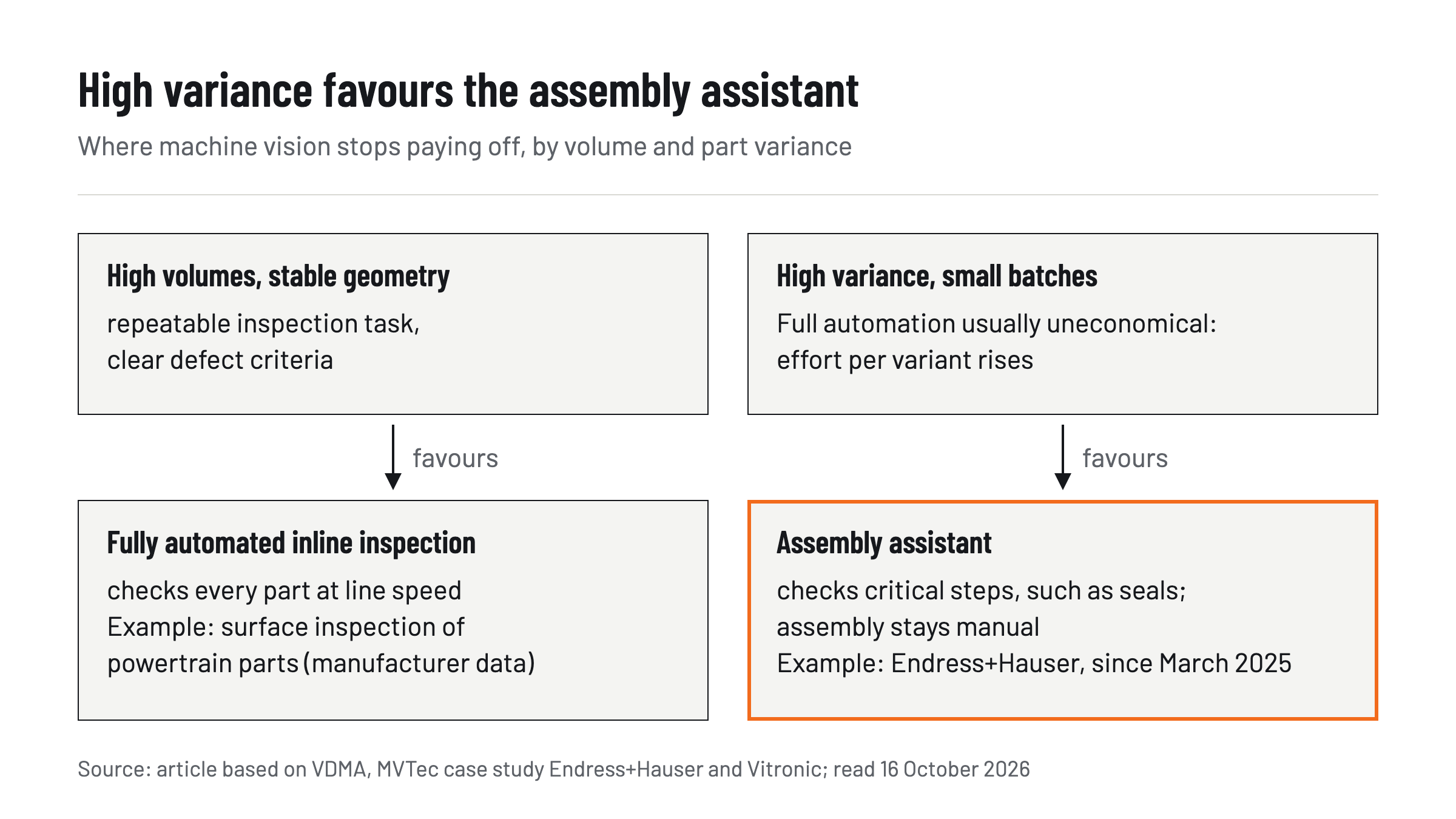
The most important limit of machine vision is economic, not technical: with high part variance and small batch sizes, capturing and maintaining the variants costs more than fully automated inspection returns. That is why Endress+Hauser deploys machine vision not as full automation but as a digital assembly assistant: the software checks critical work steps, such as whether seals have been fitted, while assembly remains manual. The system has been in operation since March 2025 and has been rolled out at further sites worldwide since autumn 2025.[2] A second limit is stability: new lighting conditions, material variants or additional product classes make retraining of the models necessary, according to MVTec.[7]
What does a machine vision system cost in quality control?
The cost of a machine vision system consists of several blocks, and hardware is only one of them. Anyone who narrows budget requests down to camera prices systematically underestimates the total budget.
| Cost block | What drives it |
|---|---|
| Components | Camera, lens, lighting and computer or edge hardware |
| Software licences | Runtime licences per inspection, developer licences or camera bundle |
| Integration and commissioning | Mounting, triggering, fieldbus connection, connection to PLC and MES |
| Validation | Evidence that the system maintains the agreed detection rates under production conditions |
| Training data | Capturing, reviewing and labelling good-part and defect images |
| Ongoing operation | Maintenance, cleaning of the optics, retraining after product or supplier changes |
Machine vision costs: orders of magnitude and their limits
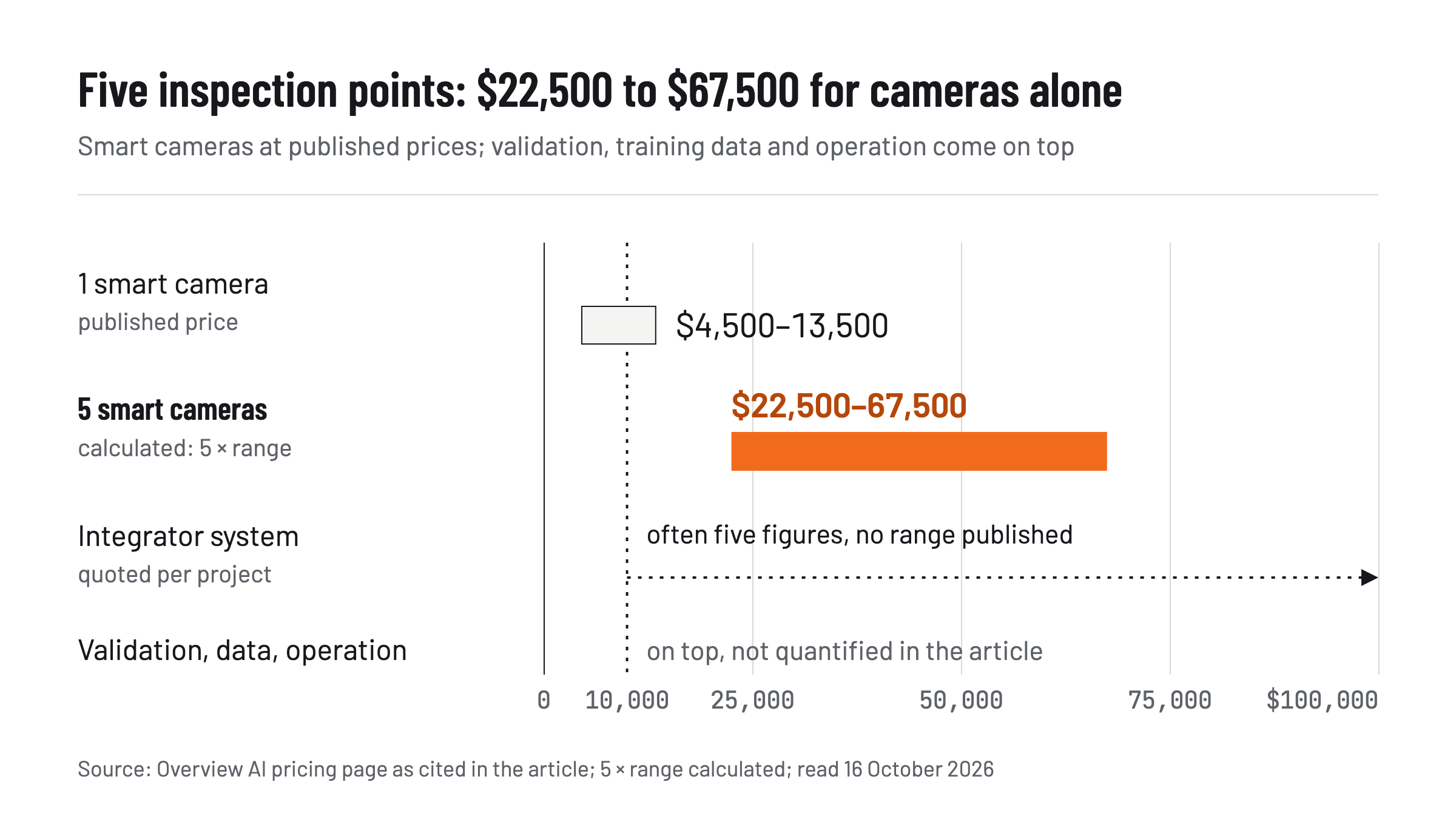
Reliable figures are hard to obtain because the integration effort depends heavily on the line, the inspection task and the existing systems. One point of orientation comes from the smart camera vendor Overview AI: it publishes prices of 4,500 to 13,500 US dollars per camera, set up by the user's own team in the browser, without an integrator and without the cloud. Systems built by an integrator are calculated per project, according to the same manufacturer's page, and often reach five-figure dollar amounts once integration is included.[5] Five inspection points with smart cameras therefore cost five times this range in cameras alone, before validation, training data and operation are added. Only a quotation with a defined scope provides a reliable order of magnitude for one's own case.
Trade-offs in the investment decision
- In-house build or integrator: no-code software lowers the entry barrier but requires image processing expertise in-house; an integrator project delivers schedule and accountability but ties budget and knowledge to the service provider.
- Cloud or on-premises: cloud-based assistance systems are ruled out by some companies for data protection reasons; Endress+Hauser decided against the cloud and for a solution on self-managed hardware.[2]
- Unit volume and variance: they set the economic limit. High variance with small batch sizes favours assistance systems, high unit volumes with stable geometry favour fully automated inline inspection.
Frequently asked questions
What does a machine vision system for quality control cost?
Costs comprise components, software licenses, integration, validation, training data and operation. Smart cameras with edge inference are offered at published prices of 4,500 to 13,500 US dollars per camera; integrator-led projects often reach five-figure dollar amounts.
What is the difference between machine vision and computer vision?
Computer vision is the overarching discipline of extracting information from images. Machine vision is its industrial application with additional requirements such as real-time capability, robustness and reproducible results.
Which inspection tasks is machine vision suited to in manufacturing?
Typical tasks are presence and assembly checks, surface inspection, geometric measurement, code and text reading (OCR) and the documentation of inspection and image data. Deep learning methods such as semantic segmentation additionally localise defects pixel by pixel.
Is machine vision worthwhile for small batch sizes and high part variance?
Fully automated inspection is usually uneconomical there, because the effort per variant increases. As an assembly assistant that checks and documents critical work steps, machine vision can still make sense even with high variance.
Which software is used for industrial image processing?
In use are no-code standard software such as MVTec MERLIC, developer libraries such as MVTec HALCON, PC platforms such as Cognex VisionPro, and smart cameras with integrated AI evaluation. The choice depends on the inspection task, interfaces to the control system, in-house know-how and ongoing licence costs.
How many images are needed to train an AI inspection?
It depends on the method. For updating an existing classification model, MVTec typically names five to ten images; initial training needs considerably more depending on part variance, and only a pilot trial shows the exact number.
What does Vitronic Machine Vision do?
Vitronic Machine Vision, based in Wiesbaden, develops industrial image processing systems, including the VINSPEC systems for quality inspection. The company markets them for inline inspection of powertrain parts for shrinkage cavities, pores, scratches and dents in the micrometre range.
Further assessments of machine vision, automation and AI in industry can be found in the Industry section on GoMaschine.
Sources
Related reading
All Automation →Buying a PLC: Siemens, Beckhoff and Alternatives
Buying a PLC: what Siemens S7, Beckhoff CX and alternatives cost, which options exist, and what courses and PLC programmers charge.
Machine Retrofit: When Modernisation Is Cheaper Than Buying New
Machine retrofit explained: definition, practical examples, maintenance to DIN 31051 and when modernising is cheaper than buying new.