Energy Monitoring in Industry: Measurement Concept and Software
Energy monitoring for machines: when an energy management system is mandatory, how a metering concept is built and how to choose the software.
In this article6
What does energy management mean?
According to VDI 4602, energy management is the anticipatory, organised and systematic coordination of the procurement, conversion, distribution and use of energy, taking ecological and economic objectives into account.[1] The guide from the PTW institute at TU Darmstadt distinguishes three levels: energy monitoring records energy-relevant data such as consumption, temperatures, weather conditions and reference variables. Energy controlling evaluates this data in order to detect and correct excessive consumption. Energy management uses the results for decisions.
For maintenance teams, the distinction is practical: a meter on a sub-distribution board is not yet energy management. Only when someone regularly evaluates the values, reports deviations and derives measures does a closed loop emerge. The international standard for energy management systems (EnMS), DIN EN ISO 50001, organises this loop as a Plan-Do-Check-Act cycle. The valid version is ISO 50001:2018; Amendment 1 of February 2024 adds climate-related requirements.[2]
Within an EnMS, measurement data serves three tasks:
- Baseline: the reference state against which later improvements are measured.
- Energy performance indicators (EnPI): consumption related to a reference variable, for example kWh per component or per machine hour.
- Effectiveness verification: the check of whether an implemented measure actually reduces consumption.
The article on ISO 50001 certification with process, duration and costs explains the path to the certificate.
Is an energy management system mandatory for companies in 2026?
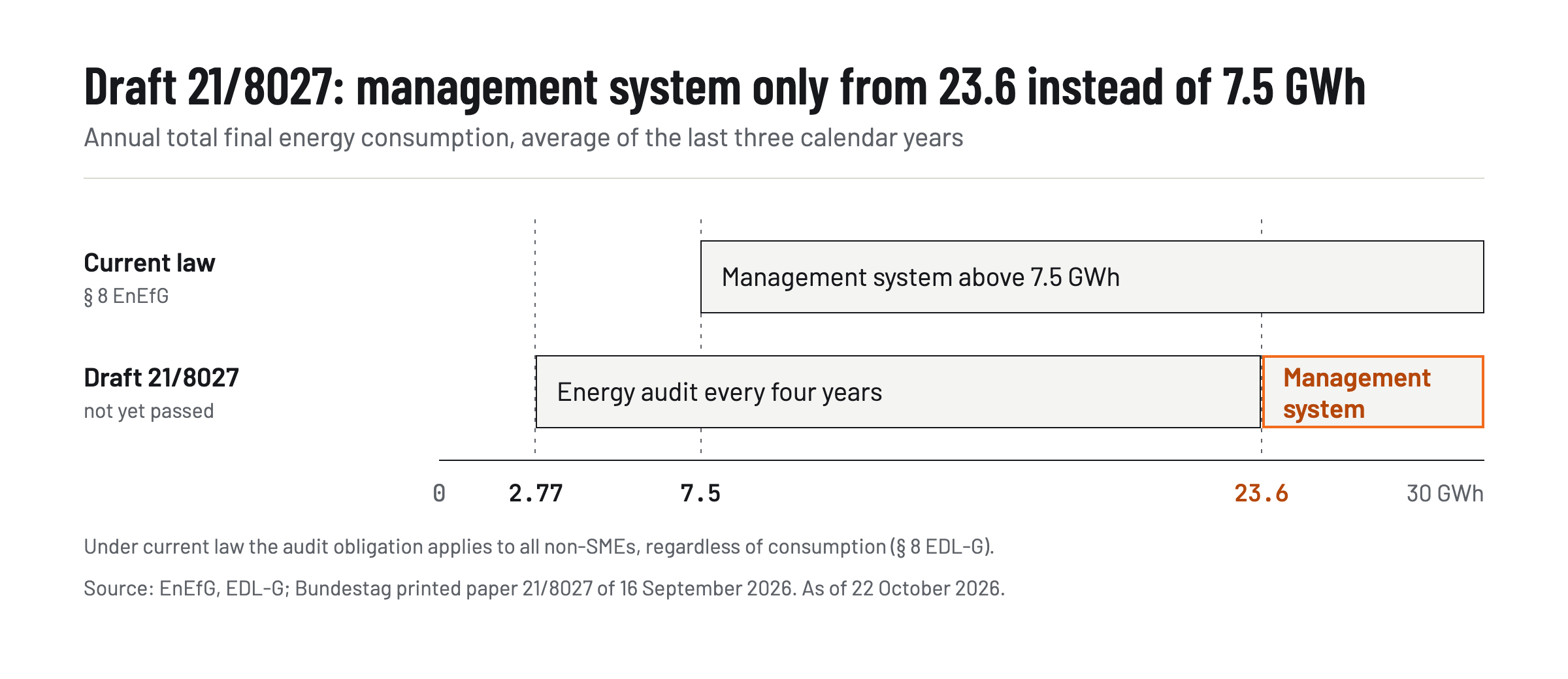
As of 22 October 2026, an energy management system is mandatory in Germany for companies whose average annual total final energy consumption over the last three completed calendar years exceeds 7.5 GWh. This is governed by § 8 of the Energy Efficiency Act (EnEfG); an environmental management system is also permissible instead of an EnMS.[3] Companies that had reached the threshold by 17 November 2023 had to set up the system by 18 July 2025; companies crossing it later have 20 months.
Below this threshold, the Energy Services Act (EDL-G) applies. Companies that are not small and medium-sized enterprises under EU Recommendation 2003/361/EC must carry out an energy audit at least every four years.[4] Exempt are those who have set up an energy or environmental management system, or have begun setting one up.
What government draft 21/8027 would change
On 16 September 2026, the German government presented the draft of a law to accelerate the implementation of the Energy Efficiency Directive as printed paper 21/8027.[5] It transposes EU Directive 2023/1791 and rolls several EnEfG requirements back to the EU minimum level. The Bundestag debated the draft in first reading on 24 September 2026, and the Committee on Economic Affairs and Energy heard expert testimony on 5 October 2026.[6] It has not yet been passed; until promulgation, the existing law applies.
| Obligation | Current law | Draft 21/8027 |
|---|---|---|
| Energy or environmental management system | above 7.5 GWh | above 23.6 GWh |
| Deadline for entities already obligated | 18 July 2025 | 11 October 2027 (status as of 31 December 2025) |
| Deadline for newly obligated entities | 20 months | 24 months |
| Coverage level of the system | no quota in the law | at least 90 percent of total final energy consumption |
| Energy audit under the EDL-G | all non-SMEs | companies above 2.77 GWh |
For manufacturing operations between 7.5 and 23.6 GWh, the system obligation would fall away; above 2.77 GWh, the energy audit every four years would remain, regardless of company size. An SME above 2.77 GWh that is not currently subject to audits would thus be newly covered. In both cases, the measurement concept remains the foundation: without reliable consumption data, neither an audit nor a management system is meaningful. Further articles on measurement, standards and obligations are collected in the energy monitoring section.
How can energy be measured?
Energy monitoring in production measures different quantities per energy carrier: electricity via voltage and current, compressed air and gases via volume or mass flow. For fluids such as heating or cooling water, thermal power is determined from volume flow and the supply and return temperatures.[1] Which points are measured is defined in a measurement concept. The standard DIN EN 17267, German edition October 2020, sets out the requirements and principles for such a plan for energy measurement and monitoring. It applies to all energy types and organisation types, but not to residential buildings.[7]
Step by step to a measurement concept
The PTW guide structures the build-up into goal definition, as-is analysis, conception, implementation and operation. The order matters because the goal determines the type of data collection:
- Define the goal. To evaluate a single measure on one machine, a temporary mobile measurement is sufficient. For load management, the guide recommends stationary metering with a one-second interval.[1]
- Take stock. What is already being measured, which bus systems and IT systems exist, which energy carriers are relevant?
- Prioritise consumers. An ABC analysis sorts equipment by connected load and operating hours; category A covers the consumers accounting for roughly 70 percent of connected load, B the next 20 percent, C the rest.
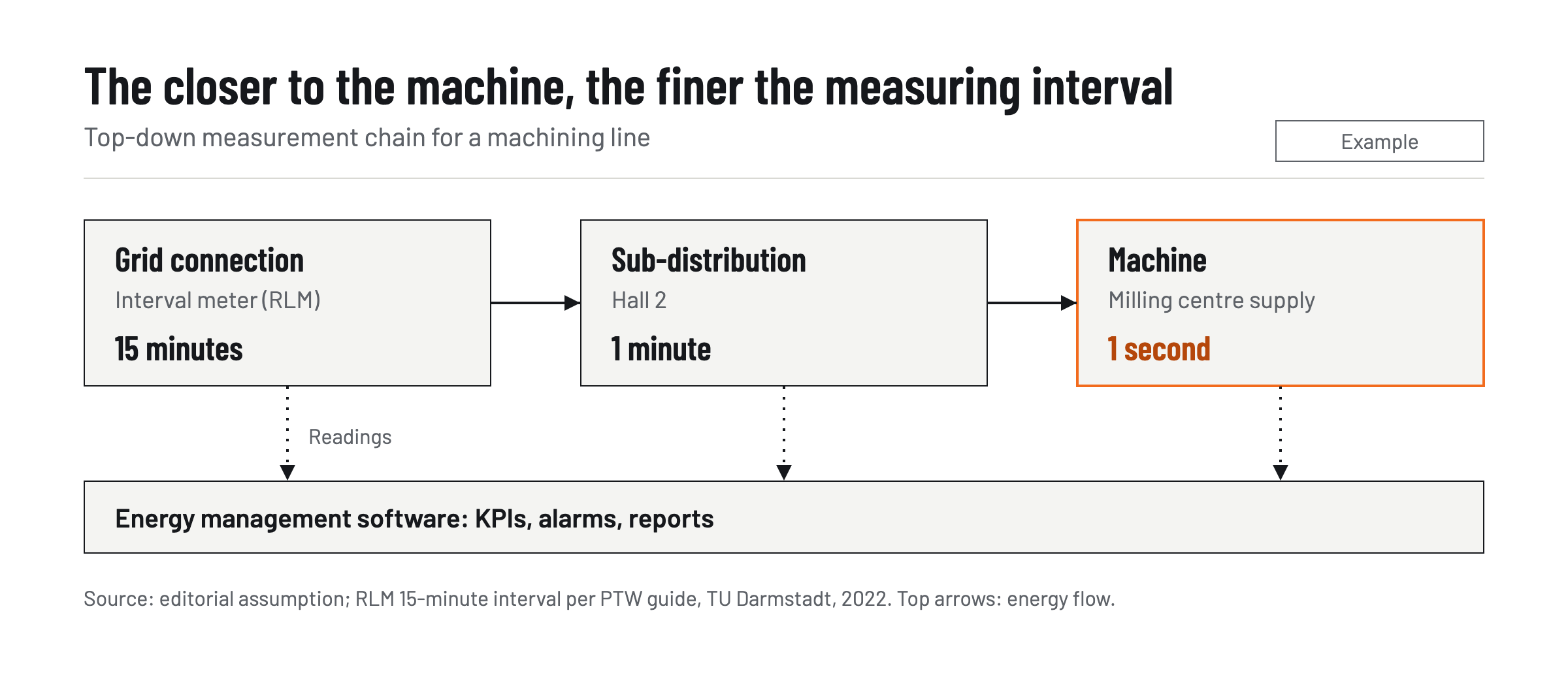
- Choose measurement points. Top-down from the main meter via sub-distribution boards to equipment, bottom-up from the equipment upwards, or a combination of both.
- Write the data collection plan. It lists, per measurement point, the variable, measured quantity, location, device, responsibility and collection interval.
An inexpensive starting point is existing data from the grid operator. According to the guide, companies consuming more than 100 MWh of electricity or 1,500 MWh of natural gas per year receive registered power metering (RLM), which delivers quarter-hour values for electricity and hourly values for gas.[1] These load profiles show base load, peaks and consumption during production-free periods before a single sensor has been purchased. For several identical machines with similar operating patterns, the guide suggests it may suffice to measure one of them and extrapolate the others from operating hours and average power.
Mobile or stationary metering
Mobile, temporary measurements are suitable for initial diagnoses and for checking individual measures; they are quick to install but laborious to operate. Stationary, continuous metering technology costs more to install, but in return delivers consistent, up-to-date data for long-term monitoring, reports and alarms. As a guide to how far the rollout should go, the PTW guide reproduces an application note from the German accreditation body (DAkkS) dated May 2014, tiered by energy costs:[1]
| Annual energy costs | Type of data collection according to the DAkkS note |
|---|---|
| up to 10,000 euros[1] | possibly RLM data, calculated estimation |
| 10,000 to 100,000 euros[1] | RLM data, estimation, verification by mobile measurement, possibly individual stationary meters |
| 100,000 to 1,000,000 euros[1] | in addition, continuous measurement of the sub-distribution boards |
| over 1,000,000 euros[1] | in addition, automatic data collection and evaluation |
As a rule of thumb, the guide states that a sensible monitoring system can be built for roughly 3 percent of annual energy costs.[1] This is an empirical value, not a normative requirement. For consumption data, intervals of 1 to 15 minutes are common; for load peak smoothing or condition monitoring, seconds or less. Installation should take place outside production hours, because current transformers or temperature sensors in the medium usually require a shutdown.
Example: data collection plan for a machining line
The KfW annex to funding programme Module 3, as of May 2025, requires a data collection plan within the meaning of Section 5.9 of DIN ISO 50015:2018-04 for funded metering technology and specifies the minimum columns.[8] The following example is an editorial assumption for a line with a machining centre and a compressor, not a template issued by an authority:
| Variable | Measured quantity | Measurement point | Interval | Purpose |
|---|---|---|---|---|
| Strom_Einspeisung | electrical energy in kWh | grid operator's RLM meter | 15 minutes | total consumption, load peaks |
| Strom_UV_Halle2 | electrical power in kW | sub-distribution board hall 2 | 1 minute | allocation to cost centre |
| Strom_BAZ_01 | electrical power in kW | power feed to machining centre | 1 second | base load at standstill, reference per part |
| Druckluft_K1 | volume flow in Nm³/h | outlet of compressor 1 | 15 seconds | leakage during production-free periods |
| Wärme_KSS | heat quantity in kWh | recooling of coolant | 1 minute | waste heat, cooling demand |
For the key figures to be correct, modifications to the line must be recorded in the data collection plan and in the software; otherwise worn sensors or changed parameterisation falsify the values unnoticed. In older plants, metering technology is often part of a larger modernisation; the article on machine retrofit puts into context when this pays off.
What is the best energy management system?
There is no best energy management system; the suitable software is the one that fits the measurement concept, the IT landscape and the company's obligations. Even the Federal Office for Economic Affairs and Export Control's (BAFA) list of eligible energy management software points out that it is not a product recommendation and does not guarantee suitability for every company. To be included in this list, a software must support the introduction, maintenance and improvement of an EnMS according to DIN EN ISO 50001, confirmed by a body accredited under ISO/IEC 17065.[8]
A Haufe technical article summarises the tasks such software performs: recording all energy and operating data, central evaluation, key figures, alarms on deviations, allocation to cost centres and automatic energy reports.[9] It is said to be important that the software can adapt to the organisational structure and scale, and that it can integrate metering technology for electricity, water, gas, heat and compressed air.
Criteria for selection
The selection of energy monitoring software can be structured using a four-step procedure from Fraunhofer IPA for small and medium-sized enterprises. First, requirements are clarified; then suitable solutions are evaluated, for example by performance, usability, data security and cost. The criteria are then weighted according to the specific company and the result presented clearly.[10] For a manufacturing operation, these criteria can be made concrete as follows:
| Criterion | Question to ask the vendor |
|---|---|
| Interfaces | Does the software read the existing protocols — such as Modbus, M-Bus, Profibus, OPC UA or Profinet — directly, or only via gateways? |
| Data model | Can the structure be mapped spatially, technically, organisationally and by cost centre? |
| Performance indicators | Can it take in reference variables such as unit counts from ERP or MES? |
| Resolution and storage | Does it store second-level values and automatically aggregate older data? |
| Data quality | Does it detect measurement point failures and implausible values? |
| Funding eligibility | Is the product on the current BAFA list? |
The protocols, the structuring and the data maintenance come from the PTW guide; which functions a product actually offers are manufacturer specifications and should be verified in a test phase using your own measurement data. For the performance indicators, the connection to the Manufacturing Execution System (MES) is often more important than the dashboard presentation.
Funding via BAFA Module 3
The federal government funds energy monitoring hardware and software through the Federal Funding for Energy and Resource Efficiency in Industry programme. Under Module 3 it subsidises energy management software, sensors, analogue-to-digital converters, data loggers, gateways as well as control and regulation technology whose purpose is to reduce energy demand.[8] The funding is available as a direct grant from BAFA or as a KfW loan with a repayment bonus; applications can be submitted before the measure begins and until 31 December 2028.[11] For Module 3, KfW names up to 45 percent of eligible costs for small, up to 35 percent for medium-sized and up to 25 percent for large companies.[12] According to the KfW annex, the condition is that the hardware is integrated into a listed software product and that the energy performance indicators are stored for at least three years from commissioning. Maintenance, updates and licence extensions are not eligible for funding.
For your decision this means: start with the load profile from the RLM and an ABC analysis, and write the data collection plan. Only then request quotations for software and measurement technology. That way the software fits the measurement concept rather than the other way round, and the funding application is half prepared. Further context is available in the Industry section on GoMaschine; on measurement technology and standards, for example, see Energy.
Frequently asked questions
What does energy monitoring for machines cost?
The costs depend on the number and type of measurement points, installation, cabling and software. The PTW guide cites a rule of thumb of around 3 percent of annual energy costs for a sensible system; under BAFA Module 3, 25 to 45 percent of eligible costs are possible as a grant.
Are the data from the electricity meter enough for energy monitoring?
For a first overview, yes: the RLM meter delivers quarter-hour values for the entire site. Which machine consumes which share is not shown by these data; for that, measurements at sub-distribution boards or individual systems are needed.
Do I need an ISO 50001 certificate for energy monitoring?
No. Energy monitoring is a technical task and possible without a certificate. Section 8 of the Energy Efficiency Act (EnEfG) requires an energy or environmental management system above the threshold, but does not mandate certification.
What distinguishes an energy audit from an energy management system?
An energy audit under DIN EN 16247-1 is an assessment at a single point in time and is repeated every four years under the Energy Services Act (EDL-G). An energy management system (EnMS) under ISO 50001 is a continuous cycle of planning, implementation, measurement and improvement that constantly needs measurement data.
How often should a machine be measured?
For consumption volumes, 1 to 15 minutes is sufficient. Anyone who wants to evaluate base load at standstill, load peaks or consumption per component needs values in the seconds range.
Sources
Related reading
All Energy →ISO 50001 Certification: Process, Duration and Costs
ISO 50001 certification: the two audit stages, 6 to 18 months' duration and a cost example from a published price list, with source and date.

Industrial heat pumps: temperatures, costs and funding in Germany
Industrial heat pumps in Germany: which temperatures they reach, cost per kilowatt, when they beat gas and which BAFA funding applies.