Industrial heat pumps: temperatures, costs and funding in Germany
Industrial heat pumps in Germany: which temperatures they reach, cost per kilowatt, when they beat gas and which BAFA funding applies.
In this article10
- Is the heat pump the future of process heat?
- What are the 4 types of heat pumps?
- Who is currently the market leader in heat pumps?
- How efficient is a heat pump at 0 degrees outdoor temperature?
- How many degrees below zero can a heat pump handle?
- Is heating with a heat pump cheaper than with gas?
- What funding is available for industrial heat pumps?
- Are heat pumps really the future?
- Frequently asked questions
- Sources
An industrial heat pump uses electricity to raise heat from a source such as waste heat, groundwater or outdoor air to the temperature a process needs. For the managing director of a manufacturing SME, the question is usually concrete. Is the temperature enough for cleaning, drying or painting, what does the unit cost, and how much of it does the German federal government cover? The answers depend on a few figures, which this article sets out with source and date.
Is the heat pump the future of process heat?
For process heat up to 200 °C, the heat pump is the obvious technical option, but in the market it is still at an early stage. All of Germany's heat demand up to 200 °C can technically be covered by heat pumps. That is the conclusion of the study "Roll-out von Großwärmepumpen in Deutschland" (roll-out of large heat pumps in Germany) by Agora Energiewende and Fraunhofer IEG.[1] According to the same study, heat applications up to 200 °C account for more than three quarters of Germany's natural gas consumption.
The gap to practice is large. According to the study, only 60 megawatts of large heat pump capacity had been installed in 2023, held back by complex permitting. A further brake is the higher burden of levies on electricity than on natural gas. Fraunhofer IEG puts the savings potential of large heat pumps in Europe at up to 150 million tonnes of CO₂ a year.[2] Whether the technology is the future for a particular plant therefore depends on temperature, heat source and the local electricity price.
What are the 4 types of heat pumps?
By heat source there are four types: air, water, ground and waste heat. The source determines efficiency and investment more than any other choice, because it sets the temperature lift, the difference between source and target temperature. The smaller the lift, the higher the coefficient of performance (COP): the ratio of heat delivered to electricity used. Fraunhofer IEG also describes the link between temperature lift, COP and economics.[3]
| Heat source | Typical examples | Specific investment (large heat pump) | Assessment |
|---|---|---|---|
| Outdoor air | Air-to-water heat pump on the hall roof | €700–1,600/kW | available everywhere, coldest source in winter |
| Water | Groundwater, river, wastewater | €700–1,600/kW | steady temperature, permit required |
| Ground | Shallow and deep geothermal | €2,200–3,600/kW | high development costs, drilling risk |
| Waste heat | Refrigeration units, compressors, dryers, process wastewater | €700–1,600/kW | often the warmest source, tied to production hours |
The cost ranges come from the Agora study (June 2023) and apply to large heat pump projects. For geothermal energy, according to the study, 60 to 80 percent of the investment goes into developing the heat source.[1] How much waste heat a plant actually has only becomes clear from measurement; the approach is described in the article on energy monitoring with a measurement concept.
By operating principle, Fraunhofer IEG distinguishes three groups. The closed compression heat pump is the most common design. Mechanical vapour recompression (MVR) compresses low-pressure steam directly. Thermally driven sorption heat pumps play a minor role and can pay off where the electrical connection capacity is limited.
What temperatures does an industrial heat pump reach?
According to Fraunhofer IEG, large and high-temperature heat pumps supply heat from 50 °C to over 200 °C.[3] Combined with steam compressors, even up to 300 °C is possible according to the Hessian energy minister, whom Fraunhofer IEG quotes in its press release.[2] The refrigerant sets the limits. According to the Agora study, ammonia (R717) reaches a sink temperature of about 110 °C, and CO₂ heat pumps operate between 80 and 120 °C. Above 120 °C, hydrocarbons such as butane or pentane come into question.
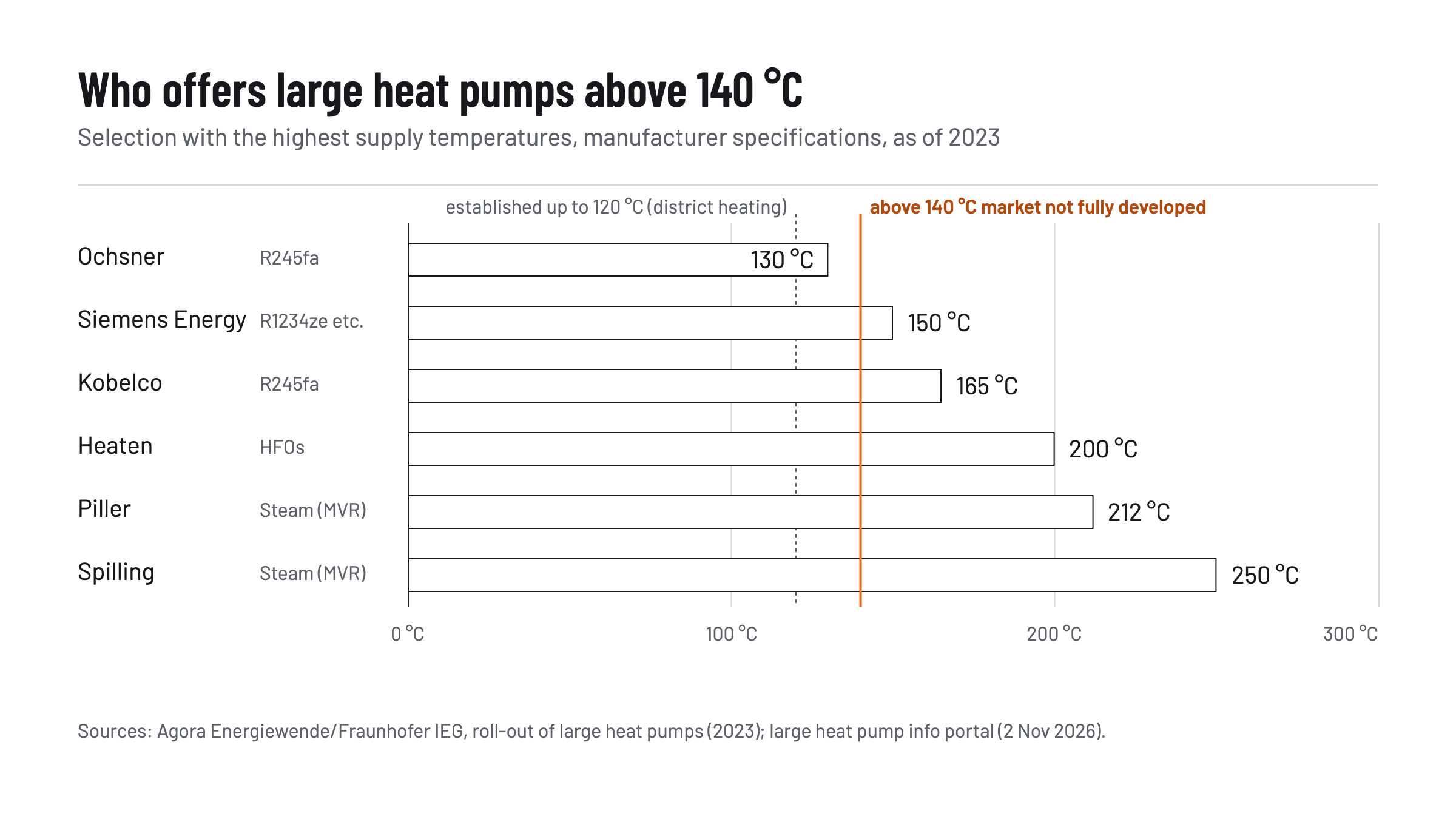
A second limit matters more for planning. According to the large heat pump information portal run by Fraunhofer IEG, units up to a supply temperature of 120 °C are widespread and established in district heating. Above 140 °C, the market is not yet fully developed and is often limited to products below series maturity.[4] A process needing steam at 160 °C therefore requires a different assessment from parts cleaning at 70 °C.
Who is currently the market leader in heat pumps?
There is no documented market leader for industrial heat pumps, because no public market share statistics exist for large heat pumps. The database of the large heat pump information portal lists more than 60 manufacturers with commercially available units above 0.5 megawatts of heating capacity. They include established refrigeration and air-conditioning suppliers, process and power plant engineering companies and start-ups.[4] Up to 1 MW, units are mostly series products; from 10 MW, customer-specific solutions dominate. The largest single units reach up to 70 MW.
In the product overview of the Agora study, Johnson Controls has the most entries. At the highest temperatures, other names appear. The following values are manufacturer specifications for the maximum supply temperature, as compiled by the study as of 2023:[1]
| Manufacturer | Max. supply temperature (manufacturer specification) | Refrigerant / principle |
|---|---|---|
| Ochsner | 130 °C | R245fa |
| Siemens Energy | 150 °C | R1234ze and others |
| Kobelco | 165 °C | R245fa |
| Heaten | 200 °C | HFOs |
| Piller | 212 °C | Water vapour (MVR) |
| Spilling | 250 °C | Water vapour (MVR) |
The table is not a ranking. It shows that high-temperature applications lie with a few specialised suppliers. For a current overview by capacity, temperature and refrigerant, the portal's manufacturer database, which Fraunhofer IEG keeps up to date, can be filtered.
How efficient is a heat pump at 0 degrees outdoor temperature?
At 0 °C outdoor air, efficiency depends almost entirely on the target temperature: for 60 °C, an air-source heat pump stays efficient enough for funding, for 80 °C it gets tight. In Module 2, BAFA requires an effective COP of at least 2.05 and a performance grade (Gütegrad) of at least 0.4 at the operating point, with outdoor air explicitly demonstrated at 0 °C.[5] The performance grade states which share of the physically possible Carnot coefficient of performance the unit achieves.
Using the formula from the BAFA information sheet, it is possible to check in advance whether an application can meet the threshold. The values are our own calculation; 0.4 is the BAFA minimum, 0.5 an editorial assumption for a better unit:
| Source → sink | Carnot COP | COP at performance grade 0.4 | COP at performance grade 0.5 |
|---|---|---|---|
| Outdoor air 0 °C → 60 °C | 5.55 | 2.22 | 2.78 |
| Outdoor air 0 °C → 80 °C | 4.41 | 1.77 | 2.21 |
| Groundwater 10 °C → 80 °C | 5.04 | 2.02 | 2.52 |
| Waste heat 40 °C → 80 °C | 8.83 | 3.53 | 4.41 |
| Waste heat 40 °C → 120 °C | 4.91 | 1.97 | 2.46 |
The calculation shows the core point: an air-source heat pump for 80 °C reaches 2.05 only with an above-average performance grade. A waste heat source at 40 °C delivers 80 °C with a COP of around 4. For funding, the manufacturer's evidence at the specific operating point always counts, not this estimate.
How many degrees below zero can a heat pump handle?
How many degrees below zero an air-source heat pump can handle is stated in the data sheet as the operating limit of the heat source. In hard frost it usually no longer delivers its highest supply temperature. The technical data sheet of the Stiebel Eltron WPL 25 A gives an operating limit of −20 to 40 °C for the heat source and a maximum of 65 °C on the heating side.[6] For the commercial Vitocal 250-A PRO with a rated heat output of 39.5 kW, Viessmann specifies a 70 °C supply temperature, but only at outdoor temperatures down to −2 °C.[7]
For process heat, this means the question is rarely whether the unit survives the frost, but whether it still delivers the process temperature in frost. A process that needs 70 °C in January can run into a gap with outdoor air as its only source. Groundwater, water bodies and waste heat hardly have this problem, because their temperature stays stable over the year. That is why industrial installations prefer these sources or plan air only for low temperatures.
Is heating with a heat pump cheaper than with gas?
Heating with a heat pump is cheaper than with gas as soon as its COP is higher than the ratio of electricity to gas price multiplied by the boiler efficiency. In the first half of 2026, non-household customers paid a provisional average of 17.64 cents per kilowatt hour for electricity, according to the German Federal Statistical Office (Destatis). Natural gas cost them 6.29 cents per kilowatt hour, each excluding VAT and deductible taxes.[8] The ratio is 2.8. Assuming a boiler efficiency of 90 percent, the heat pump is cheaper from a COP of about 2.5 (our own calculation).
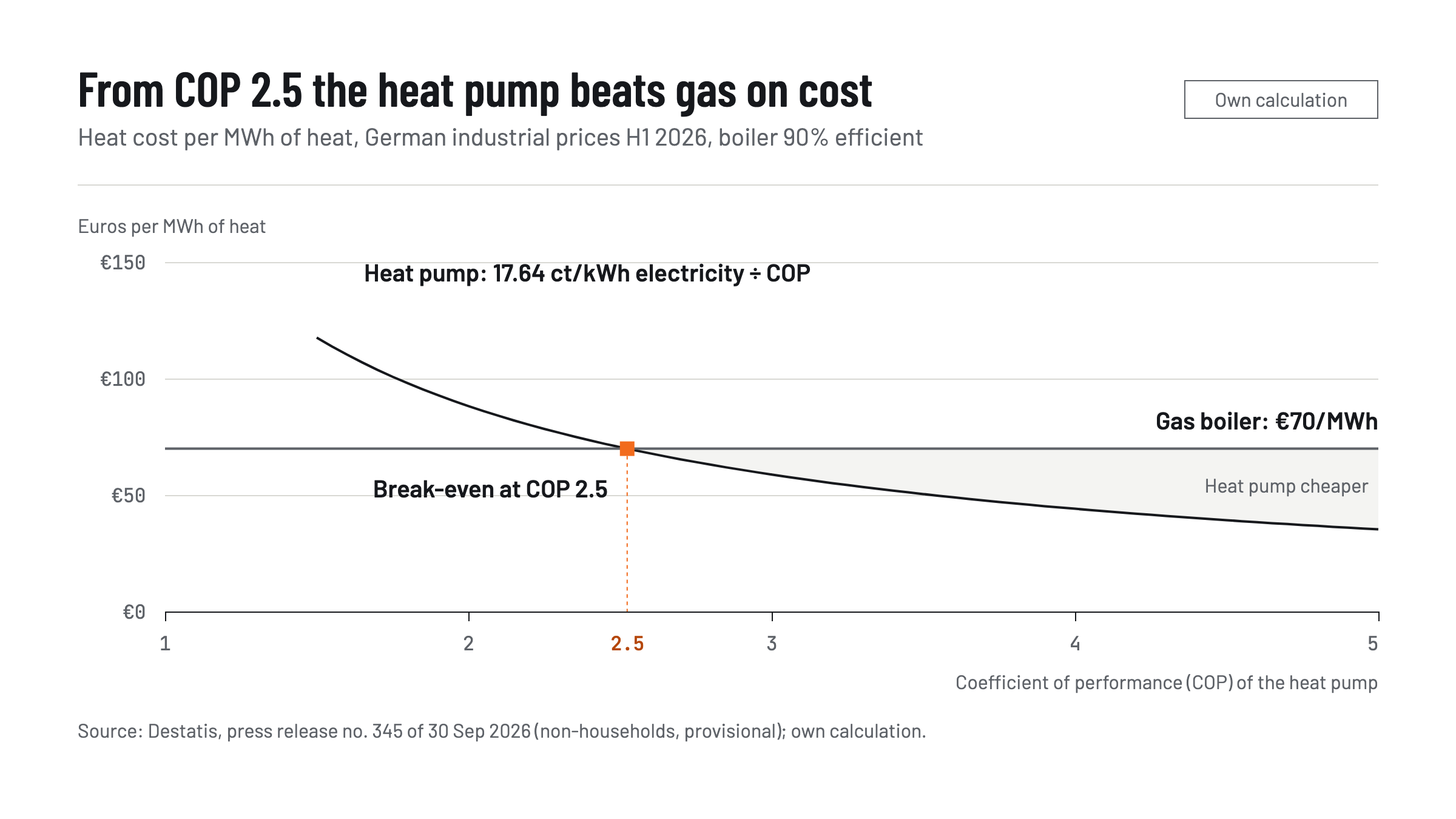
The threshold barely shifts with the consumption band. Smaller customers using 20 to 500 megawatt hours of electricity paid a provisional 23.66 cents. Gas cost 8.11 cents at an annual consumption of 1,000 to 10,000 gigajoules; this gives a break-even COP of about 2.6. The bands of the two statistics do not match exactly, but the order of magnitude holds. Destatis points out that Germany's planned industrial electricity price (Industriestrompreis) is not yet included in these figures.
Worked example: 1 MW of process heat over 6,000 hours
A worked example with disclosed assumptions shows how strongly the COP determines the payback. It assumes 1 MW of heat output and 6,000 operating hours a year, i.e. 6,000 megawatt hours of heat, the Destatis average prices and an investment of 1,000 euros per kilowatt within the Agora range. Maintenance, grid connection and a gas boiler kept in operation are not included.
| Case | Energy costs per year | Savings compared with gas | Payback without funding | With 50% grant |
|---|---|---|---|---|
| Gas boiler, 90% efficiency | €419,300 | – | – | – |
| Heat pump, COP 4 (e.g. waste heat 40 → 80 °C) | €264,600 | €154,700 | 6.5 years | 3.2 years |
| Heat pump, COP 3 | €352,800 | €66,500 | 15 years | 7.5 years |
| Heat pump, COP 2.5 (e.g. waste heat 40 → 120 °C) | €423,400 | none | – | – |
So there is no blanket answer to the payback period of an industrial heat pump for 120 degrees. At 120 °C from 40 °C waste heat, the COP in the example is 2.5, and the unit saves nothing at average prices. Only a warmer source, a cheaper electricity tariff or an own PV system turns the calculation around. When a high-temperature heat pump up to 150 °C pays off is a separate topic in the section.
What funding is available for industrial heat pumps?
The most important funding is Germany's federal programme for energy and resource efficiency in industry (Bundesförderung für Energie- und Ressourceneffizienz in der Wirtschaft, EEW). It comes either as a BAFA grant or as a KfW loan with a repayment grant. The heat source decides which module applies. Module 2 "process heat from renewable energies" funds heat pumps whose heat goes more than 50 percent into processes. The grant is 60 percent for small, 50 percent for medium-sized and 40 percent for large companies, up to 20 million euros per project (BAFA page as of 30 April 2026).[9]
Module 2 sets three conditions that need to be clarified early in planning:
- The heat comes predominantly from outdoor air, ground, water bodies or the sun. Waste heat may only be used in addition if measurements show that, on annual average, the greater share comes from renewable sources.
- The electricity comes entirely from renewable sources: an own PV, wind or hydro plant, a PPA or a green electricity contract covering at least the pump's annual electricity demand.
- Electricity and heat meters record operation continuously and store the data for at least three years.
Heat pumps that mainly use waste heat may fall under the premium funding of Module 4, according to the BAFA information sheet.[5] It provides up to 45 percent for small, 35 percent for medium-sized and 25 percent for large companies. For selected measures in waste heat use and electrification, a decarbonisation bonus of up to 10 percentage points is added. A savings concept on the BAFA form is required.[10]
| Route | Heat source | Funding rate small / medium / large | Form |
|---|---|---|---|
| EEW Module 2 | predominantly renewable | 60 / 50 / 40% | BAFA grant or KfW 295 |
| EEW Module 4 Premium | predominantly waste heat | up to 45 / 35 / 25% + up to 10 points bonus | BAFA grant or KfW 295 |
Companies that want financing rather than only a grant use KfW loan 295, which has the same technical minimum requirements. It covers up to 100 million euros per project with a term of up to 20 years, and the repayment grant follows the same rates.[11] Whether a loan or leasing is cheaper for the remaining equipment is compared in the article lease or buy a machine. Feasibility studies and planning can be co-funded under Module 2 if they belong to the measure applied for.
Are heat pumps really the future?
For process heat up to about 120 °C, heat pumps are a mature choice today; above that, each case needs its own assessment. Three conditions decide whether they are economical in a given plant. The heat source has a small temperature lift, the COP is clearly above the break-even of about 2.5, and the funding route fits the heat source.
Uncertainty remains about the electricity price and maturity above 140 °C. Agora and Fraunhofer IEG explicitly name the higher burden of levies on electricity compared with natural gas as an obstacle. An industrial electricity price would shift the calculation, but its level has not yet been set. Companies building energy management anyway obtain, with an ISO 50001 certification, the measurement data that heat pump planning needs.
The next step is a list of heat consumers with temperature, output and operating hours, alongside the available heat sources with their temperature. This shows which consumers the heat pump can take over. More analysis of compressed air, drives and process heat is available in the GoMaschine energy section.
Frequently asked questions
What does an industrial heat pump cost?
According to Agora Energiewende and Fraunhofer IEG, large heat pumps cost 700 to 1,600 euros per kilowatt of heating capacity depending on the heat source, and 2,200 to 3,600 euros with geothermal energy. For 1 MW this means roughly 0.7 to 1.6 million euros before funding.
From which COP does a heat pump pay off against gas?
With the average prices for non-household customers in Germany in the first half of 2026 and 90 percent boiler efficiency, from a COP of about 2.5. Every point above that lowers heat costs considerably.
Is a heat pump using waste heat funded under BAFA Module 2?
Only if, on annual average, the greater share of the heat comes from renewable sources. BAFA may assess units running mainly on waste heat under the premium funding of Module 4.
Does the heat pump have to run on green electricity?
For Module 2, yes: the electricity must come entirely from renewable energies, proven by own generation, a PPA or a green electricity contract.
Sources
Related reading
All Energy →Energy Monitoring in Industry: Measurement Concept and Software
Energy monitoring for machines: when an energy management system is mandatory, how a metering concept is built and how to choose the software.
ISO 50001 Certification: Process, Duration and Costs
ISO 50001 certification: the two audit stages, 6 to 18 months' duration and a cost example from a published price list, with source and date.