ISO 50001 Certification: Process, Duration and Costs
ISO 50001 certification: the two audit stages, 6 to 18 months' duration and a cost example from a published price list, with source and date.
In this article9

What is DIN ISO 50001?
DIN EN ISO 50001 is the international standard for energy management systems (EnMS); it defines how a company systematically records, controls and improves its energy performance. The valid version is ISO 50001:2018, published on 21 August 2018; the transition period for certificates under the previous version ended on 21 August 2021. The standard follows the Plan-Do-Check-Act cycle: define energy policy, objectives and action plans, implement measures, measure results and derive improvements from them.[1]
Two concepts carry the system. The energy baseline is the reference point against which later improvements are measured; LRQA recommends using data from a representative period, typically twelve months. Energy performance indicators (EnPIs) make consumption comparable and should be adjusted for factors such as weather or production mix.[1] For a manufacturing company this means: without reliable measurement data on electricity, gas and compressed air, no baseline can be established. How a measurement concept is structured is covered in our section on energy monitoring.
The certification process
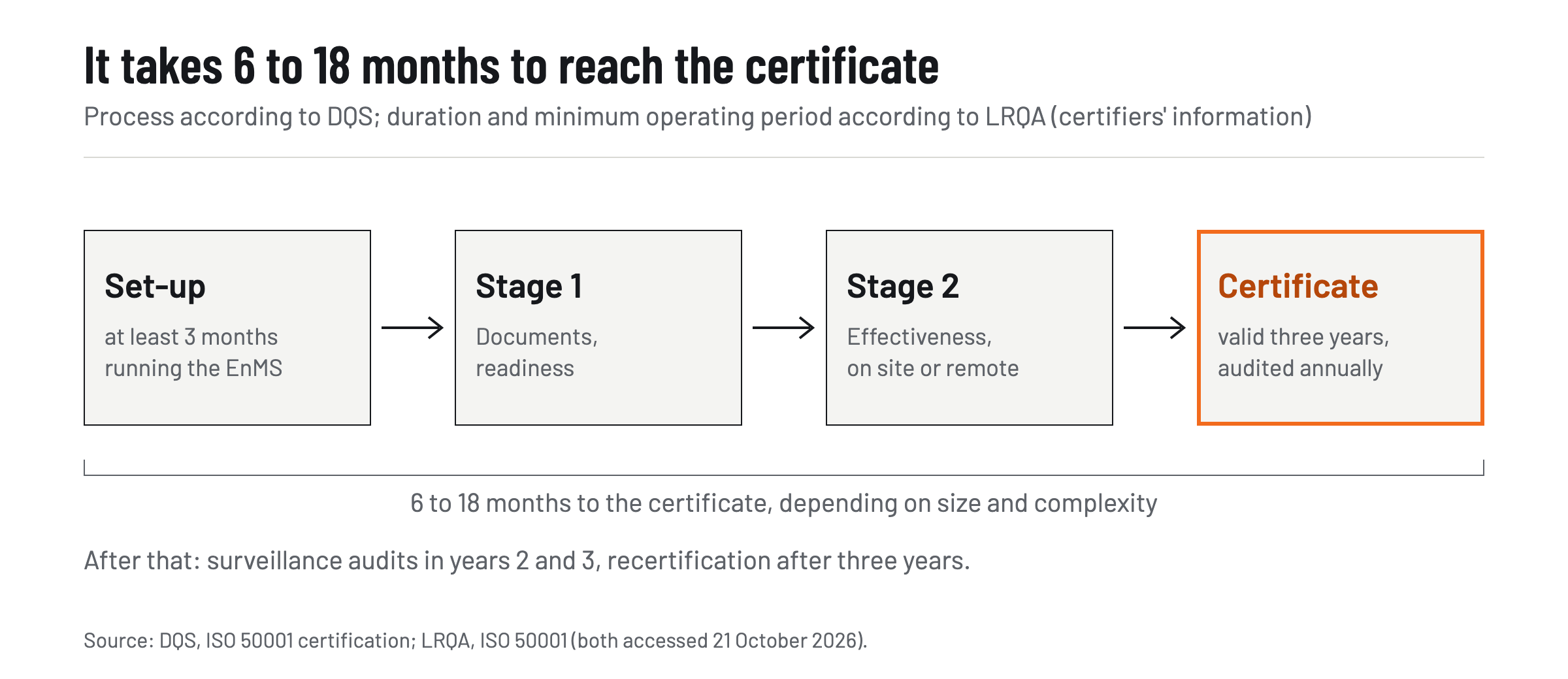
The process divides into internal implementation and the external audit. At certification body DQS, the external procedure looks like this:[2]
- Enquiry and quotation; for multiple sites, with a project plan.
- In the Stage 1 audit, the auditor reviews documentation, management review and internal audits and determines whether the system is ready for certification.
- In the Stage 2 audit, it is assessed on site or remotely whether the management system processes function effectively; the closing meeting discusses results and any necessary actions.
- Certification decision by an independent body and issuance of the accredited certificate.
- Surveillance audits at least once a year; the certificate is valid for three years.
Before step 2, several things must be in place internally: scope, energy review, baseline and performance indicators, an internal audit and a management review. According to LRQA, the certification audit requires the energy management system to have been in operation for at least three months.[1]
Time to certificate
LRQA states 6 to 18 months to ISO 50001 certification, depending on company size and complexity. According to this source, smaller companies can complete implementation in 6 to 9 months, while large organisations with multiple sites need 12 to 18 months.[1] This is a statement from a certification body, not a requirement of the standard. Anyone who first has to collect twelve months of measurement data for the energy baseline will tend to land at the upper end of the range.
Is EMAS certification mandatory?
No, EMAS is a voluntary instrument of the European Union. Participating organisations record their environmental impacts, continuously improve their environmental performance and publish an environmental statement; state-approved environmental verifiers audit the system and the statement, after which the organisation is entered into the public EMAS register.[3] Strictly speaking, EMAS is therefore a validation and registration, not a certification. According to its own description, EMAS covers all requirements of DIN EN ISO 14001.
A management system only becomes mandatory through the Energy Efficiency Act. Companies with an average annual total final energy consumption of more than 7.5 gigawatt-hours must establish an energy or environmental management system under Section 8 EnEfG.[4] EMAS is one of the two options here, not the obligation itself. For the energy audit under EDL-G, the law recognises EMAS registration as proof if it covers at least 90 percent of total energy consumption.[5]
How much does ISO 50001 certification cost?
The cost of ISO 50001 certification consists of the certification body's audit days, the daily rate, and travel and administrative costs. Certifiers rarely publish fixed package prices; LRQA, for example, quotes costs individually, depending on size, locations, industry and existing management systems.[1] One exception is the schedule of fees of TÜV Saarland Certification GmbH, as of 1 February 2025, all figures in euros plus value-added tax:[6]
| Item | Unit | Net price |
|---|---|---|
| Audit execution incl. preparation and follow-up, ISO 50001 | person-day | 1,390 euros |
| Project management (application review, certification decision, administration) | hour | 95 euros |
| Additional effort, e.g. for late planning documents | hour | 181.25 euros |
| Travel time | hour | 85 euros |
| Travel by car | kilometre | 0.65 euros |
| Main certificate | each | included in the price |
| Site certificate | each | 75 euros |
How many audit days a company needs is defined for certification bodies by the standard ISO 50003. It calculates audit time using a key based on energy sources, areas with significant energy uses, energy consumption and personnel involved in the system. The certifier may increase or reduce the time with justification.[7] Since the ISO 50003:2021 edition, only those energy types that together account for at least 80 percent of total consumption are counted.[8] A plant with electricity and natural gas as its main energy sources and few large consumers will therefore likely require fewer audit days than a factory with many energy types and linked installations.
Worked example over three years
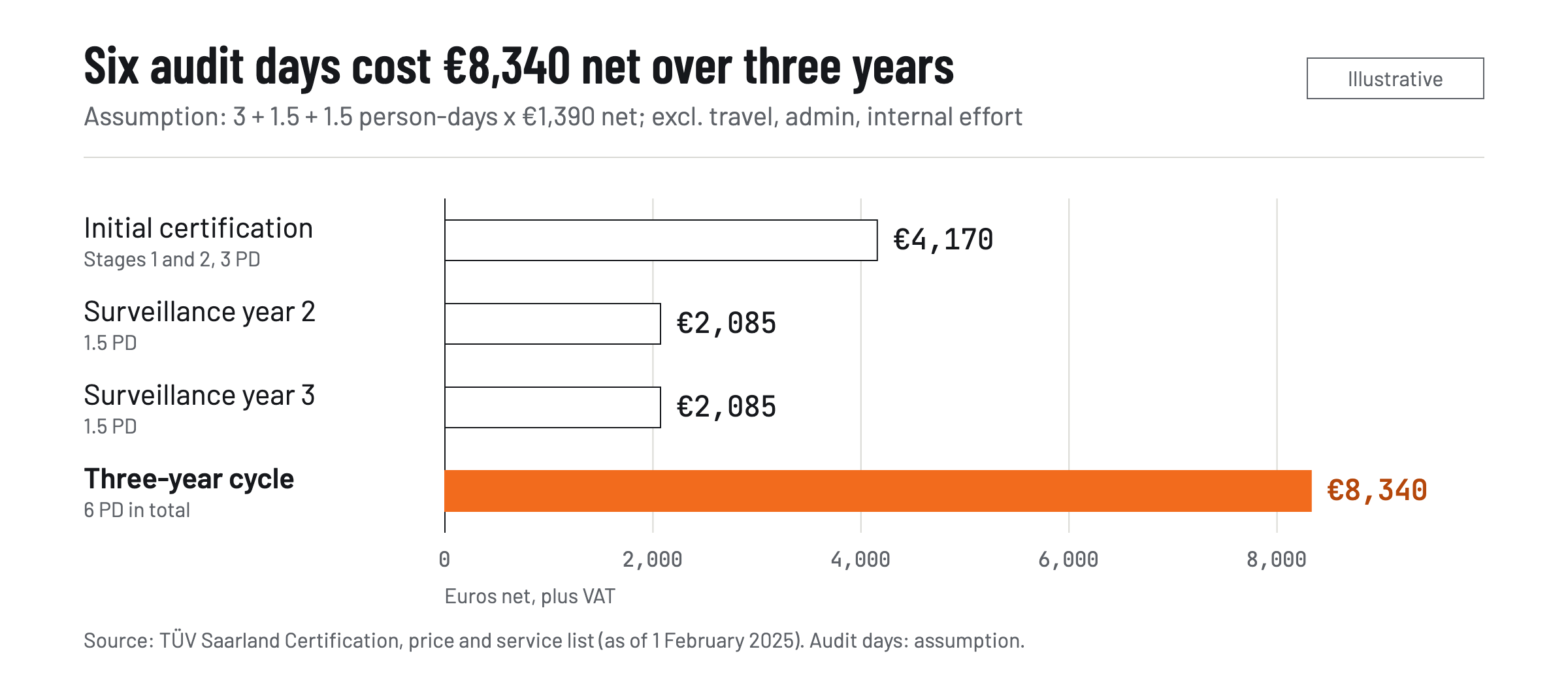
A worked example with disclosed assumptions shows the order of magnitude. It assumes three person-days for stage 1 and stage 2 combined, plus 1.5 person-days each for the two surveillance audits. These audit days are editorial assumptions, not figures from a certification body.
| Audit type | Person-days (assumption) | Net cost at 1,390 euros |
|---|---|---|
| Initial certification, stage 1 and 2 | 3 | 4,170 euros |
| Surveillance audit year 2 | 1.5 | 2,085 euros |
| Surveillance audit year 3 | 1.5 | 2,085 euros |
| Total certification cycle | 6 | 8,340 euros |
Not included are travel time, mileage, project management hours and site certificates. Also not included is the internal effort of building the system, for metering technology and, where applicable, external consulting; there is no reliable flat rate for this. A quotation can be checked with this calculation: ask for the number of audit days per audit type and for the justification under ISO 50003.
How much does ISO 9001 certification cost?
According to benchmark figures from a Haufe specialist article, an ISO 9001 certification costs around 3,500 euros for a site with up to five full-time employees. For six sites with 875 full-time employees, the article cites around 23,000 euros.[9] The authors explicitly describe these values as sample calculations; the article does not state a date for the calculation.
| Organisation | Initial certification | Recertification |
|---|---|---|
| 1 site, up to 5 full-time employees | approx. 3,500 euros | approx. 3,000 euros |
| 2 sites, 65 full-time employees | approx. 8,000 euros | approx. 7,000 euros |
| 6 sites, 875 full-time employees | approx. 23,000 euros | approx. 18,000 euros |
For comparison with ISO 50001, the day rate is revealing. TÜV Saarland Certification charges the same rate for ISO 9001 as for ISO 50001, namely 1,390 euros net per person-day.[6] Differences therefore arise from the number of audit days, which is determined by different criteria for the two standards. Companies that already operate a quality management system under ISO 9001 can reuse document control, internal audits and the management review for energy management. For more on management systems in manufacturing, see.[10]
Is ISO 50001 certification mandatory?
There is no general obligation to obtain ISO 50001 certification in Germany, but there are obligations that require an energy management system or recognise a certificate as evidence. The exact distinction of when an energy management system is mandatory is covered in a separate article; here are only the essentials.
- Energy Efficiency Act: From an average annual consumption of more than 7.5 GWh over the last three completed calendar years, an energy or environmental management system must be established. Companies that had reached this threshold by 17 November 2023 had to comply by 18 July 2025; companies joining later have 20 months. Section 8 of the Energy Efficiency Act does not state a certification obligation.[4]
- Energy Services Act: Companies that are not SMEs within the meaning of EU Recommendation 2003/361/EC are subject to the energy audit obligation.[11] The audit must be repeated at least every four years; exempt are those who have established an energy or environmental management system or have begun doing so.[12]
- Evidence: For this exemption, Section 8c EDL-G requires a valid ISO 50001 certificate; those who can only demonstrate the start of implementation must submit the certificate within two years.[5]
For a manufacturing SME below 7.5 GWh, this does not create a statutory obligation. A certificate may still be demanded, for example by customers in the supply chain; that is then a contractual, not a statutory, requirement.
What benefits does ISO 50001 certification bring?
The most tangible benefit is legal in nature: for non-SMEs, the certificate removes the separate energy audit under the EDL-G.[5] For companies above 7.5 GWh, an energy management system under ISO 50001 also fulfils one of the two options under Section 8 of the Energy Efficiency Act.[4]
Operationally, the certification body DQS cites greater transparency over energy consumption, better control of efficiency measures and structured energy data for ESG and sustainability reports.[2] These are statements from a provider that sells the certification itself. Savings in percent or euros cannot be derived from them; they depend on which measures the system produces and whether they are implemented.
A sober benefit lies in the data foundation. Anyone who maintains a baseline and performance indicators can see how much energy each system consumes, [13]for example compre[14]ssed air or process heat. Whether this leads to economically viable measures only becomes clear in an individual assessment. The Funding section collects support programmes for ene[15]rgy consulting and efficiency measures.
How much does ISO certification cost?
The cost of ISO certification depends less on the standard than on the audit scope: audit days multiplied by the daily rate, plus travel, administration and certificates. Daily rates differ only moderately between standards; as of 1 February 2025, TÜV Saarland Certification quotes the following net rates:[6]
| Standard | Net daily rate per person-day |
|---|---|
| ISO 9001, ISO 14001, ISO 45001, ISO 50001 | 1,390 euros |
| ISO/IEC 27001 | 1,490 euros |
| IATF 16949 | 1,490 euros, plus 5 percent annual IATF licence fee |
The bigger lever is the scope, i.e. which sites and processes the certificate covers. Two ISO/IEC 27001 announcements in the trade press illustrate this. At Paul Vahle, the certificate initially applies to the headquarters in Kamen, with a further site planned.[16] The project began in January 2025; the trade press reported its completion in March 2026.[17] Facturee has defined its scope as the development, operation and provision of its procurement platform as well as the processing of customer, supplier and order data. The fewer sites and processes the scope covers, the fewer audit days are required.[5] For ISO 50001, the scope remains limited if the certificate is to serve as statutory proof; for the exemption under EDL-G, Section 8c does at least allow different systems to be operated per site.
For your decision, this means: obtain two or three quotations and compare audit days per audit type across the entire three-year cycle, not just the initial audit. Also check whether an existing ISO 9001 or ISO 14001 system can be audited in combination. Further assessments of energy and standards can be found in the Industry section of GoMaschine[18], for example under Energy.[19]
Frequently asked questions
How long is an ISO 50001 certificate valid?
Three years. During this period, the certification body audits the system at least once a year in a surveillance audit, followed by a recertification.
What happens in the ISO 50001 audit?
In the stage 1 audit, the auditor reviews documentation, the management review and internal audits. In the stage 2 audit, the auditor assesses on site or remotely whether the processes of the energy management system work effectively.
Can an SME get certified to ISO 50001?
Yes, the standard applies to organisations of any size. A statutory obligation for SMEs only arises once average annual consumption exceeds 7.5 GWh.
How many audit days does an ISO 50001 certification require?
The certification body determines this under ISO 50003, depending on energy consumption, relevant energy sources, significant energy uses and the personnel involved in the system. Ask for the number to be justified per audit type in the quotation.
Sources
- lrqa.com
- dqsglobal.com
- emas.de
- gesetze-im-internet.de
- gesetze-im-internet.de
- cert.tuev-saar.de
- weka.de
- weka.de
- haufe.de
- gomaschine.com
- gesetze-im-internet.de
- gesetze-im-internet.de
- gomaschine.com
- gomaschine.com
- gomaschine.com
- maschinenmarkt.vogel.de
- maschinenmarkt.vogel.de
- gomaschine.com
- gomaschine.com
- industrie.de
Related reading
All Energy →Energy Monitoring in Industry: Measurement Concept and Software
Energy monitoring for machines: when an energy management system is mandatory, how a metering concept is built and how to choose the software.
Industrial heat pumps: temperatures, costs and funding in Germany
Industrial heat pumps in Germany: which temperatures they reach, cost per kilowatt, when they beat gas and which BAFA funding applies.