Lease or buy a machine: which is cheaper for SMEs
Leasing or buying a machine: which is cheaper for SMEs? Costs, tax rules and the key factors in the decision, explained clearly.
In this article9
Whether leasing vs. buying pays off for a company depends on four variables when it comes to machines: service life, capacity utilisation, liquidity and profit situation. This article puts the question into context for managing directors of manufacturing SMEs in Germany. It does not replace tax advice in individual cases. All statutory references reflect the status as of 19 October 2026, based on the versions of the EStG and GewStG available at gesetze-im-internet.de. Terms, contract durations and the tax attribution of leasing agreements are covered in a separate article in the Financing section.
What is the catch with leasing?
The catch with leasing is that you pay for the machine without owning it. The rate includes not only the loss of value but also the refinancing costs, the risk and the margin of the lessor. Calculated over the entire service life, you therefore usually pay more than when buying with equity capital or a favourable investment loan.
Added to this is the contractual commitment. A leasing agreement can usually not be terminated early without cost. If you no longer need a machine after three years because an order falls away, you still carry the remaining rates.
What is the disadvantage of leasing?
The biggest disadvantage is the restricted control over the machine. Modifications, retrofits or a resale generally require the lessor's consent. This is relevant for manufacturing companies because machines are often adapted over their lifetime. The article on machine retrofit shows when modernisation is cheaper than buying new.
Further disadvantages you should check before signing the contract:
- Return condition: The contract specifies the condition in which the machine is returned. Wear beyond the agreed level can be charged afterwards.
- Trade tax: One fifth of the lease rates for movable fixed assets flows into the sum of financing components, one quarter of which is added back to the trade income to the extent that it exceeds 200,000 euros.[1] For small businesses this often has no effect; for larger leasing volumes it does.
- No residual value: When the contract ends, you own nothing unless you have agreed a purchase option.
Is leasing cheaper than buying?
Leasing is generally not cheaper than buying; it merely distributes the costs differently. A fair comparison puts both routes over the same period, ideally over the machine's standard service life. For example, the AfA table of the Federal Ministry of Finance assumes 15 years for stationary milling machines and 16 years for lathes.[2]
| Cost block | Purchase | Leasing |
|---|---|---|
| Acquisition | Purchase price, plus loan interest if applicable | Down payment, if agreed |
| Ongoing costs | Maintenance, insurance | Lease instalments, often with maintenance and insurance charged separately |
| Tax effect | Depreciation, plus special depreciation and investment deduction allowance where applicable | Instalments as operating expenses, trade tax add-back rule |
| End of term | Residual value on sale | Return or purchase option |
Only once you fill all four rows with your own quotes does it become clear which route is cheaper. The monthly instalment alone tells you nothing about that.
Is leasing worthwhile at 30,000 km per year?
The question comes from car leasing and only transfers to machinery if you replace mileage with usage. For a production machine, mileage corresponds to the agreed usage, such as operating hours or the shift model. The higher the utilisation, the more likely purchase pays off: a machine running three shifts wears faster, and precisely this wear is part of the lessor's calculation under a lease.
You should therefore check the quote for a usage limit in the contract and what exceeding it costs. The same logic applies to a company's fleet vehicles: high mileage argues for purchase, low mileage for leasing.
What are the 5 biggest mistakes when leasing?
The five most common mistakes arise not in the contract but in the preparation. This checklist helps before you sign:
- Comparing only the instalment: without a total cost comparison over the service life, it remains unclear what the machine really costs.
- Underestimating the tax effect of purchase: declining-balance depreciation, the investment deduction allowance and special depreciation apply only to assets you own.
- Not aligning the term with the service life: a term far below the service life drives up the instalment, while one that is too long ties you to outdated technology.
- Overlooking return and maintenance clauses: recalculations on return can wipe out the cost advantage.
- Not checking alternatives: buying used or applying for funding can be cheaper than either option.
Which is better, leasing for 3 or 4 years?
For machinery, a shorter term is rarely better, because the service life usually extends well beyond four years. With a 15-year service life, a three-year contract covers only a small share of the value loss. Either the instalment rises, or the contract assumes a high residual value that you pay later under a purchase option.
A short term pays off mainly for technology with fast innovation cycles, such as controllers or metrology and inspection systems that you would replace soon anyway. Which terms are common in the market and how they affect taxes is covered in the article on conditions and terms in the Financing section.
Which is cheaper, leasing or buying?
For most manufacturing SMEs, buying is cheaper over the full service life, provided liquidity and utilisation are sound. The current tax situation reinforces this. For movable fixed assets acquired after 30 June 2025 and before 1 January 2028, declining-balance depreciation is permitted again: at most three times the straight-line rate and no more than 30 percent.[3]
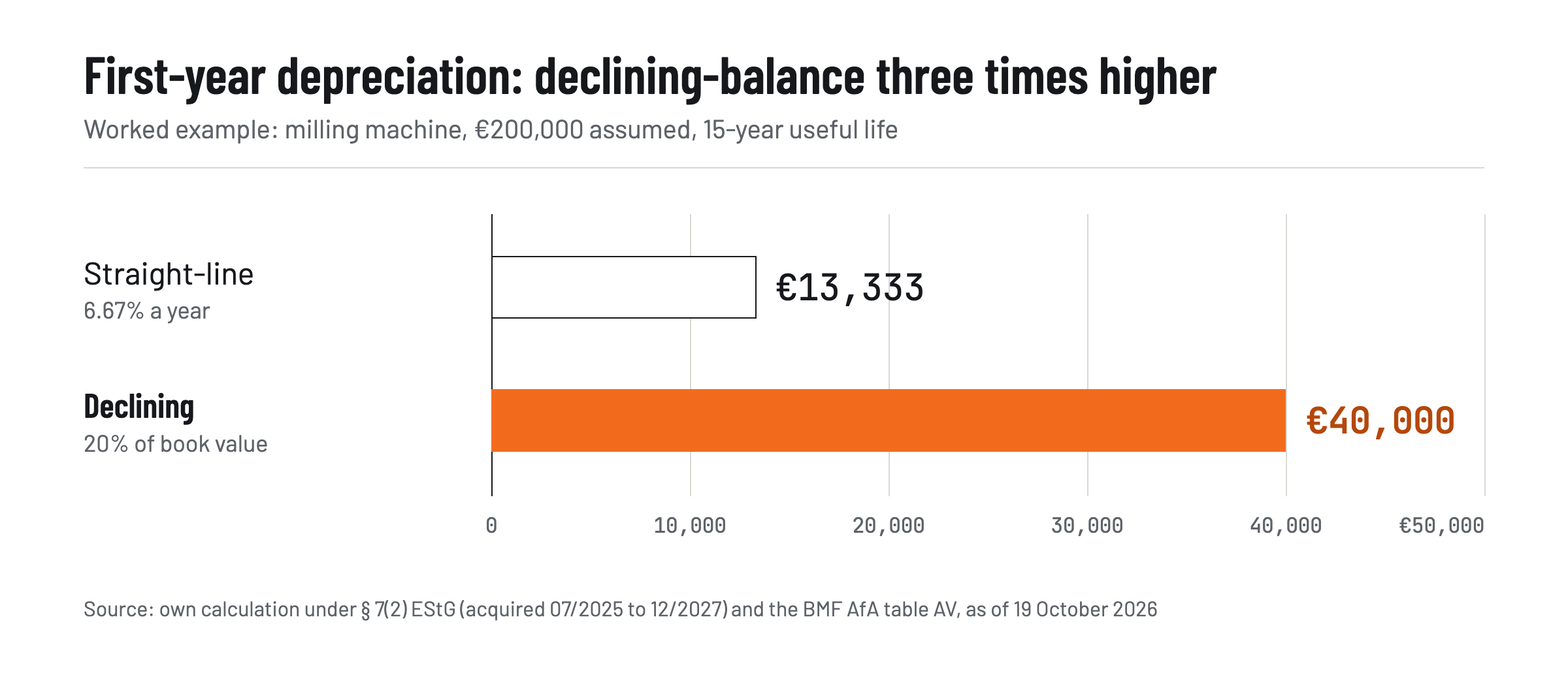
Worked example (own calculation, assumed purchase price): A stationary milling machine costs 200,000 euros, and the AfA table assumes a 15-year service life.[2] Straight-line, you may depreciate 13,333 euros per year, i.e. 6.67 percent (own calculation: one fifteenth). Declining-balance, the first year is 20 percent, i.e. 40,000 euros, because three times the straight-line rate stays below the 30 percent cap. The tax benefit therefore falls in the early years, when financing is also at its heaviest.
Small businesses can additionally make use of § 7g EStG. If profit is at most 200,000 euros, you may deduct up to 50 percent of the expected acquisition costs in advance as an investment deduction allowance.[4] In the year of acquisition and the four following years, special depreciation totalling up to 40 percent is also possible. One prerequisite, among others, is that the machine is used almost exclusively for business purposes at a domestic place of operation by the end of the following year.[4]
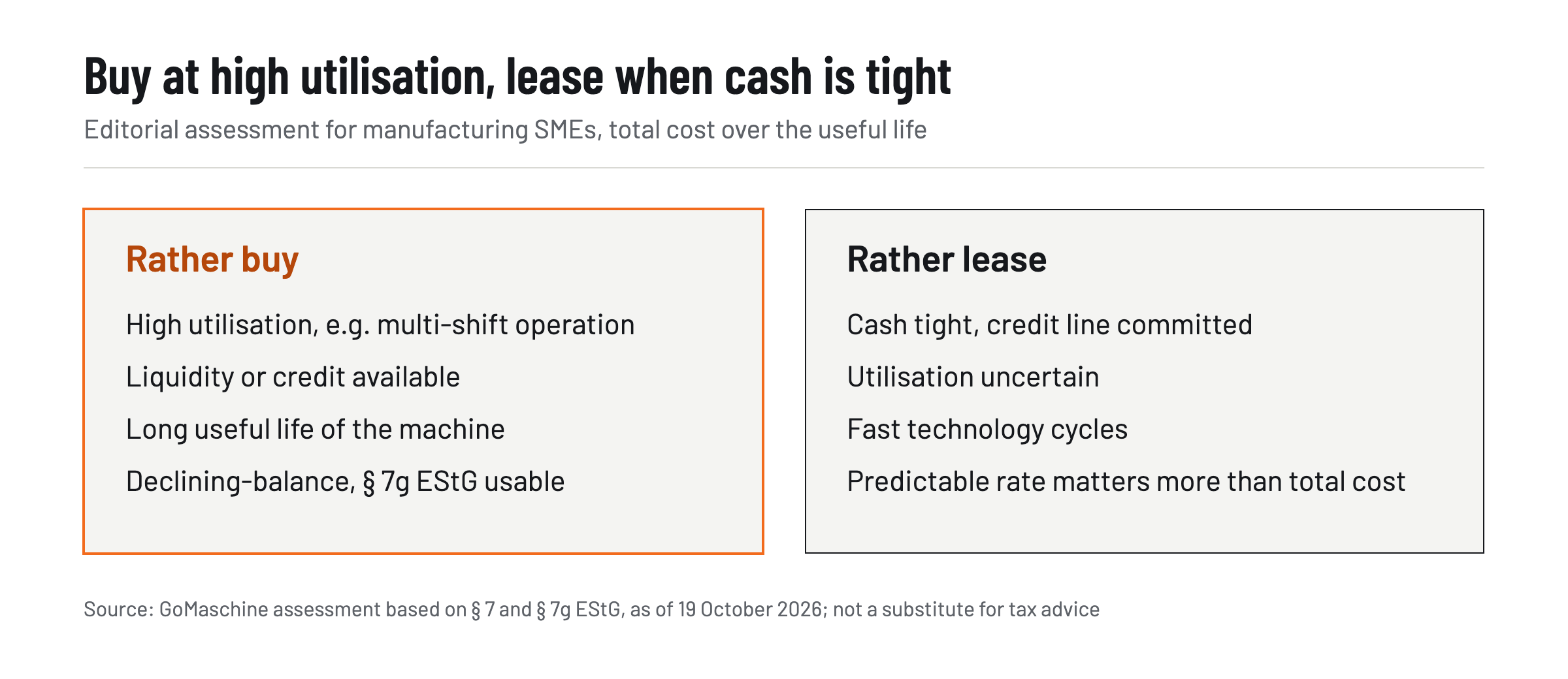
Leasing remains the better choice when liquidity is tight, the credit line is needed for other investments, or utilisation is uncertain. Work through both variants with your quotations and have the tax effects reviewed by your tax advisor. You can find further context in the Industry section on GoMaschine.
Frequently asked questions
Can I depreciate a leased machine on a declining balance?
As a rule, no. Depreciation belongs to the economic owner, and under standard leasing contracts that is the lessor. Instead, you record the leasing instalments as operating expenses.
Does the investment deduction allowance also apply to leasing?
No. The investment deduction allowance under § 7g EStG applies to the future acquisition or manufacture of your own movable assets. With leasing, the business does not acquire the machine itself.
Until when does the 30 percent declining-balance depreciation apply?
It applies to acquisitions from July 2025 to the end of 2027. After that, only straight-line depreciation applies again, unless the legislator decides otherwise.
When is leasing still worthwhile for an SME?
Leasing pays off when liquidity and the credit line should be conserved, utilisation is uncertain, or the technology becomes outdated quickly. In that case, the predictability of the instalment matters more than the lower total cost of buying.
Is hire purchase an alternative?
Hire purchase combines instalment payments with ownership at the end. Whether it is cheaper than buying on credit or leasing depends on the specific terms and should be included in a total cost comparison.
Sources
Related reading
All Procurement →Contract manufacturing: advantages, disadvantages and when it pays off
What contract manufacturing is, what an hour of milling costs and at what utilisation your own machine is cheaper: a guide for manufacturing SMEs.