Contract manufacturing: advantages, disadvantages and when it pays off
What contract manufacturing is, what an hour of milling costs and at what utilisation your own machine is cheaper: a guide for manufacturing SMEs.
In this article9
Contract manufacturing is the production of parts or process steps by an external company to the client's specifications, billed per piece or per hour. For executives of manufacturing SMEs, it is above all a make-or-buy question: does your own machine pay off at the utilisation you can realistically achieve? This article explains the term, the advantages and disadvantages, hourly rates and the CNC basics needed for a conversation with a contract manufacturer. All information reflects the status as of 23 October 2026; how GoMaschine selects and verifies sources is described in the editorial methodology.
What is contract manufacturing?
Contract manufacturing means that a company outsources part of its production or the entire manufacturing process to a subcontractor. The official classification of economic activities of the Federal Statistical Office of Germany (Destatis) refers to such activities as work carried out "on a contract basis". The client provides the technical specifications for the work on the workpieces; the workpieces or materials may or may not come from the client.[1]
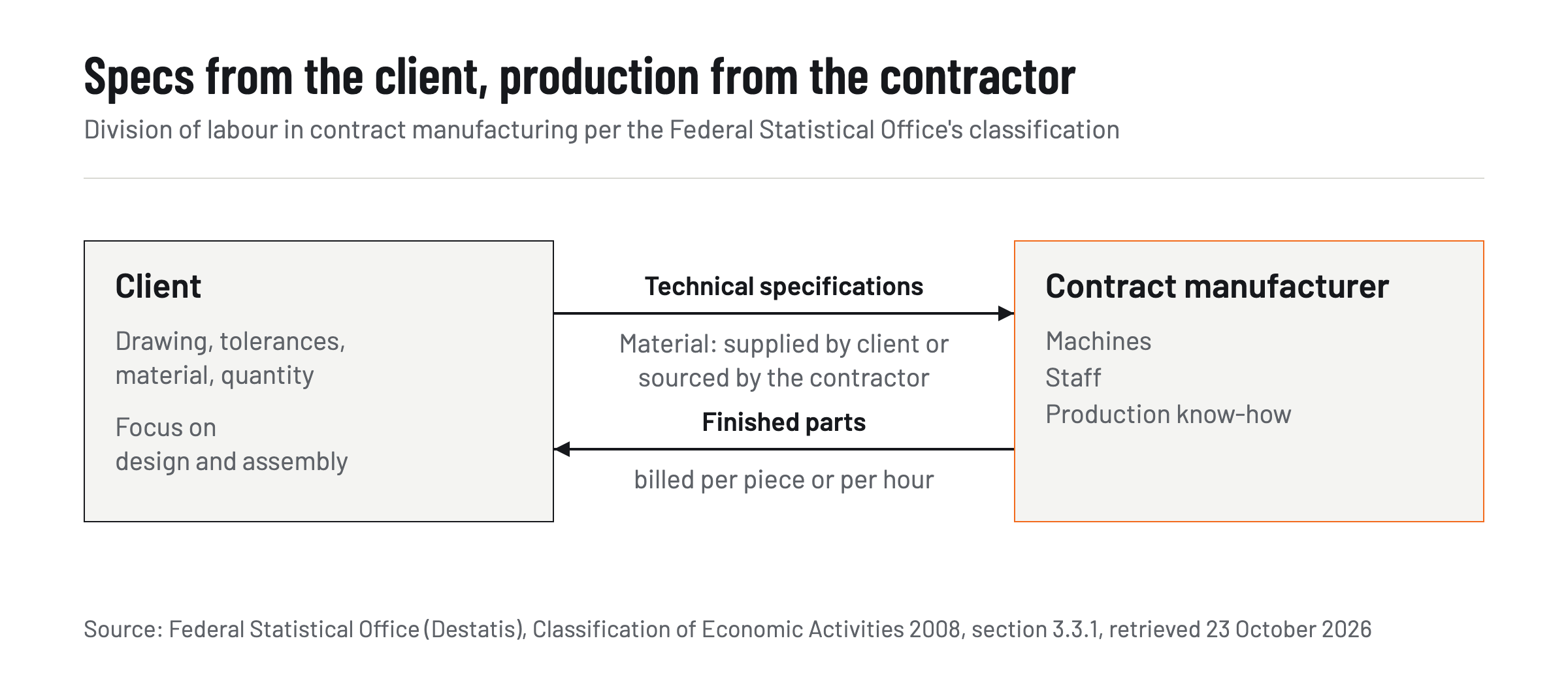
In metalworking this is the normal case. According to Destatis, the economic activity class "Machinery a. n. e. c." covers drilling, turning, milling, electrical discharge machining, grinding, welding and cutting metal by laser. The higher-level group describes this metalworking as activities that are typically carried out on a contract basis.[1] In mechanical engineering, contract manufacturing therefore frequently involves turned and milled parts, sheet-metal parts and welded assemblies that a manufacturer does not produce itself.
Advantages and disadvantages of contract manufacturing
The advantages of contract manufacturing lie in investment and capacity; the disadvantages lie in quality, delivery time and dependency. The procurement glossary of the software provider Tacto lists as advantages the elimination of investment in own equipment and the ability to adapt capacity to the order situation. As risks it names quality defects and delivery delays at the contract manufacturer, dependency and the loss of in-house production competence.[2] The table arranges these points according to the trade-offs a manufacturing company has to weigh.
| Criterion | Advantage of contract manufacturing | Disadvantage of contract manufacturing |
|---|---|---|
| Investment | No machine, no floor space, no financing | Unit price includes the contract manufacturer's margin and overhead |
| Capacity | Peaks and special processes can be covered | Lead time depends on the supplier's utilisation |
| Quality | Access to processes and metrology that are missing in-house | Inspection and release must be contractually defined and controlled |
| Know-how | Focus on design and assembly | Drawings and process knowledge leave the company; in-house competence erodes |
| Flexibility | No staff needed for fluctuating volumes | Changing supplier costs first-article inspection and time |
Many disadvantages can be mitigated with a second qualified supplier; the article on dual sourcing explains how this works in procurement.
What does an hour of milling cost?
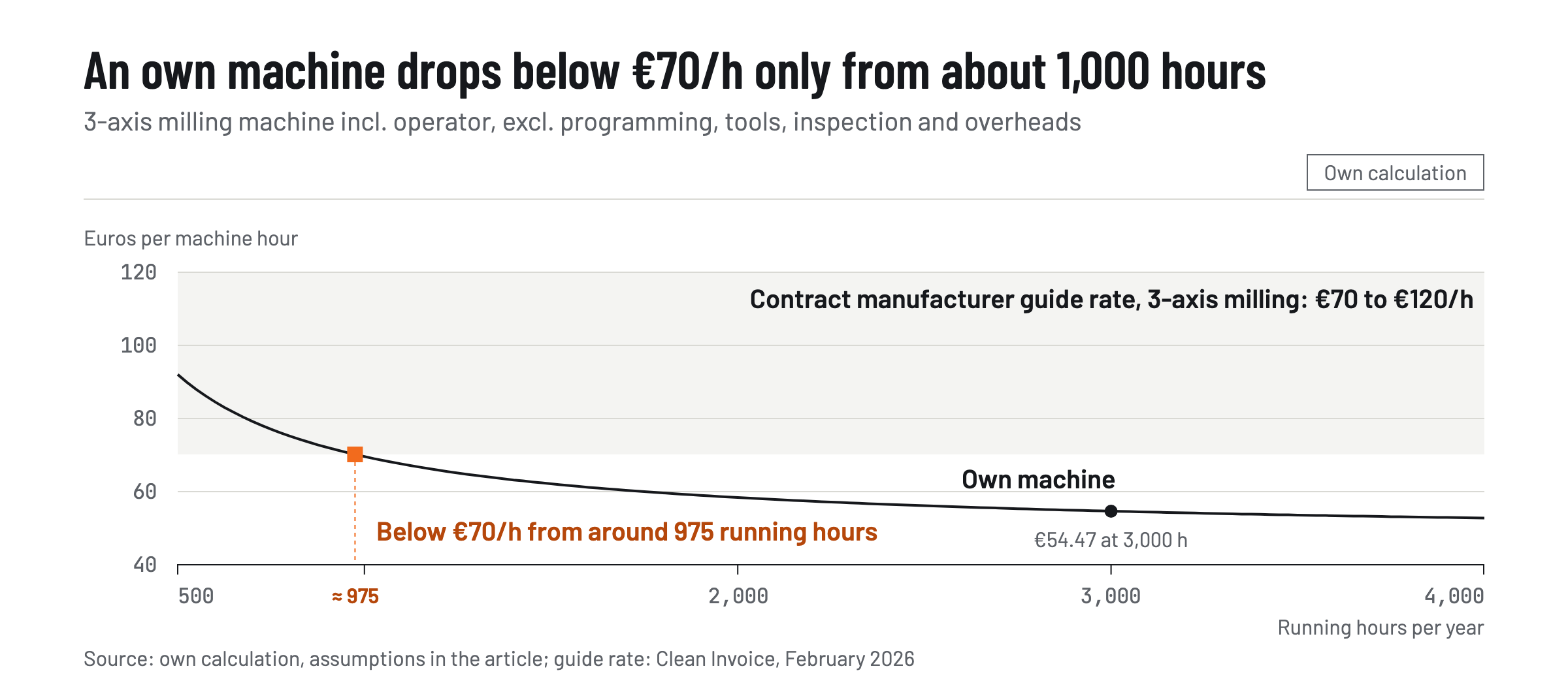
At a contract manufacturer in Germany, an hour of CNC milling costs, according to guideline figures from the Clean Invoice guide, 70 to 120 euros on a 3-axis machine and 100 to 160 euros on a 5-axis machine. For CNC turning, the same guide quotes (as of February 2026) 60 to 120 euros per hour. It states regional deviations of roughly 20 percent in either direction, but does not disclose the data basis for these figures.[3] Treat the ranges, therefore, as a reference point for a quotation, not as a market price.
Your own benchmark is the machine hourly rate. It divides the machine-dependent costs by the running hours; these include depreciation, imputed interest on half the capital tied up, and floor space, energy and maintenance costs.[4] For stationary milling machines, the German Federal Ministry of Finance's depreciation table assumes a useful life of 15 years, and for lathes 16 years.[5]
Worked example (own calculation, all figures assumed): a 3-axis milling machine costs 180,000 euros, is depreciated over 15 years and calculated with 5 percent interest. It occupies 20 square metres at 8 euros per month and incurs 4,000 euros of maintenance per year. It draws 10 kilowatts at 0.20 euros per kilowatt-hour, and the operator costs 45 euros per hour.
| Item | 1,000 running hours/year | 3,000 running hours/year |
|---|---|---|
| Depreciation (€12,000/year) | €12.00/h | €4.00/h |
| Interest (€4,500/year) | €4.50/h | €1.50/h |
| Floor space (€1,920/year) | €1.92/h | €0.64/h |
| Maintenance (€4,000/year) | €4.00/h | €1.33/h |
| Energy | €2.00/h | €2.00/h |
| Operator | €45.00/h | €45.00/h |
| Total | €69.42/h | €54.47/h |
The calculation shows the lever, not the result for your operation. At 1,000 hours per year, the in-house machine is already at the lower end of the contract manufacturer's range — and that figure still excludes programming, tools, fixtures, measuring equipment, scrap and overhead. At 3,000 hours, roughly two shifts, the same fixed-cost block is spread over three times as many hours. Only when you insert your own quotations and costs does it become clear which route is cheaper.
Does CNC have a future?
CNC has a future as the standard process for machining. The industry that builds the machines, however, is going through a difficult phase. In January 2026, the German Machine Tool Builders' Association (VDW) reported an 8 percent decline in production for 2025 and expects growth of 1 percent to 13.7 billion euros for 2026.[6] According to the VDW, output remains a fifth below the record year 2018 — 35 percent in price-adjusted terms.
Added to this is competition from China: according to the VDW, Chinese manufacturers increased their machine tool exports by 18 percent, and German manufacturers lost their leading position in exports to China.[6] The number of employees in companies with more than 50 staff fell by 3.9 percent to 63,300 by October 2025.
For the make-or-buy question, this yields no forecast for hourly rates. Editorially, however, a weak investment climate means that contract manufacturers compete for utilisation and quotations can be compared; therefore check prices with at least two enquiries.
What does the abbreviation CNC stand for?
CNC stands for Computerized Numerical Control. Dassault Systèmes writes "Computer Numerically Controlled" in its manufacturing guide.[7] It refers to a machine tool whose movements are derived by a computer from a program, rather than being guided by hand by an operator. In quotations from contract manufacturers, the abbreviation usually appears as a process specification, such as "CNC milling" or "CNC turning", often supplemented by the number of axes.
What is the difference between CNC and NC?
NC is the older numerical control, which read its instructions from a data carrier such as a punched tape. With CNC, a computer in the control unit processes the program, which can be stored and modified at the machine. The first NC milling machines emerged from 1949 onwards out of a collaboration between Parsons Corporation and the Massachusetts Institute of Technology. They received their instructions via perforated paper tape; from 1960, direct numerical control transferred programs from the computer to the machine.[7]
The program format has remained the same. A program according to DIN 66025 consists of individual blocks with a block number, as described for example in the documentation of the CODESYS control software. It contains path commands such as G1 for a straight line or G2 for a circular arc.[8] This is why workshops still speak of the "NC program" even though the machine has a CNC control. For collaboration with a contract manufacturer, the label matters less than the question of in which format you hand over drawings and 3D data.
Is CNC programming difficult?
CNC programming can be learned, but only those who also understand machining master it professionally. According to IHK Rostock, the apprenticeship as a cutting machine operator takes three and a half years; the occupational profile includes programming CNC-controlled machine tools and setting up machines and production systems.[9]
The real difficulty rarely lies in the commands. It lies in the clamping concept, tool selection, cutting parameters and the inspection of the first part. For the make-or-buy decision, this is a cost item that appears in no machine quotation: anyone who buys their own machine needs skilled staff who can program, set up and represent the process. A contract manufacturer brings this personnel and charges for it in the hourly rate.
What is contract manufacturing?
In practice, contract manufacturing is usually one of several related terms that differ mainly in who owns the material and how permanent the collaboration is. The official classification even makes the ownership question a criterion. Anyone who outsources the entire production process only counts as part of the manufacturing industry if they own the materials used and thus the result.[1]
| Term | Typical meaning in practice | Who owns the material |
|---|---|---|
| Contract manufacturing | External production of parts according to your drawing | You or the contract manufacturer, depending on the contract |
| Contract machining | Machining of parts supplied to the manufacturer, e.g. milling a cast blank | You |
| Order-based production | Production only after a customer order instead of for stock | The manufacturer |
| Extended workbench | Permanent integration of a supplier into your production planning | Depending on the contract |
| Outsourcing | Outsourcing of entire business processes, not just individual parts | Depending on the contract |
When contract manufacturing pays off
Contract manufacturing usually pays off when at least two of these conditions apply:
- The utilisation of an in-house machine would remain permanently low or fluctuates strongly.
- The process is not available in-house, for example 5-axis milling, EDM or hardening.
- Volumes arrive as peaks that your core workforce cannot cover.
- The parts contain no process knowledge that constitutes your competitive advantage.
Arguments against contract manufacturing are when the machine could be planned to run beyond a single shift, when short response times matter, or when the part carries your core production know-how. Supplier selection, quotation comparison and contractual issues such as quality, liability and tool ownership are separate topics in the Procurement section.
Alternative: a used CNC machine
If you want to manufacture in-house but shy away from the investment, you will often consider a used CNC machine. Its advantages are the lower price and usually a shorter delivery time; its disadvantages are unknown wear on guideways and spindle, a possibly discontinued control system and little or no warranty. The guide to buying a CNC milling machine for metal shows what to look for in terms of axis count, accuracy and service. Whether an older machine can be kept in use with a new control system is covered in the article on machine retrofit, and whether buying or leasing is cheaper is addressed in the comparison lease or buy a machine.
Decide with numbers, not gut feeling. Obtain two quotes from contract manufacturers for a typical part and calculate your own machine hourly rate using the utilisation you realistically expect. Compare both figures including programming and inspection. Further context on manufacturing, procurement and automation can be found in the Industry section on GoMaschine.
Frequently asked questions
Who supplies the material in contract manufacturing?
That is governed by the contract. In contract machining you supply the blanks; in contract manufacturing in the broader sense, the contract manufacturer may also procure the material and include it in the unit price.
Is contract manufacturing billed per piece or per hour?
Both are common. Individual parts and prototypes are often calculated per machine hour, while series parts are usually quoted as a unit price that includes setup time, material and inspection.
At what utilisation does an in-house CNC machine pay off?
There is no fixed threshold. The more hours the machine runs per year, the lower its hourly rate; calculate your figure with realistic utilisation and compare it with concrete quotes.
What should you send a contract manufacturer to get a quote?
A dimensioned drawing with tolerances and material, a 3D model if available, the quantity per call-off and per year, and your requirements regarding surfaces, inspection and documentation.
Is contract manufacturing the same as outsourcing?
No. Contract manufacturing places individual parts or operations with external partners according to your specifications, while outsourcing moves entire business processes out of the company — for example the complete production function including planning and procurement.
Sources
Related reading
All Procurement →Lease or buy a machine: which is cheaper for SMEs
Leasing or buying a machine: which is cheaper for SMEs? Costs, tax rules and the key factors in the decision, explained clearly.