Automated Small Parts Warehouse (AKL): Costs, Advantages and Disadvantages
What an automated small parts warehouse costs, where its drawbacks lie and when it pays off for manufacturing SMEs, with project figures and the calculation.
In this article8
- What are the disadvantages of an automated small parts warehouse?
- How much does an automated small parts warehouse cost?
- What warehouse systems are there?
- What are the 3 warehouse types?
- What different warehouse systems are there?
- What is "Automatisches Kleinteilelager" in English?
- Frequently asked questions
- Sources
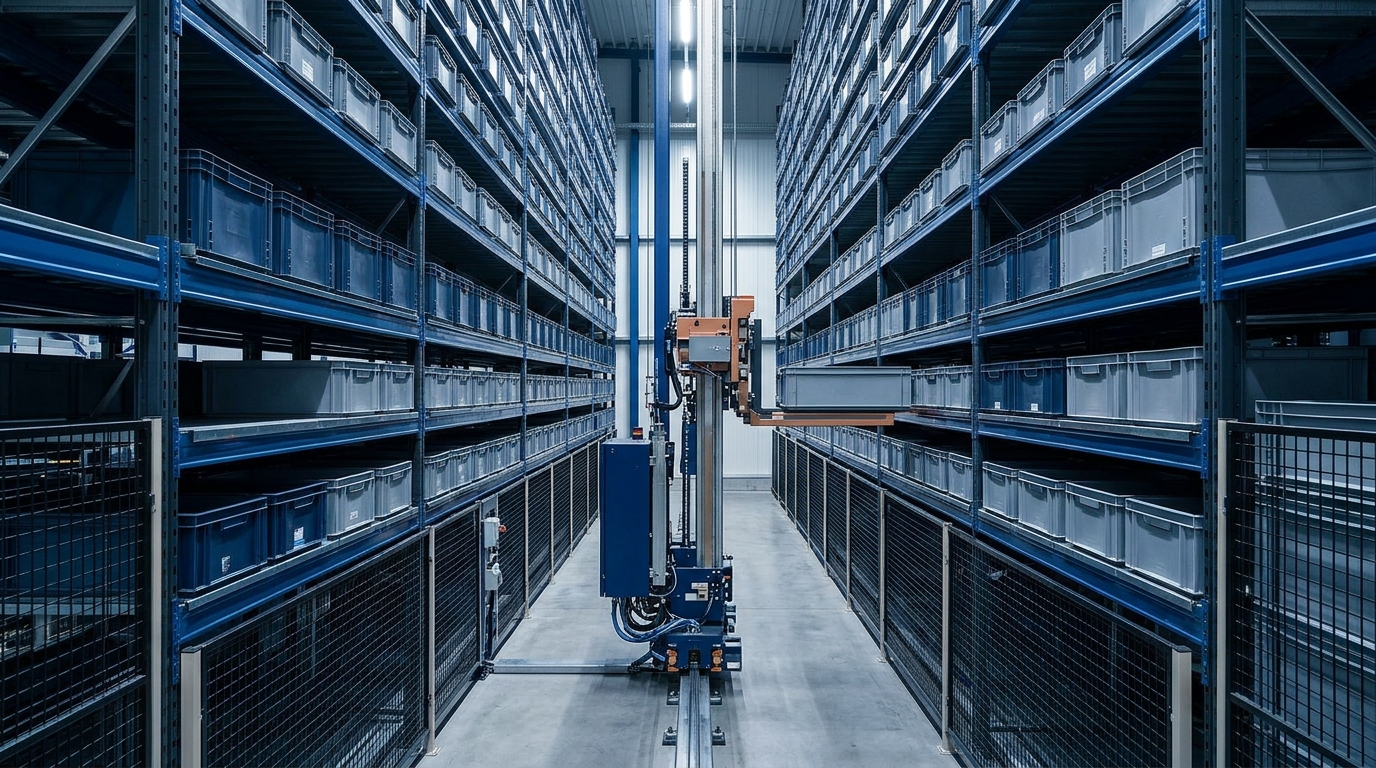
An automated small parts warehouse pays off when many small items in containers must be available quickly and frequently and floor space is scarce. The storage and retrieval machine (SRM) brings the container to the workstation instead of staff walking to the rack. The price is an investment that, in published projects, ranged between 3.4 and 8 million euros. Added to this is a system with fixed load carriers, fixed aisles and its own maintenance. The article first puts the disadvantages into context, then examines the costs using published projects with the calculation shown, and finally positions the AKL among other warehouse systems.
What are the disadvantages of an automated small parts warehouse?
The disadvantages of an automated small parts warehouse lie in the high initial investment, the commitment to specific load carriers, the dependence on technology and maintenance, and the structural requirements. The FEM 9.832 guideline of the European Federation of Materials Handling describes the structure: The storage units are usually kept in load carriers such as boxes, storage bins and cassettes, and storage and retrieval machines handle storage and retrieval automatically.[1] Most of the limitations follow from this structure.
Investment. An automated solution requires higher investment costs than a manual one; how much depends on the degree of automation. This is stated by the general contractor Unitechnik in the trade journal f+h — in other words, a supplier of such systems.[2] According to the same source, the payback comes mainly from higher throughput without additional staff, primarily in multi-shift operation. A single-shift operation with few retrievals therefore has a harder time carrying the investment.
Fixed load carriers. An automated warehouse works with defined load carriers; because containers have fixed dimensions and a maximum weight, later changes to the item spectrum are sometimes restricted, according to Unitechnik.[2] FEM 9.832 names plastic and metal containers, trays, rigid plates and carton boxes as load carriers; as a rule, a specific load carrier requires a matching load-handling device on the SRM.[1] Anyone who plans only for containers today but must store bulky parts tomorrow needs a second warehouse alongside it.
Technology and maintenance. Like any technology, the system can fail; Unitechnik names trained maintenance personnel as a success factor, and operating errors and improper loading as frequent causes of faults.[2] In a classic AKL, one SRM serves each aisle. If that machine is down, our editorial assessment is that the containers in that aisle are inaccessible until the repair is complete. An operation with only one or two aisles should therefore clarify the response time of the service contract before ordering.
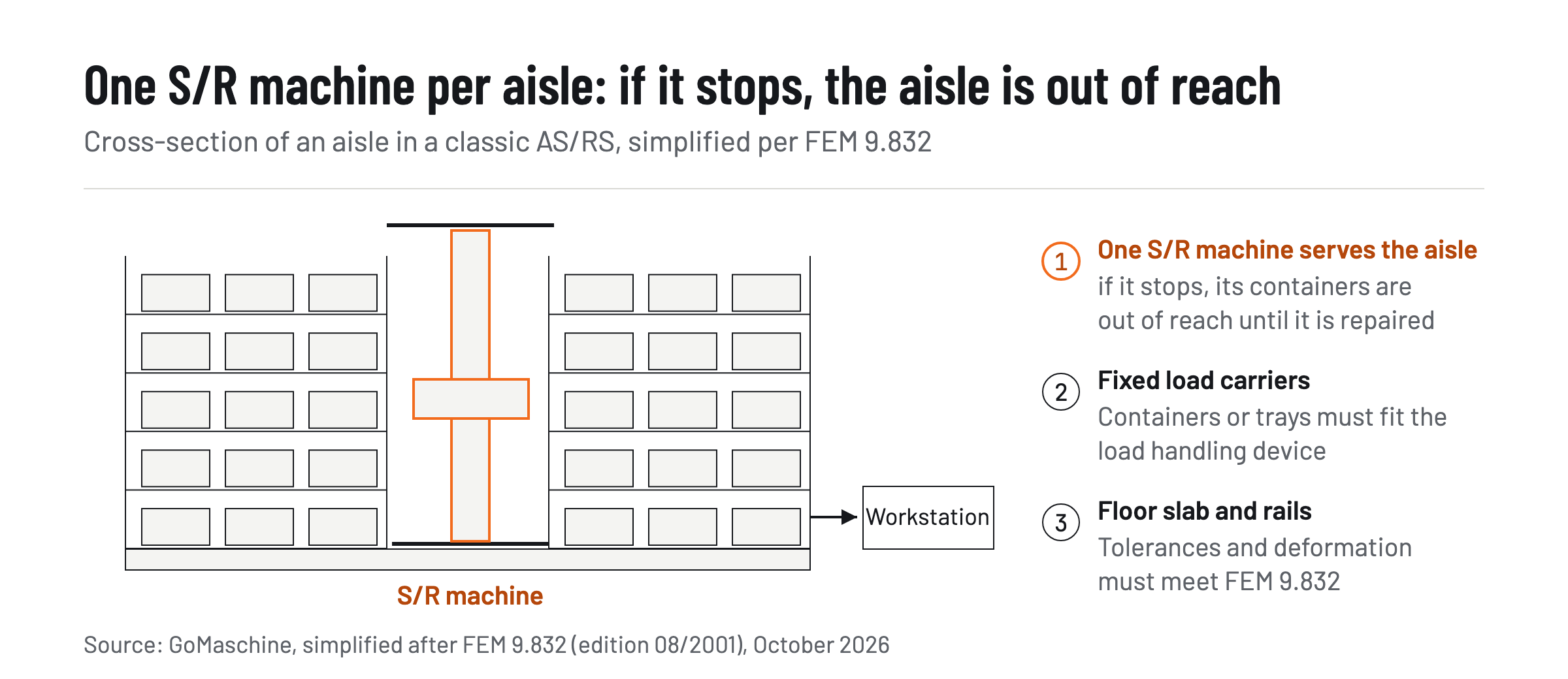
Construction and tolerances. FEM 9.832 lists the parts whose tolerances and deformations interact: the subsoil, floor slab, travel and guide rail, load carrier, rack structure and the SRM itself.[1] In an existing hall, it is therefore necessary to check before planning whether the floor slab meets the requirements.
These drawbacks are offset by advantages that the sources also mention:
| Criterion | Advantage | Drawback |
|---|---|---|
| Footprint | tall racks on a small ground area; at Belimo, SRMs 21 metres high | the hall needs a suitable height and floor slab |
| Throughput | at Belimo up to 280 containers per aisle and hour (vendor specification) | output per aisle is tied to one SRM |
| Staff | goods come to the workstation, fewer walking distances | maintenance requires trained personnel |
| Costs | amortisation through throughput in multi-shift operation | investment in the millions range |
| Flexibility | output can be increased with an additional load-handling device | load carriers and product range are fixed |
The Belimo figures come from a project announcement about the logistics centre that TGW Logistics built in Shanghai: a two-aisle automated small parts warehouse with more than 11,000 double-deep storage positions.[3] The subsequent performance increase via an additional load-handling device is described by Unitechnik.[2]
How much does an automated small parts warehouse cost?
Based on published project figures, an automated small parts warehouse costs a mid single-digit million amount; there is no public list price, because every system is planned according to number of positions, height, aisles and throughput. The following projects state an investment sum and the size of the system:[4]
| Project | Status | Investment | Size | Performance |
|---|---|---|---|---|
| Škoda, Mladá Boleslav | November 2018 | around €8 million for construction of the automated small parts warehouse[4] | 71,000 small load carriers, 2,000 m², 14 m rack height[4] | up to 580 containers per hour[4] |
| Haver & Boecker | May 2008 | around €3.4 million for the entire project[5] | 6,600 trays in 2 aisles, plus a high-bay warehouse with 1,200 positions and a heavy-duty rack[5] | 2 SRMs with 78 double cycles per hour each[5] |
Sources: press release from Škoda[4] and report by VerkehrsRundschau on the project at Haver & Boecker.[5]
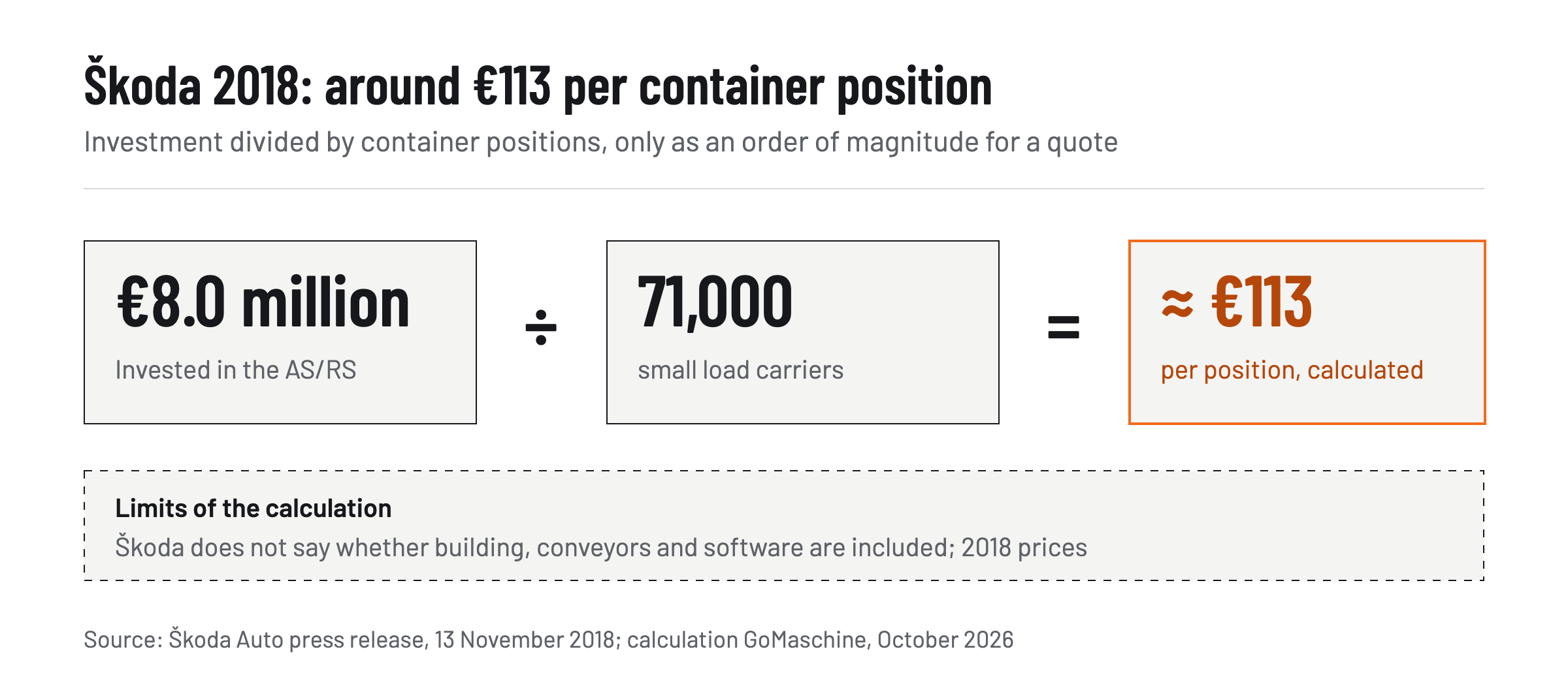
If the Škoda investment is converted into container positions, a rough rule of thumb emerges: around eight million euros divided by 71,000 small load carriers gives around €113 per container position, price level 2018.[4] This calculation has limits. The press release does not break down whether the hall, conveyor technology and software are included, and prices have changed since 2018. At Haver & Boecker, the sum covers not only the automated small parts warehouse but also the high-bay warehouse and heavy-duty rack, so a conversion to tray positions would be set too high.[5] For an own project, the value is only useful for checking the order of magnitude of a quotation.
What drives the costs can be read from the project data:
- Number of locations and size advantage: More locations spread the fixed costs of the SRM, controls and pre-zone across more containers.
- Aisles and machines: Every aisle needs its own SRM. Haver & Boecker managed with two aisles and two machines; more throughput means more machines or additional load-handling devices.
- Load carriers: Trays or containers, single- or double-deep storage determine the rack and the load-handling device.
- Pre-zone and software: Picking stations, conveyor technology and the connection to the warehouse management system or the ERP warehouse module come on top of the rack.
- Construction: Floor slab and hall must meet the tolerances specified in FEM 9.832.
On payback there are above all manufacturer figures. AutoStore CEO Karl Johan Lier stated in 2022 a typical payback period of one to three years for his company's cube-shaped container system.[6] That is a vendor figure for a different system design than an AKL with SRM, not an independently verified value. For your own calculation, what counts are the staff hours saved per shift, the hall space gained and the costs for maintenance and energy. How purchasing and financing a system affect liquidity is covered in the article leasing or buying a machine.
What warehouse systems are there?
Warehouse systems can be classified by design into floor storage, rack storage and automated warehouses; the AKL belongs to the automated small-parts rack warehouses. This classification is an editorial overview, not a standard:
| Group | Examples | Typical load unit | Operation |
|---|---|---|---|
| Floor storage | Block and row storage | Pallets, wire mesh containers, large parts | Forklift, manual |
| Static rack storage | Shelving racks, pallet racks, cantilever racks | Cartons, pallets, long goods | manual or forklift |
| Dynamic rack storage | Flow-through and sliding racks | Pallets, containers | manual or forklift |
| Automated warehouses | High-bay warehouses for pallets, small parts warehouses for containers (designs further below) | Pallets or containers and trays | Storage and retrieval machine or other conveyor technology |
The different types of pallet racks are covered in a separate article. For choosing between the groups, three factors matter most: how heavy and how large is the load unit, how often is it accessed, and how much floor space is available? For a warehouse with few heavy items, pallet racks and a forklift are more likely to fit; the inspection points for that are covered in the article on used forklifts.
What are the 3 warehouse types?
The three warehouse types by their function in operations are material warehouse, buffer warehouse and distribution warehouse. The Lexikon der Wirtschaft (Duden Wirtschaft, 6th edition 2016, published by the Bundeszentrale für politische Bildung) describes the warehouse as the area of a company in which raw, auxiliary and operating materials as well as semi-finished and finished products are stored.[7] It distinguishes:
- Material warehouse: goods for production, i.e. raw materials, purchased parts, auxiliary and operating materials.
- Buffer warehouse: production-related warehouses that follow on from the material warehouse, for example for semi-finished parts between two manufacturing steps.
- Distribution warehouse: finished products that remain in stock until sale.
Warehouse type and warehouse system are two different questions. An AKL can take on any of the three roles: at Škoda it supplies assembly with small parts and thus operates as a material warehouse.[4] At Belimo in Shanghai, according to the project announcement, the AKL is intended to supply production and deliver to customers quickly at the same time.[3]
What different warehouse systems are there?
For small parts in containers, besides the AKL with a storage and retrieval machine, the main options are shuttle warehouses, container cubes with robots, and lift systems and carousels. The systems differ in who moves the containers and how throughput can be expanded:
| System | What moves the containers | Expanding throughput |
|---|---|---|
| AKL with SRM | one storage and retrieval machine per aisle | additional load-handling device or another aisle |
| Shuttle warehouse | vehicles on the rack levels | via the number of vehicles |
| Container cube | robots on a grid above stacked containers | via robots and workstations |
| Lift system, carousel | lift or rotating compartments in one unit | another unit |
Unitechnik describes how shuttle warehouses scale via the number of vehicles, while classic SRM warehouses scale via an additional load-handling device.[2] In the container cube, robots travel on a grid and bring containers to workstations, as the description of the AutoStore system shows.[6] According to an overview by the trade magazine Modern Materials Handling from 2011, carousels and vertical lift modules also count among the storage technologies that are sometimes likewise referred to as AS/RS, i.e. automated storage and retrieval systems.[8] A detailed comparison of shuttle warehouse, AutoStore and paternoster is covered in a separate article.
For pallets, the automated high-bay warehouse is the counterpart to the automated small parts warehouse. According to Unitechnik, combining the two has proven its worth: pallets and large parts in the high-bay warehouse, small parts in the automated small parts warehouse.[2] Haver & Boecker implemented exactly this split with an automated small parts warehouse for 6,600 trays and a high-bay warehouse for 1,200 pallets and wire mesh containers.[5]
What is "Automatisches Kleinteilelager" in English?
In technical English, an automated small parts warehouse is usually called a mini-load AS/RS, short for mini-load automated storage and retrieval system. Modern Materials Handling distinguishes it from the unit-load AS/RS: unit-load systems store loads of 1,000 pounds and more, usually on pallets, while mini-load systems store lighter loads under 1,000 pounds in trays, totes or cartons.[8] 1,000 pounds is roughly 454 kilograms. The trade magazine also points out that vendors use many different names for these systems.
Besides the technical term, the literal translation is also common. In its English press release, Škoda calls its facility an "automatic small parts warehouse".[9] When submitting an enquiry to international vendors, it is best to state both terms and add the load carrier, dimensions and weight per container.
Before submitting an enquiry, a short stocktaking within your own operation is worthwhile: number of articles and containers, peak accesses per hour, shift model, hall height and the condition of the floor slab. With these figures, a quotation can be checked against the project values above. Further analysis of intralogistics and investments can be found in the Industry section on GoMaschine.
Frequently asked questions
What is an AKL?
AKL stands for automatisches Kleinteilelager, the German term for an automated small parts warehouse. Containers, boxes or trays are automatically stored and retrieved there by storage and retrieval machines (SRMs) and brought to workstations.
When does an automated small parts warehouse pay off?
It tends to pay off with many articles in uniform containers, frequent accesses and multi-shift operation, because the investment is recouped mainly through higher throughput without additional staff. With few accesses per shift, the investment is harder to justify; in that case, manual racking should be considered.
What does a container position in an automated small parts warehouse cost?
There is no public list price. Based on Škoda's investment in 2018, the arithmetic works out to roughly 113 euros per container position; the press release does not state exactly what the sum includes.
What is the difference between an automated small parts warehouse and a shuttle warehouse?
In an automated small parts warehouse, a storage and retrieval machine (SRM) serves an entire aisle; in a shuttle warehouse, vehicles travel on the individual rack levels. A shuttle warehouse can be expanded by adding vehicles.
Which standard applies to automated small parts warehouses?
For tolerances, deformations and clearance dimensions, the FEM 9.832 guideline of the European Materials Handling Federation applies. It applies to automated small parts warehouses with storage and retrieval machines on a travel rail with an upper guide rail.
Sources
Related reading
All Intralogistics →WMS system or ERP warehouse module: When a dedicated WMS pays off
WMS system or ERP warehouse module? The distinction under VDI 3601, cost examples as of October 2026 and five criteria for manufacturing SMEs.
Buying a used forklift: inspection points and prices
Buying a used forklift: inspection points, typical operating hours and used prices at a glance, plus transport costs - each with source and date.