WMS system or ERP warehouse module: When a dedicated WMS pays off
WMS system or ERP warehouse module? The distinction under VDI 3601, cost examples as of October 2026 and five criteria for manufacturing SMEs.
In this article9

Anyone looking for a WMS system usually faces a question of distinction: Is the warehouse module in the existing ERP sufficient, or does the operation need a dedicated warehouse management system? The answer depends less on the software brand than on the tasks in the warehouse. An ERP manages stock as part of purchasing, production and accounting. A WMS controls what physically happens in the warehouse: which location is occupied, which route is short, and which transport handles the order.
What does WMS mean for shoes?
For shoes, WMS refers to the children's foot measuring system (Kinderfußmess-System) of the Deutsches Schuhinstitut (DSI) and has nothing to do with warehouse management. According to the DSI, it has been a quality seal for well-fitting children's shoes for over 40 years.[1] The system distinguishes three widths: W for wide, M for medium and S for narrow feet; the multi-width system has carried the name WMS since 1974.[2] Shoe manufacturers can acquire the certificate and thereby commit to the WMS guidelines.[2]
In the Deutscher Kinderfußreport 2020, according to the DSI, 82 percent of the worn WMS shoes fitted, compared with 73 percent for shoes without the WMS seal.[1] This is a statement by the institute that awards the seal itself. In the rest of this article, WMS stands for warehouse management system, i.e. software for the warehouse.
How much does a WMS system cost?
What a WMS system costs depends first on the licensing model: standalone warehouse software is frequently billed by order volume, an ERP warehouse module usually per user. Two publicly listed pricing models illustrate the difference; all figures are manufacturer specifications from the vendors' pricing pages, as of October 2026:
| Offer | Billing | List price |
|---|---|---|
| weclapp ERP Trade, including warehouse management and mobile warehouse app | per user and month, net | 163 to 179 euros depending on term[3] |
| weclapp Warehouse, single licence for staff working only in the warehouse | per user and month | from 49 euros[3] |
| Picqer Team, standalone warehouse software | per month, 3,000 orders included[4] | 379 euros, each additional order 0.28 euros[4] |
These examples are neither a recommendation nor a market average; they only show which metric is used for billing. With the ERP module, the price grows with the number of users; with order-based warehouse software, with shipping volume. Picqer includes an unlimited number of users in all plans.[4] Implementation, interfaces to conveyor technology and shipping providers, and scanner hardware come on top in many projects. Licence models and implementation costs in detail are a topic of their own and are deliberately not explored further here.
What is SAP Warehouse Management?
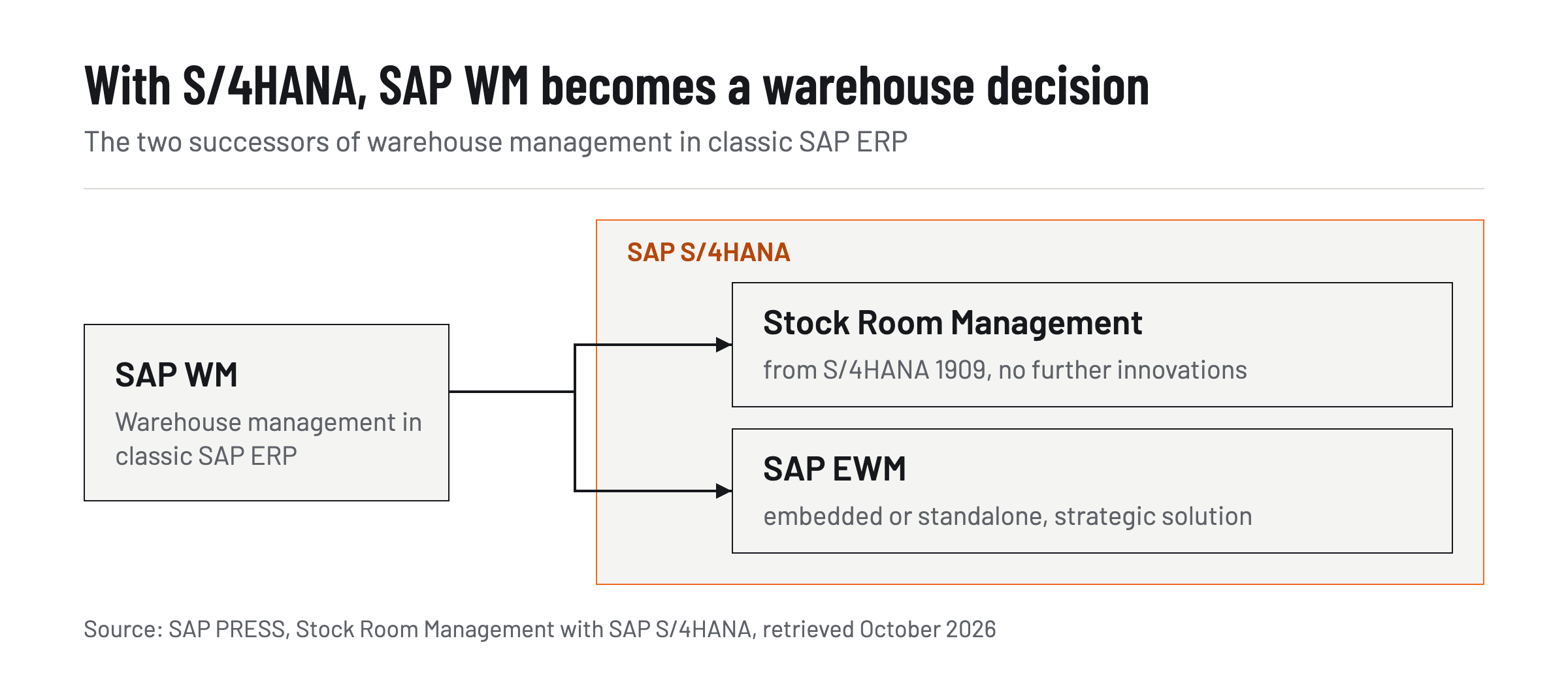
SAP Warehouse Management (WM) is the warehouse management component in classic SAP ERP; SAP S/4HANA offers two successors. According to the SAP specialist publisher SAP PRESS, Stock Room Management is only available from SAP S/4HANA 1909 onwards, and SAP is not planning any further innovations for it.[5] SAP Extended Warehouse Management (SAP EWM), including the variant embedded in S/4HANA, is regarded there as the strategic solution that SAP recommends to all new customers.[5]
For a manufacturing SME running classic SAP WM, this means: the migration to S/4HANA forces a warehouse decision. Which variant fits is decided by the same criteria as the question of ERP module versus a dedicated warehouse management system; they follow below.
What is the definition of a warehouse management system?
According to the VDI 3601 guideline, a warehouse management system (WMS) is an IT system that manages and optimises in-house storage and transport systems.[6] The guideline, September 2015 edition, defines Warehouse Management as the administration, control and optimisation of storage and distribution systems, including quantity and storage location management as well as transport control and dispatch planning. This includes methods for monitoring system states and selectable strategies for operation and optimisation.
The VDI also names a prerequisite: the underlying systems must deliver throughput, data quality and stability for the WMS to fulfil its task.[6] A WMS is therefore not a substitute for clean master data and functioning scanners — it presupposes them.
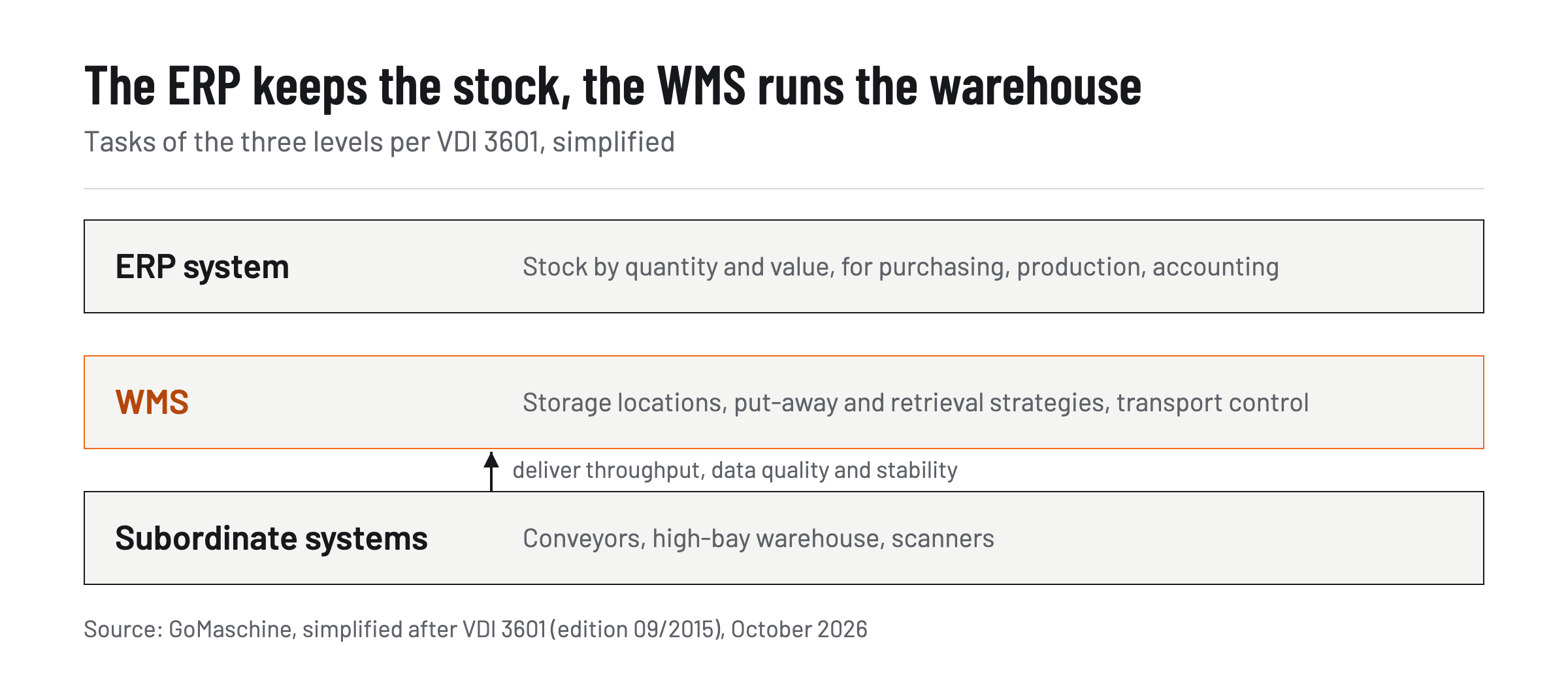
SAP distinguishes three types of WMS software: standalone systems on their own hardware, cloud-based SaaS offerings, and applications delivered as part of an ERP or supply chain solution.[7] In this classification, the ERP warehouse module is the integrated variant; so the question is not ERP or WMS, but how much warehouse control the ERP itself should perform.
ERP warehouse module and WMS compared
The following comparison is an editorial assessment based on the tasks defined in VDI 3601. The functional scope of individual ERP warehouse modules varies considerably; many offer storage locations and mobile data capture.
| Task | Typical in an ERP warehouse module | Core of a WMS according to VDI 3601 |
|---|---|---|
| Stock by quantity and value | yes, as part of purchasing, production and accounting | yes, with reference to the physical location |
| Storage location management | depending on the system, often basic | yes, quantity and storage location management |
| Transport control and dispatch planning | rare | yes |
| Strategies for putaway, removal and picking | limited | yes, selectable strategies |
| Monitoring of system states | via reports | continuous, with control methods |
What is warehouse management?
Warehouse management is the administration of all stock in a warehouse by type, quantity, value and storage location, from putaway to removal. VDI 3601 counts quantity and storage location management as part of Warehouse Management, which additionally covers the control and optimisation of storage and distribution systems.[6] In manufacturing, warehouse management covers raw materials, purchased parts, semi-finished goods and finished products, often at several locations such as goods receipt, production supply and shipping. How conveyor technology and industrial trucks in intralogistics interact determines how much control the warehouse needs.
When a dedicated WMS is needed
In our editorial assessment, a dedicated WMS becomes necessary when at least one of these five criteria applies:
- Automated conveyor technology: A high-bay racking system, shuttle or conveyor technology must be controlled. According to VDI 3601, transport control and dispatch planning are part of warehouse management.
- A large number of storage locations with chaotic storage: If items have no fixed location, rule-based slot assignment is required.
- Picking by strategy: Multi-stage picking or route optimisation go beyond mere stock keeping.
- High order volume: The more orders leave the warehouse each day, the more every avoided walking distance counts.
- Media breaks in the warehouse: The ERP vendor Proalpha cites printouts that are manually typed into another system at goods receipt as a sign of an ERP system that is holding operations back.[8]
The age of the ERP also plays a role. According to a Trovarit study cited by Proalpha, the average ERP system in 2020 had been installed 11.3 years earlier; older releases usually support mobile devices poorly.[8] If an ERP change is on the horizon anyway, that is the moment to decide the warehouse question as well, rather than later connecting a WMS to a legacy system. A similar trade-off between keeping existing equipment and buying new is covered in the article on machine retrofit.
Is SAP a warehouse management system?
SAP is not a warehouse management system but a software vendor whose ERP systems contain warehouse functions and which offers its own WMS with SAP EWM. SAP itself describes SAP EWM as a flexible warehouse management system (WMS) that controls processes for large warehouse volumes and can directly control equipment for warehouse automation (manufacturer's specification).[9]
When people refer to “SAP” as warehouse management, they therefore usually mean one of three things: the warehouse module in the ERP, the classic SAP WM, or SAP EWM. For a decision in your operation, it is worth naming precisely which component is meant, because the functional scope and the future of the three differ.
How can I control my inventory?
You control your inventory through a physical inventory, which the German Commercial Code (HGB) requires of merchants, and through continuous reconciliation between book stock and storage location. Under Section 240 HGB, an inventory must be drawn up at the end of each financial year, and the financial year may not exceed twelve months.[10] For regularly replaced raw, auxiliary and operating materials of secondary importance, Section 240 (3) HGB permits a fixed value; in that case, a physical stocktaking is generally required every three years.[10]
Section 241 HGB regulates three inventory simplification procedures:[11]
| Procedure | Legal basis | Condition |
|---|---|---|
| Sample-based inventory | Section 241 (1) HGB | recognised mathematical-statistical methods; evidential value equivalent to a physical stocktaking |
| Procedure without a stocktaking on the reference date, in practice perpetual inventory | Section 241 (2) HGB | stock by type, quantity and value is also secured without a physical count on the reference date |
| inventory brought forward or deferred | Section 241 (3) HGB | special inventory for a single day within the last three months before or the first two months after the end of the financial year |
For the software, this means: anyone who books every movement down to the exact storage location creates the basis for the perpetual inventory under Section 241 (2) HGB. Whether a procedure complies with the principles of proper bookkeeping is a question for your tax adviser or auditor, not for the software vendor. Further assessments on procurement and investment, such as the question of leasing or buying a machine, can be found in the Industry section on GoMaschine.
Frequently asked questions
What is the difference between ERP and WMS?
An ERP manages stock as part of purchasing, manufacturing, sales and accounting. A WMS controls and optimizes the warehouse itself — storage locations, travel distances, picking and conveyor technology.
What does the abbreviation LVS stand for?
LVS stands for Lagerverwaltungssystem, the German term for a warehouse management system.
Does a small warehouse need its own WMS?
A small warehouse with fixed storage locations, no automated conveyor technology and a manageable order volume can usually get by with the ERP warehouse module. A dedicated WMS only pays off once control and optimization tasks are added.
What is SAP EWM?
SAP EWM stands for SAP Extended Warehouse Management and is SAP's warehouse management system, available as a standalone solution or embedded in SAP S/4HANA.
Can a WMS replace the annual stocktaking?
A WMS can provide the basis for perpetual inventory under Section 241 (2) of the German Commercial Code (HGB). The obligation to maintain an inventory under Section 240 HGB remains in place; only the physical count at the reporting date can be dispensed with.
Sources
Related reading
All Intralogistics →Automated Small Parts Warehouse (AKL): Costs, Advantages and Disadvantages
What an automated small parts warehouse costs, where its drawbacks lie and when it pays off for manufacturing SMEs, with project figures and the calculation.
Buying a used forklift: inspection points and prices
Buying a used forklift: inspection points, typical operating hours and used prices at a glance, plus transport costs - each with source and date.