Buying a used forklift: inspection points and prices
Buying a used forklift: inspection points, typical operating hours and used prices at a glance, plus transport costs - each with source and date.
In this article9
What does a forklift do?
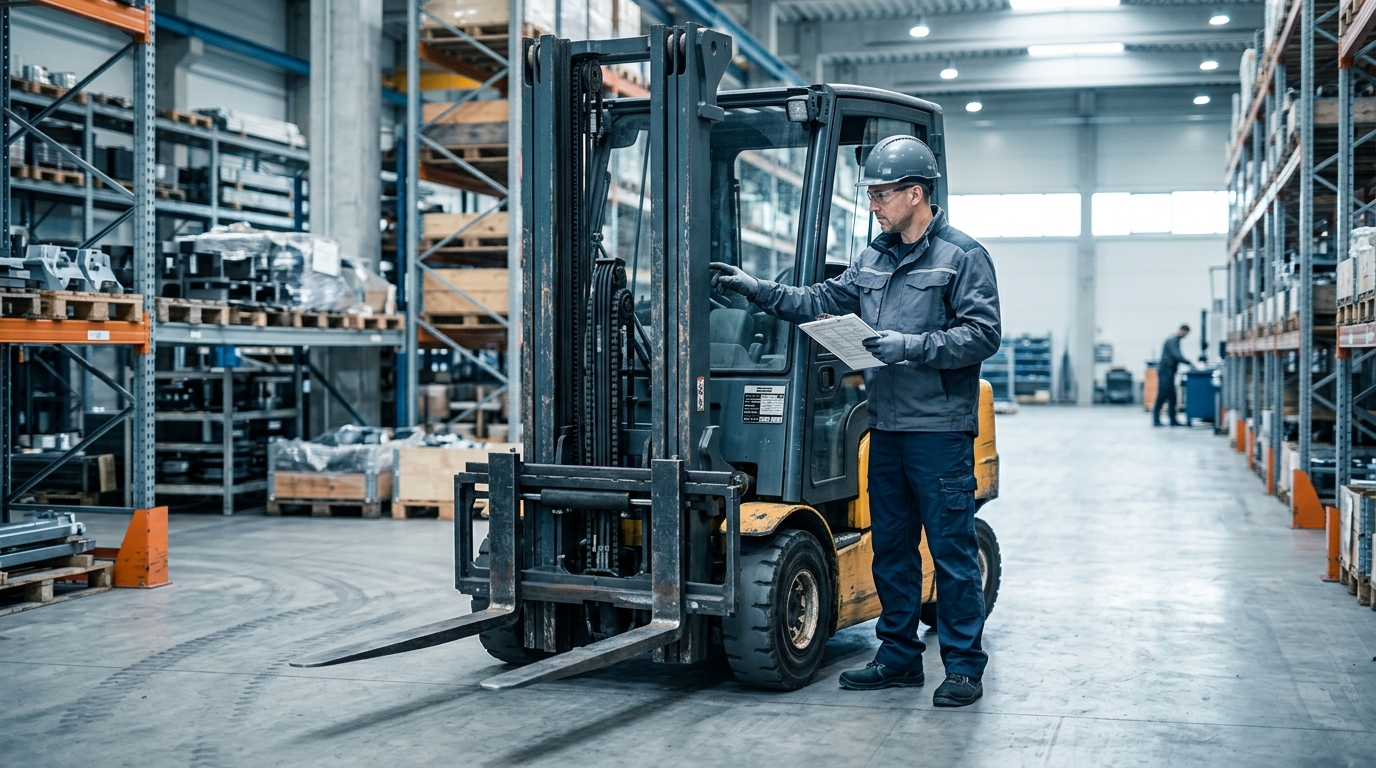
A forklift is a motor-powered industrial truck that picks up loads with forks, lifts them via a lifting mast and moves them within a plant or warehouse. The FEM guideline 4.004 for regular inspections applies to powered industrial trucks under ISO 5053, with and without a lifting function.[1] According to Staplerberater, counterbalance trucks with a load capacity of up to 3.5 tonnes are the most common type.[2]
When buying used, the mast is one of the first components to inspect. A duplex mast consists of two rails and is the simplest, lowest-maintenance design. A triplex mast adds a third rail and achieves large lift heights with a compact collapsed height, but has more moving parts and wear points at the lift chains. Collapsed height and free lift are two different dimensions: the collapsed height determines whether the truck fits through a door, while free lift determines whether it can raise pallets under a low ceiling or inside a container.[3] Both can be checked on the used unit and should match the hall before the price comes into play.
What does forklift transport cost?
Transport comes on top of the purchase price. As an example, a Hamburg freight forwarder quotes the transport of a forklift from Munich to Stuhr over 770 kilometres as part of a consolidated shipment: 4.7 tonnes, 590 euros plus VAT, i.e.[4] 702.10 euros gross. This is a single example from one provider, not a market price.
According to the same provider, the price depends on several factors: dimensions and weight, roadworthy or only rollable, distance, pickup and delivery locations, and the available time window.[4] Staplerberater advises buying from a nearby dealer if possible: a cheap forklift located hundreds of kilometres away is costly to inspect, and transport must be factored into the calculation.[5]
How can a forklift be transported?
Forklifts are transported on low-loaders, in enclosed trailers, or on special vehicles with a tail lift or loading ramp. Not every haulage company can do this: trucks with low ground clearance, such as three-wheel forklifts, require special vehicles. The forwarder mentioned describes enclosed trailers with 3.85 metres of interior height, low-bed vehicles up to 3.80 metres, and tail lifts with a 9-tonne capacity.[6]
For planning, the truck's dimensions and weight with the mast lowered matter, along with load securing and the question of where loading and unloading will take place. Anyone collecting the truck themselves needs a vehicle with suitable payload and loading height. The vehicle specifications come from a freight forwarder and should be read as provider information.
What does a good forklift cost?
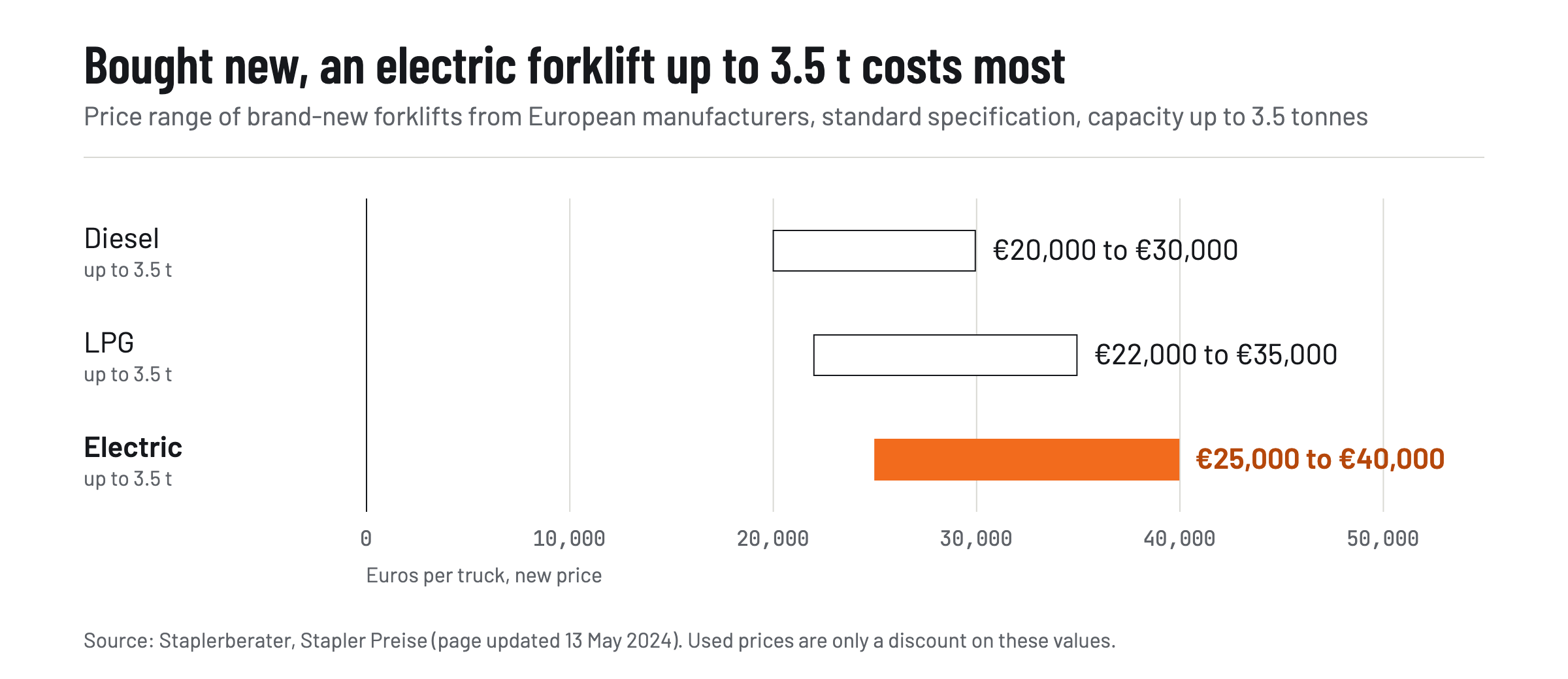
What a good forklift costs depends on the truck type, load capacity, lift height, drive variant, mast type, equipment, manufacturer and service. For brand-new trucks from European manufacturers in standard configuration (source status: 13 May 2024), Staplerberater gives these approximate ranges:[2]
| Drive | up to 2.0 t | up to 3.5 t | over 3.5 t |
|---|---|---|---|
| Diesel | [2]15,000 to 20,000 euros | [2]20,000 to 30,000 euros | higher, depending on configuration |
| Gas | [2]16,000 to 22,000 euros | [2]22,000 to 35,000 euros | higher, depending on configuration |
| Electric | [2]20,000 to 25,000 euros | [2]25,000 to 40,000 euros | higher, depending on configuration |
These are list prices for orientation, not offers; according to Staplerberater, binding prices are usually only available on request.[2] Electric forklifts cost more to purchase, but according to Staplerberater they pay off over longer operating periods thanks to lower energy costs.[2] For used-truck buyers, the list prices are the benchmark: an offer without reference to the model's list price cannot be assessed.
Which forklift is the best?
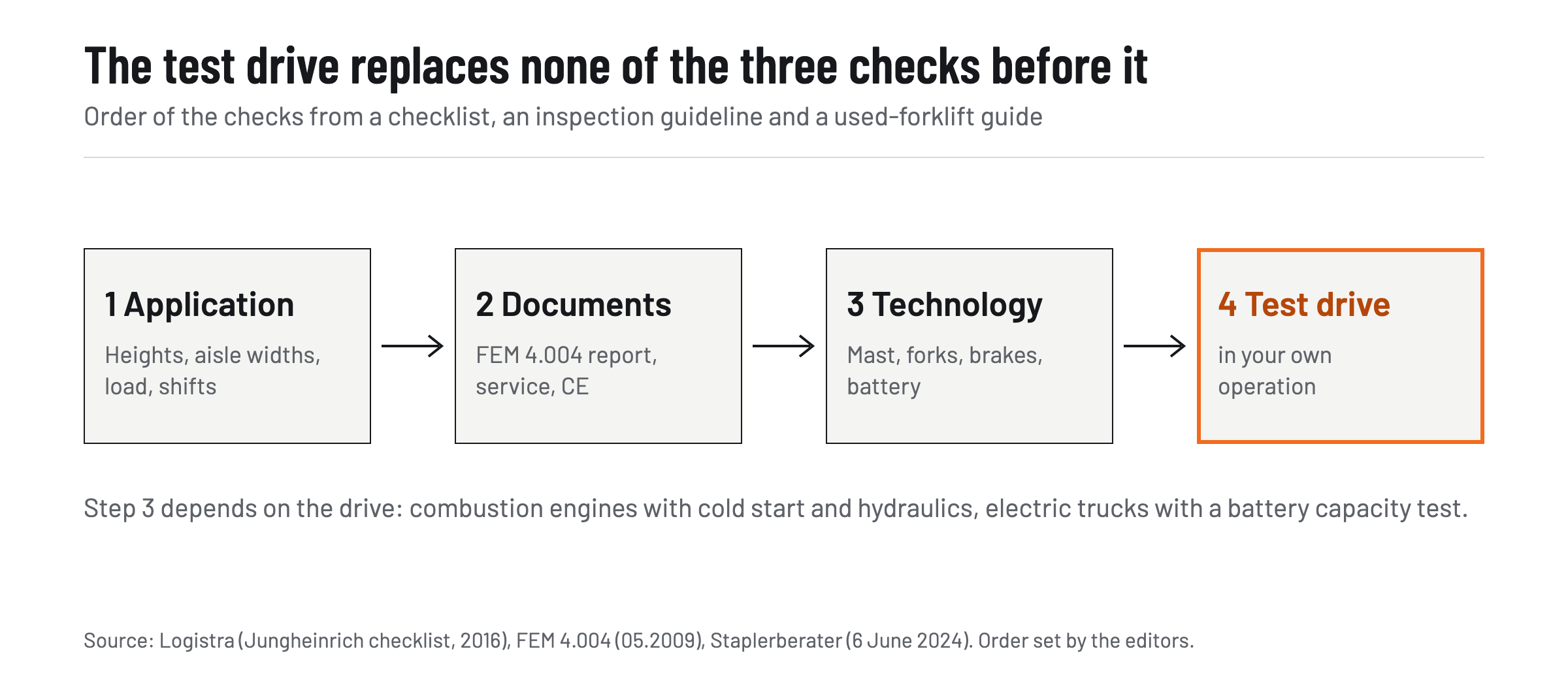
There is no best forklift, only the one that fits the application. The checklist from Jungheinrich in the trade journal Logistra therefore starts with an application assessment: clearance heights, aisle widths, indoor or outdoor use, maximum stacking height, load weights and single- or multi-shift operation.[7] Only then is it worth looking at the individual truck. The following inspection points come from this checklist, from Staplerberater and from the FEM inspection guideline.
| Inspection point | What matters | Source |
|---|---|---|
| Inspection report | current FEM 4.004 report, renewed annually; replaces the earlier UVV inspection | Staplerberater |
| Rating plate, mast | residual capacity diagram matches the existing mast and attachments; mast without play | Logistra |
| Forks | no cracks, locks work, thickness at the fork bend at least 90 percent of the thickness at the fork shank | Logistra |
| Steering, brakes | smooth operation, tracks straight, brakes act evenly on both sides, parking brake works | Logistra |
| Combustion engine | cold start, smoke development, leaks; operate the hydraulics for a quarter of an hour with the engine running | Logistra |
| Electric forklift | battery age, capacity test instead of a mere voltage measurement, warranty on the battery | Staplerberater |
| Documentation | operating manual, CE certificate, service reports, documented operating hours | Logistra |
A test drive does not replace these inspections, because only in operation can you determine whether functionality, equipment and performance match the requirements.[2] The inspections under FEM 4.004 are divided into lifting equipment, drive and brakes, controls, electrics, hydraulics, and frame and safety equipment.[1] Anyone unable to assess the inspection themselves should have it carried out by a competent person. The exact obligations and intervals of the UVV inspection are a separate topic and are deliberately not covered in depth here.
What do used forklifts cost?
Used forklifts are cheaper than new ones, but the savings vary widely. In its price overview, Staplerberater cites savings of 50, 70, 80 or more percent compared with the list price depending on age, equipment and condition, while its used-forklift guide states up to 50 percent.[2][5] Both figures come from a brokerage portal; the discrepancy shows that there is no fixed discount.
The list price serves as a reference point: for a new electric forklift up to 3.5 tonnes, Staplerberater quotes 25,000 to 40,000 euros (page status: 13 May 2024). How far a used unit falls below that depends on age, equipment and condition; assuming a fixed discount would be an assumption, not a market statement.[2] Transport, a possible inspection and, if necessary, a new battery are added to the purchase price.
Operating hours are part of the price question. Transportkompass gives a rule of thumb that electric forklifts typically approach the end of their life between 10,000 and 15,000 hours, that diesel units can remain capable beyond that with good maintenance, and that resale value drops significantly from 8,000 to 10,000 hours, especially with patchy documentation.[8] Staplerberater considers it favourable if a unit has no more than 1,000 operating hours per year, and warns that the counter is not protected against manipulation.[5] The hour count is therefore only reliable together with service records and overall condition.
The traction battery of an electric forklift can account for up to a third of the total purchase price.[5] Ask about age, capacity test and warranty, because the battery is often excluded from the warranty.
Who invented the forklift?
The first forklift for in-plant material transport is considered to be a vehicle built by the American axle manufacturer Clark in 1917, according to the trade journal Logistik Heute; eight vehicles were delivered in 1918, and 75 in 1919.[9] The same source calls the Truclift of 1922 the first vehicle with a hydraulic lifting mast. The KION Group takes a more cautious view: the first forklift is said to be a platform truck developed in 1917, but it still lacked a lifting mast.[10] Whether you see the inventor at Clark or in a predecessor depends on whether you count the lifting mast as part of the definition. For purchasing purposes, what matters in practice is that, according to Staplerberater, the availability of original spare parts is more assured with the major brands.[5]
The Industry desk at GoMaschine places the topics of procurement and intralogistics in context, for example under procurement prices, used-equipment purchases and industrial trucks. Whether a purchase pays off compared with renting or leasing is explained in the [11]article lease or buy a machine.
Frequently asked questions
How many operating hours are too many for a used forklift?
There is no fixed limit. As a rule of thumb, Transportkompass cites 10,000 to 15,000 hours for electric forklifts; what matters are maintenance records, operating environment and condition.
How do I recognise a manipulated operating-hours counter?
The counter is not protected against manipulation. Compare the hours with service records, inspection reports and the overall condition of the unit.
Which documents do I need when buying?
Operating manual, CE certificate, a current inspection report under FEM 4.004, service records and, for electric forklifts, details on the battery.
Sources
Related reading
All Intralogistics →Automated Small Parts Warehouse (AKL): Costs, Advantages and Disadvantages
What an automated small parts warehouse costs, where its drawbacks lie and when it pays off for manufacturing SMEs, with project figures and the calculation.
WMS system or ERP warehouse module: When a dedicated WMS pays off
WMS system or ERP warehouse module? The distinction under VDI 3601, cost examples as of October 2026 and five criteria for manufacturing SMEs.