Metal 3D Printing for Small Series: When Does It Pay Off?
Metal 3D printing for small series: cost per hour, powder prices, post-processing and break-even against CNC, with the calculation assumptions and sources disclosed.
In this article8
How high are the costs of metal 3D printing?
The cost of a printed metal part consists of machine time, powder, post-processing, labour and equipment costs. The provider MakerVerse, in a guide dated 11 November 2025, cites purchase prices of 115,000 to 575,000 euros for industrial SLM and DMLS systems, up to 690,000 euros for electron beam melting (EBM) systems, and 115,000 to 170,000 euros for binder jetting systems. Maintenance is estimated by the source at 10 to 20 percent of the machine price per year.[1][1]
Powder is the second major cost block. According to the same source, stainless steel 316L and aluminium AlSi10Mg powders cost 60 to 115 euros per kilogram.[1] It cites 115 to 230 euros for tool steel, 350 to 700 euros for nickel superalloys such as Inconel, and over 1,150 euros for titanium Ti-6Al-4V.[1] A second assessment by the same provider, dated 22 May 2026, quotes partly lower ranges, for example 15 to 100 euros per kilogram for 316L and 70 to 300 euros for Ti-6Al-4V. Both figures come from the same provider yet differ from each other; they show the spread between dealer prices and manufacturer list prices, not a binding price.[2]
Process advances can reduce costs. In the EU project InShaPe, coordinated by the Technical University of Munich, the build rate for Inconel 718 parts rose from 15 to up to 93.3 cubic centimetres per hour according to a press release dated 24 July 2025, while costs fell by 50 percent. These are project results from five demonstrators, not a series price that a service provider offers today.[3]
At what point does metal 3D printing beat conventional manufacturing?
The break-even point results from fixed costs and per-part costs. CNC machining carries costs for setup, fixtures and programming, which are spread across the quantity; metal 3D printing has practically no tooling, so per-part costs remain nearly constant. As a formula, as long as printing is more expensive per part than machining: break-even point (quantity at which CNC becomes cheaper) = fixed costs of conventional manufacturing ÷ (additive per-part cost − conventional variable per-part cost). The more complex the part, the higher the variable CNC costs, the smaller the denominator, and the later the picture reverses.
MakerVerse cites rule-of-thumb values from platform data (May 2026): roughly 10 to 25 parts for simple aluminium, 20 to 50 parts for moderately complex stainless steel 316L, and 50 to 200 parts for complex titanium or Inconel parts.[2] The source itself notes that these values are indicative and that post-processing is often missing from metal quotes. In addition, the build volume of typical LPBF systems of around 400 × 400 × 400 millimetres limits part size.[2] A meaningful comparison therefore pits CNC against the combination of printing and machining post-processing.
In practical terms, this means for managing directors of a manufacturing SME: obtain two quotes for a reference part with post-processing explicitly itemised, and calculate the break-even point using your own figures. Further context on 3D printing in manufacturing, on [4]machining[4] and on buying a [4]CNC milling machine can be found in the Industry section of GoMaschine. The LPBF, Binder Jetting and DED processes, and their advantages and disadvantages compared with milling and casting, are topics in their own right.
What does 1 hour of 3D printing cost?
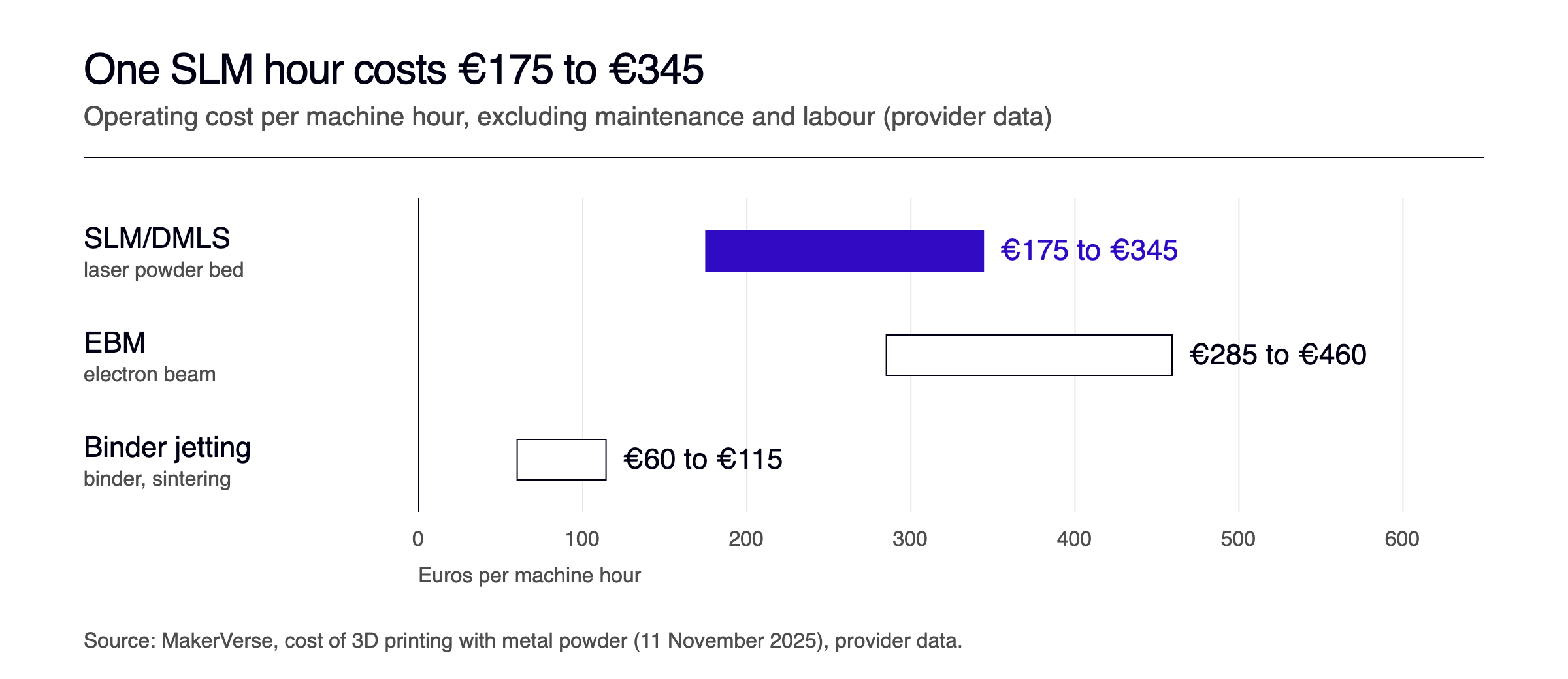
In metal 3D printing, operating costs per machine hour are far above those of a plastics printer. MakerVerse states (as of 11 November 2025) for SLM/DMLS 175 to 345 euros per machine hour, for EBM 285 to 460 euros and for Binder Jetting 60 to 115 euros; maintenance and labour costs are not included. The source puts operators at 20 to 100 euros per working hour.[1]
| Process | Operating costs per hour | System price | Source |
|---|---|---|---|
| SLM/DMLS | [1]175 to 345 euros | [1]115,000 to 575,000 euros | MakerVerse, 11 Nov 2025 |
| EBM | [1]285 to 460 euros | [1]285,000 to 690,000 euros | MakerVerse, 11 Nov 2025 |
| Binder Jetting | [1]60 to 115 euros | [1]115,000 to 170,000 euros | MakerVerse, 11 Nov 2025 |
A machine hour, however, is not the same as one printing hour per part. Because many parts are built on a build plate simultaneously, the hour is spread across all parts on the plate. This is the most important lever against high hourly rates, and the reason why build plate utilisation affects the per-part price more strongly than the hourly rate alone.
What does a small 3D print cost?
A small metal part is not automatically cheap, because setup, powder removal, support structures and post-processing are incurred regardless of size. The following worked example is illustrative; the price assumptions lie within the stated MakerVerse ranges, build time and part weight are freely chosen:
| Assumption / line item | Value |
|---|---|
| Parts per build plate | 25 (assumed) |
| Build time of the plate | 20 hours (assumed) |
| SLM machine hour rate | 250 euros (within 175 to 345 euros) |
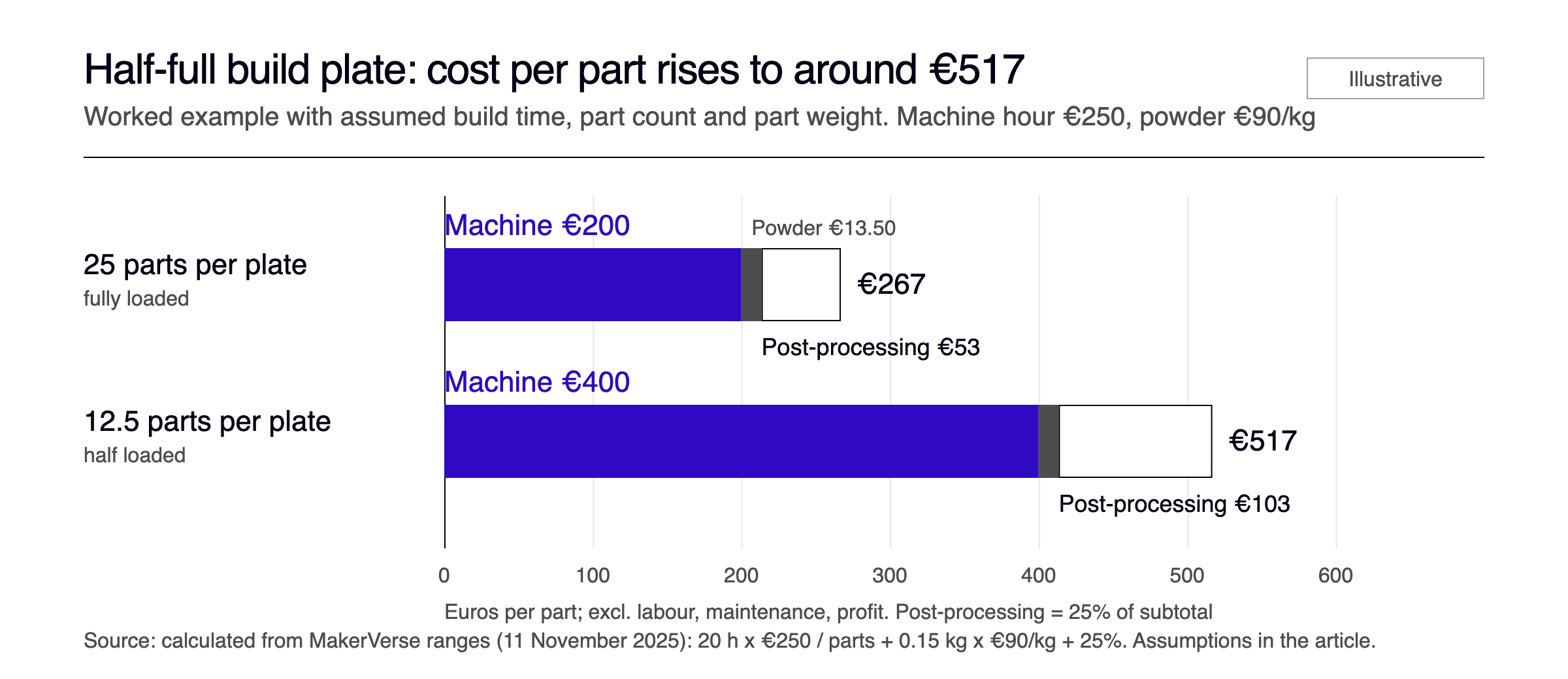
| Machine costs per part | 20 h × 250 euros ÷ 25 = 200 euros |
| Powder per part | 0.15 kg (incl. supports, assumed) × 90 euros/kg (316L, within 60 to 115 euros) = 13.50 euros |
| Subtotal | Machine costs plus powder per part |
| Post-processing | 25 percent of the subtotal (within 10 to 40 percent) |
| Total per part | Subtotal plus post-processing, excluding labour, maintenance and profit |
If the build plate is only half full, machine costs per part in the example rise to 400 euros — a doubling. It is precisely this utilisation that decides the outcome for small series. In addition, depending on requirements, hot isostatic pressing (HIP) at 115 to 345 euros per cycle or machining post-processing at 60 to 175 euros per working hour may apply, according to MakerVerse.[1]
Removing support structures is also part of the calculation. According to Fraunhofer IAPT, it is one of the most labour-intensive steps in post-processing; at Formnext (17 to 20 November 2026) the institute will present an ultrasound-based, automated process which, according to the manufacturer, is patent pending.[5]
How much should you budget for 1 hour of 3D printing?
Anyone offering metal 3D printing as a service or charging it internally should not apply the operating hour rate alone. The rate must cover depreciation of the system, maintenance, gas and powder consumption, personnel and build plate utilisation. MakerVerse explicitly quotes operating costs of 175 to 345 euros per machine hour excluding maintenance and labour, and lists laser power, gas consumption and powder consumption as cost drivers.[1]
A simple costing rule: hourly rate = (depreciation + interest + maintenance + floor space costs + energy and gas) ÷ productive hours per year, plus personnel. How high the rate turns out depends on how many hours the system actually produces. A figure for your own operation can therefore only be derived from your own system costs; the ranges quoted serve as a plausibility check.
Is 3D printing an expensive hobby?
The hobby segment with plastics follows a different cost logic than industrial metal. In metal printing, the entry threshold starts at system prices from 115,000 euros (MakerVerse, 2025), plus powder handling, shielding gas and post-processing.[1] Metal 3D printing is therefore not a hobby but an investment that only pays off with utilisation and quality assurance.
For manufacturing SMEs, sourcing from service providers is the usual entry point. According to a dpa report of 18 May 2026, the platform Unionfab states that it shortens production cycles for selected metal parts in small series from over 30 days to as little as five days; this is a vendor statement from Shanghai. In August 2026, the GMH Group launched ProMateria to industrially produce additively manufactured metal spare parts, initially for its own companies.[6] Both show the direction, but neither proves prices.[7]
How long does 1 kg of filament last?
Filament is plastic for fused deposition printers and not a material for small-series metal work. For context: according to a guide by Makers101, 1 kg of PLA with a diameter of 1.75 millimetres corresponds to roughly 335 metres of filament.[8] How many parts that yields depends on part weight.
In metal printing, the comparable quantity is powder per part. In the example above, a part including supports consumes an assumed 0.15 kilograms; 1 kilogram of powder therefore yields six to seven parts on paper. Unfused powder remains in the system: MakerVerse cites recycling systems that recover up to 100 percent of the powder for some materials and reduce long-term costs by 20 to 40 percent, with quality monitoring across multiple reuse cycles.[1]
Frequently asked questions
From how many parts does metal 3D printing beat CNC?
There is no fixed number. Platform data cites 10 to 25 parts for simple aluminium and 50 to 200 parts for complex titanium or Inconel; geometry, material and post-processing are decisive.
Which costs are often forgotten in metal 3D printing quotes?
Post-processing: removing support structures, stress-relief annealing, hot isostatic pressing (HIP) and machining of final surfaces. It adds 10 to 40 percent to costs (MakerVerse).
Why is build plate utilisation so important?
The machine hour is spread across all parts on a plate. In the worked example, a half-full plate doubles the machine costs per part.
Sources
Related reading
All Manufacturing →Buying a CNC lathe: machine types, equipment and manufacturers
Buying a CNC lathe: which machine type suits which workpiece, what equipment matters, German manufacturers and the role of control and programming.
Buying a CNC Milling Machine for Metal: What SMEs Should Look For
Buying a CNC milling machine for metal: number of axes, costs, manufacturers and the market explained, so manufacturers can make a sound decision.