Buying a CNC Milling Machine for Metal: What SMEs Should Look For
Buying a CNC milling machine for metal: number of axes, costs, manufacturers and the market explained, so manufacturers can make a sound decision.
In this article9
What does a CNC machine do?
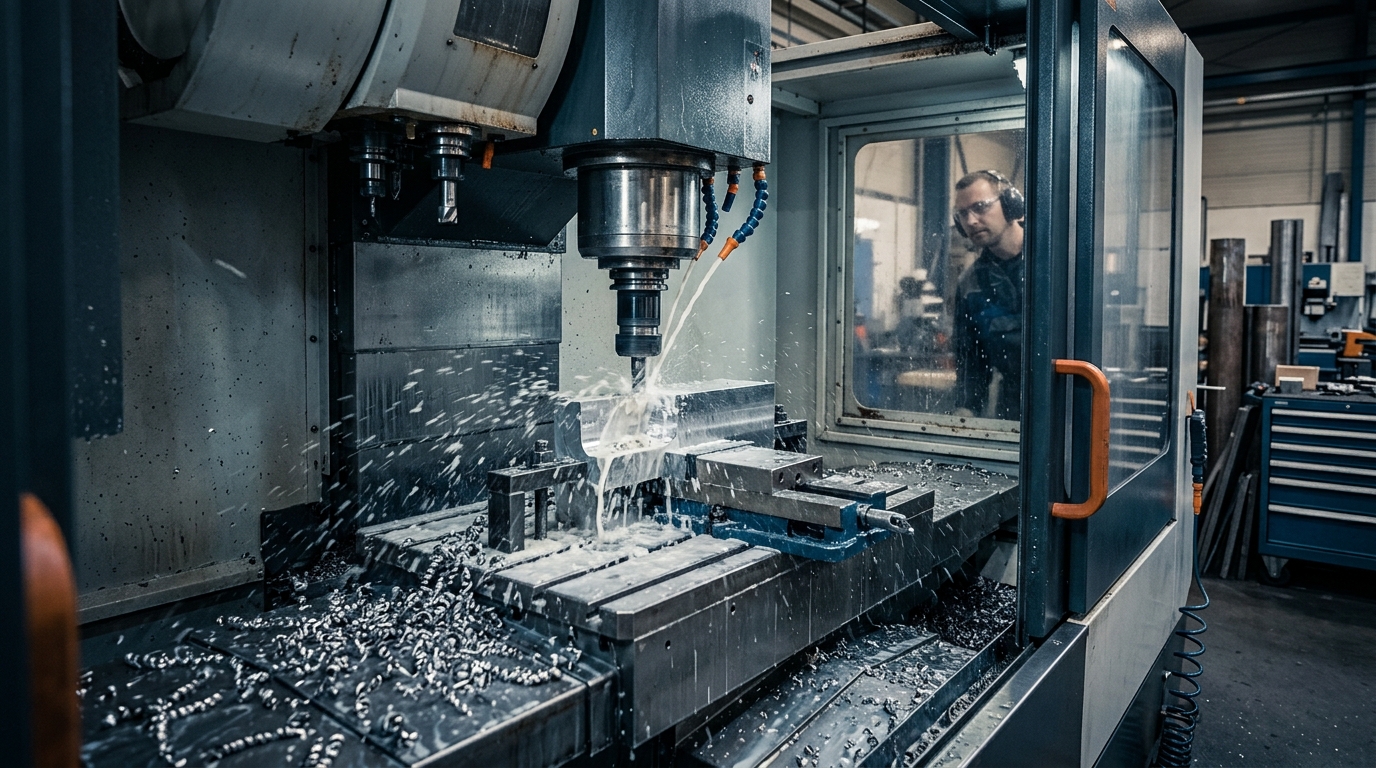
CNC stands for Computerized Numerical Control, a numerical control system that defines the movements of tool and workpiece via a program. Instead of using handwheels and mechanical stops as on a conventional milling machine, the operator runs through a programmed machining sequence: the control pre-computes the path, and the drives execute it. The program, the control and the machine form a chain whose weakest link determines the quality of the result.
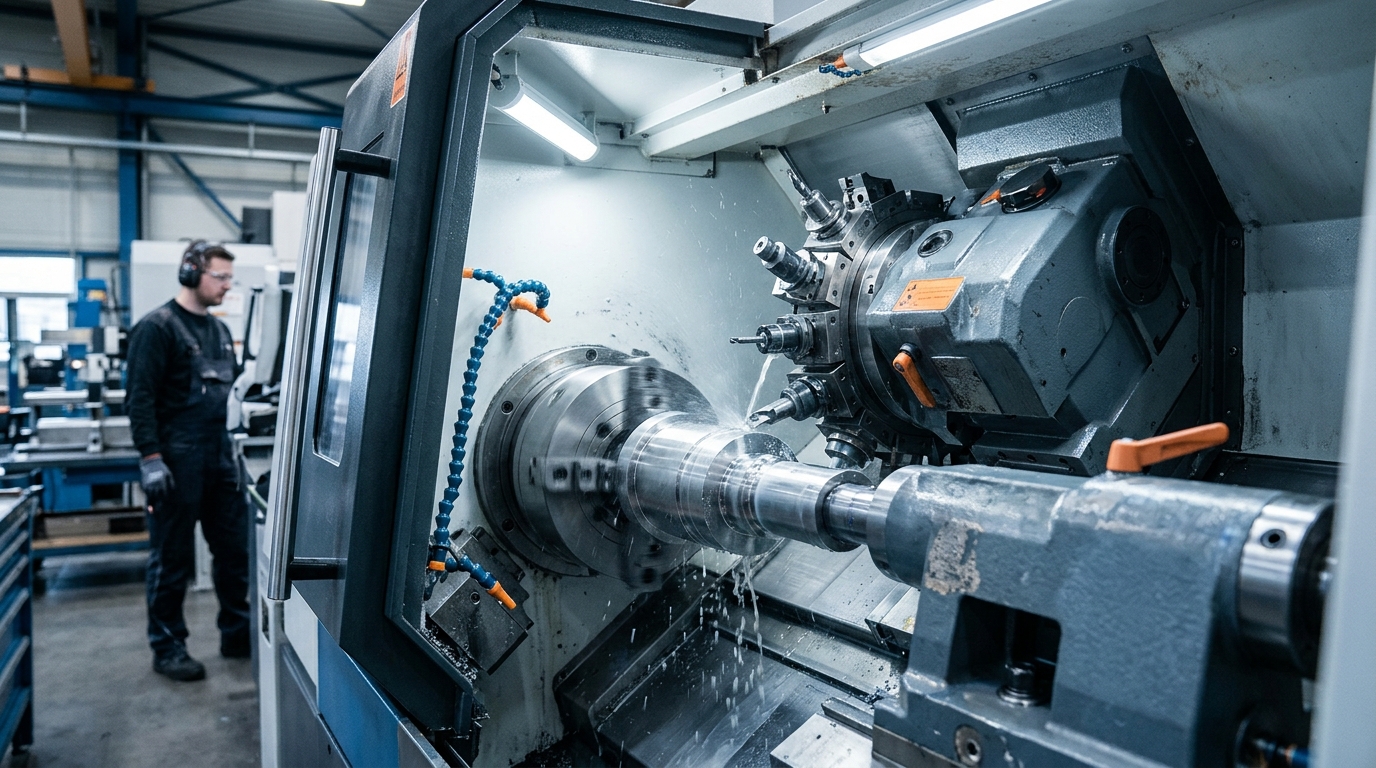
The difference from a conventional machine lies less in the individual operation than in repeatability. A CNC milling machine executes milling, drilling and threading as soon as the program is ready, with identical paths on every part. A CNC lathe applies the same principle to rotating workpieces, where the tool defines the path. For metal manufacturing, what matters most is that programs can be stored, transferred and coupled with automation such as pallet changers or robots.
The program describes tool paths and technology, the control distributes them across the axes, and the machine implements them mechanically. Typical operations are face milling and contour milling, standard drilling, threads and fits; on lathes, additionally face and cylindrical turning as well as driven tools. In metal manufacturing, this delivers consistent repeatability across the batch, documented processes and the foundation for unmanned production.
Technically decisive is how accurately the machine hits a programmed position and how precisely it reaches the same position the second time. Positioning accuracy is tested according to DIN EN ISO 230; a machine dealer quotes positioning accuracies of up to 5 micrometres for its machining centres.[1] Such figures are vendor specifications under defined measurement conditions, not a guarantee for the component in your own operation.
What does a professional CNC machine cost?
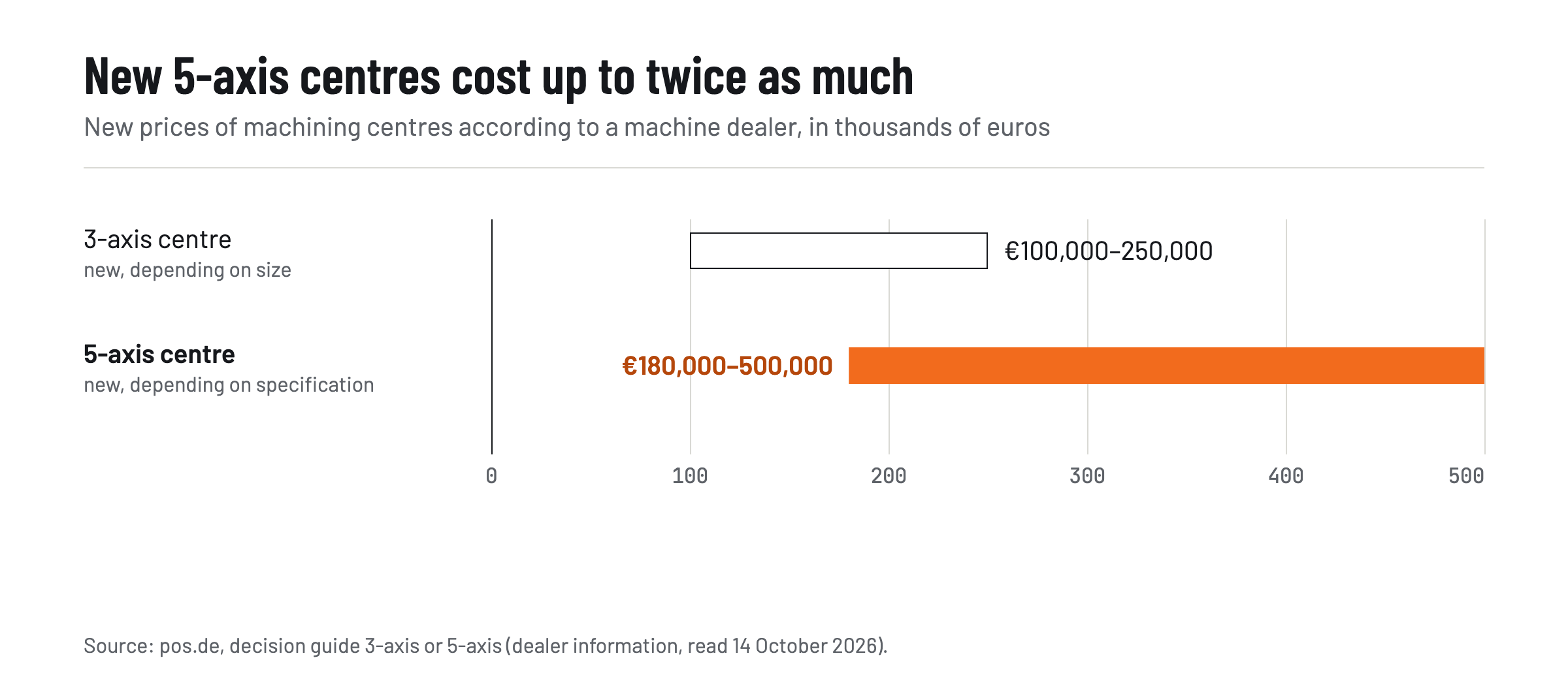
According to a machine dealer, new 3-axis machining centres typically cost between 100,000 and 250,000 euros, and 5-axis centres between 180,000 and 500,000 euros, depending on size and equipment.[1] These are indicative figures, not quotations. The purchase price is thus the most visible, but not the most important part of the investment decision.
| Configuration | Typical investment (new) | Characteristics |
|---|---|---|
| 3-axis machining centre | [1]100,000 to 250,000 euros | Proven standard for planar geometries; multiple setups for complex parts |
| 5-axis machining centre | [1]180,000 to 500,000 euros | Complete machining in a single setup, higher purchase price, fewer re-clamping errors |
Beyond the purchase price, ongoing costs arise that carry considerable weight over the machine's lifetime. A sample calculation by the same dealer works with machine-hour rates of 85 euros for a 3-axis and 110 euros for a 5-axis machine, the 5-axis figure being higher because of the greater depreciation. Added to this are tooling costs, maintenance contracts, spare parts, energy and the labour costs for programming and operation.
The machine-hour rate bundles depreciation, interest, energy, maintenance and floor-space costs per productive hour and thus determines what every production hour costs. For tooling — cutters, holders and gauges — costs depend on the workpiece material and cutting parameters; according to the same dealer, shorter, stiffer tools in 5-axis machining extend tool life by 30 to 50 percent.[1] Maintenance intervals, the manufacturer's response times and spare-parts supply act directly on availability. Training, programming capacity and CAM integration are also part of the investment and are not a residual item.
For the purchase decision, the rule is: the price of the machine is only the beginning of a cost calculation that is decided by hourly rates, availability and the part mix.
Does CNC have a future?
Yes, CNC remains the core of metal manufacturing, though in a difficult market. The VDW (Verein Deutscher Werkzeugmaschinenfabriken, German Machine Tool Builders' Association) expects German production to grow by 1 percent to 13.7 billion euros in 2026 after two years of decline; in 2025 production fell by 8 percent, and compared with the 2018 peak the gap in real terms is 35 percent.[2]
The competitive pressure is visible in exports: according to the VDW, Chinese machine tool exports rose by 18 percent, and China has displaced Germany as the world's largest exporter for the first time.[2] Sentiment on the shop floor is more positive: around 63 percent of works councils report good or very good capacity utilisation, six percentage points more than a year earlier, and 58 percent see good to very good prospects.[3] Employment is moving in the opposite direction: the Federal Employment Agency counts around 177,000 jobs lost in German industry within one year, around 28,000 of them in mechanical engineering, and puts the decline at 15,000 jobs per month.[4]
For investment planning this creates a trade-off: utilisation in the plants is picking up, while the industry as a whole is cutting jobs and domestic order intake fell by 16 percent in 2025.[5] Anyone buying now is buying into an economic turning point, not a stable market. That argues for a decision based on the concrete order book rather than on the hope of a general upswing.
Technologically, too, there is little to argue against CNC: the VDW names automation, efficiency gains in energy and material use, and digitalisation and artificial intelligence in manufacturing as the industry's current innovation drivers.[2] CNC is therefore not an obsolete technology, but a market in which choosing the right manufacturer and application profile is becoming more important.
How many axes does a CNC milling machine have?
A CNC milling machine has three, four or five axes. The basis is three linear axes: X, Y and Z. A 3-axis machine moves the spindle in these directions while the workpiece remains fixed in one setup; per setup, one side can be machined, and each additional side requires new clamping.[1] Features that sit at an angle to the coordinate system cannot be reached this way, or only with special tools.
| Number of axes | Additional movement | Typical consequence for manufacturing |
|---|---|---|
| 3 axes | none, only X, Y, Z | Planar geometries, multiple setups for complex parts, every re-clamping carries positioning errors |
| 4 axes | rotary axis around the X-axis (A-axis) | Angled features, more sides of the workpiece reachable without manual re-clamping |
| 5 axes | two rotary axes (A/C or B/C) | [1]Complete machining in one setup as 3+2 or simultaneous, eliminating re-clamping errors |
In 4-axis machining, the A-axis rotates the workpiece while the spindle remains linear. This allows angled features and more economical production of parts that would theoretically also be feasible on 3 axes, because clamping fixtures and changeovers are eliminated. 5-axis technology comes in two variants: with 3+2, the rotary axes operate independently of each other and position the workpiece; in the fully simultaneous variant, both axes rotate at the same time as milling takes place, which enables complex freeform surfaces.[1]
Economically, each step means something different. More axes cost more to purchase and maintain, but save re-clamping operations and thus time and sources of error. The decision should depend on the part spectrum: anyone producing predominantly prismatic parts with hole patterns is often better off with 3 axes; anyone who re-clamps frequently or turns down orders because of geometry should examine 4 or 5 axes.
Who is the largest CNC machine manufacturer?
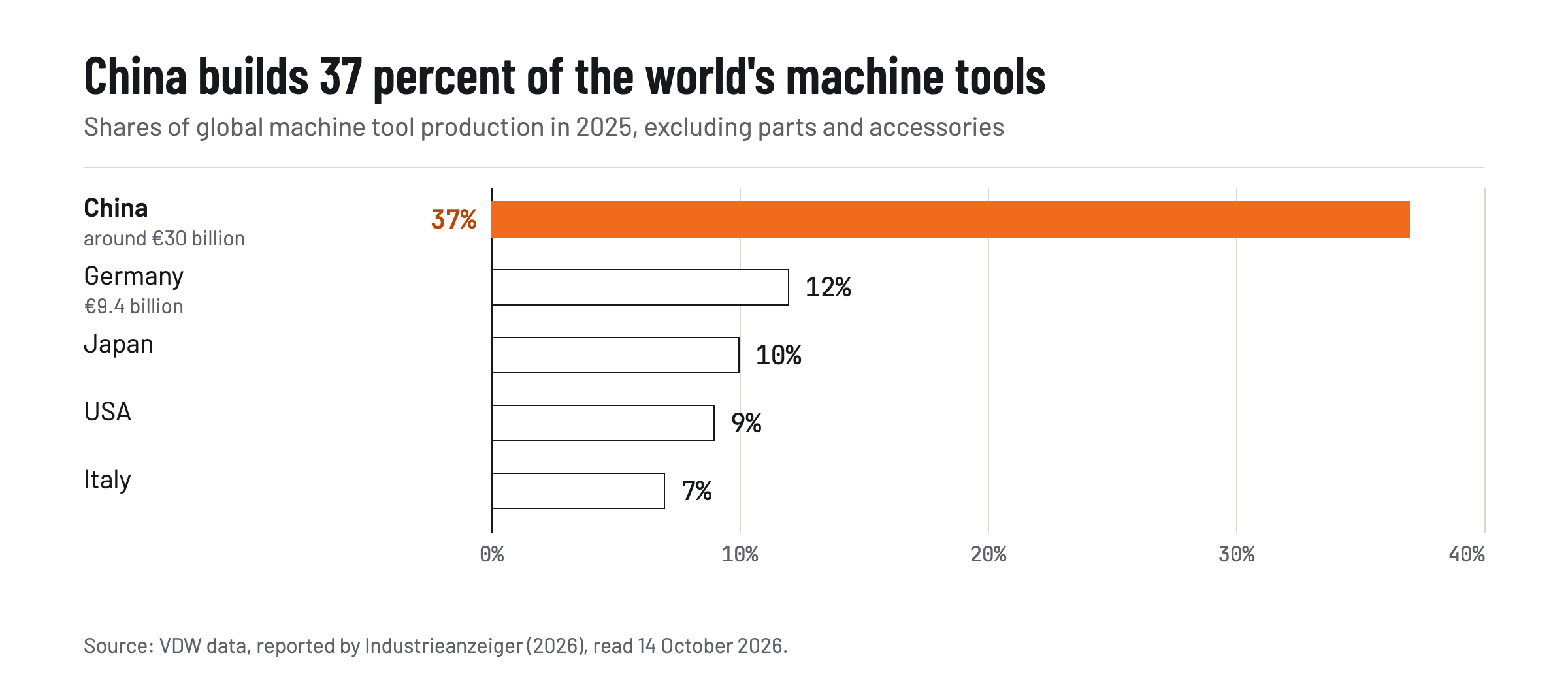
Measured by production, China is the largest manufacturing country for machine tools; the available data do not identify a single largest manufacturer. Company rankings vary depending on source and year, whereas the VDW's country data are reliable: global production is concentrated in a few countries, with a 37 percent world market share for China, 12 percent for Germany and 10 percent for Japan; the USA and Italy follow with 9 and 7 percent respectively.[5] Chinese production reached around 30 billion euros in 2025, German production 9.4 billion euros, in each case excluding parts and accessories.
In production, Germany thus ranks second.[5] In exports, China overtook Germany as the world's largest exporter for the first time in 2025, with 8.6 billion euros compared with 7 billion euros of German exports.[5] The VDW describes Germany as the world's second most important supplier, citing technology leadership, service and retrofit.[2]
At company level there is no reliable single figure that objectively makes one manufacturer the largest, because market definition, segment and cut-off date change the result. For the purchasing decision, the ranking question is secondary anyway: service availability in the region, spare parts supply and the control ecosystem can be checked before purchase; an abstract ranking position cannot. A manufacturer that tops a ranking list but has no service technicians nearby is the wrong partner in the event of a breakdown.
Which manufacturers of CNC lathes are there?
Manufacturers of CNC lathes are based mainly in the major production countries China, Germany, Japan, the USA and Italy. The German machine tool industry is strongly shaped by small and medium-sized enterprises; the VDW puts employment in companies with more than 50 employees at 63,300 people and reports capacity adjustments in the industry.[2] Many of the manufacturers are small and medium-sized companies specialised in particular segments and technologies.
The German providers form an SME-dominated sector with a high R&D ratio; the VDW cites over 4 percent of revenue as research and development intensity in mechanical engineering.[2] According to VDW data, Japan, the USA and Italy are among the other major production nations alongside China and Germany.[5] In addition, twelve larger German machine tool manufacturers now produce abroad (local for local); their foreign production accounts for just over one fifth of total German production, with 45 percent in Europe, 32 percent in China and 20 percent in the USA.[2]
The trend towards local-for-local production directly affects what a buyer experiences in terms of service and delivery. Machines built in the target market can bypass trade barriers and, according to the VDW, offer better chances of participating in local market growth and realising cost advantages.[2] For operations, this means: when comparing manufacturers, ask where the specific machine is built and where spare parts and service technicians are stationed, because this determines delivery times and downtime risks.
Who builds the best CNC lathes?
There is no objective best-of ranking. The assessment depends on operating conditions: part spectrum, batch sizes, materials, existing CAM chain, team qualifications and the service environment. A turn-mill centre for medical technology parts is measured against different criteria than a plunge lathe for pipe fittings in series production. The conclusion: the best manufacturer is the one whose machine, control system and service fit your own operating profile.
- Control ecosystem: The control is a platform, not an operating panel. Heidenhain stands for shop-floor-oriented plain-language and dialogue programming, Siemens for an automation-open architecture with a digital twin, Fanuc for an ISO-like platform with a large installed base.[6]
- Service and spare parts: Response times, technician coverage in the region and spare parts stocking determine availability and thus economic operation.
- Materials and technology portfolio: The manufacturer must demonstrably master the turning, turn-milling and materials of your own part spectrum, not just in the catalogue.
- CAM integration: For the specific machine-control combination you need a tested post-processor; acceptance should be carried out with your own reference part from your operation.[6]
Manufacturer accuracy specifications should be treated with caution, not because they are wrong, but because they apply under defined conditions. For your own decision, what counts is which accuracy actually arrives at your own workpiece under your own thermal and mechanical conditions. A test with a real reference part is the only reliable acceptance procedure.
Anyone who mirrors the selection against their own part spectrum therefore does not ask for the best manufacturer, but for the best fit: Which control system does the team master, which geometries dominate the order book, how quickly does the service arrive on site in the event of a breakdown? Further assessments of machines, manufacturing processes and investment decisions can be found in the [7]Industry section on GoMaschine.
Frequently asked questions
What does a CNC milling machine for metal cost?
Typical 3-axis machining centres range from 100,000 to 250,000 euros, 5-axis systems from 180,000 to 500,000 euros. Operating costs such as the machine-hour rate, tools, maintenance and energy come on top. The exact price classes depend on size, equipment and degree of automation.
How many axes does a CNC milling machine need?
For flat geometries, holes and threads, 3 axes (X, Y, Z) are sufficient. Angled features require a fourth rotary axis; complex freeform surfaces and complete machining in a single setup require five axes. The choice is a question of the part spectrum, not of the underlying technology.
Who is the largest CNC machine manufacturer in the world?
At country level, China leads machine tool production with a 37 percent world market share; Germany ranks second with 12 percent (VDW data, 2025). In exports, China overtook Germany for the first time in 2025 as the world's largest exporter. At company level, rankings vary depending on source and year, so no reliable single figure can be given.
Does CNC manufacturing in Germany have a future?
Yes, but in a more difficult environment. The VDW expects a slight production increase of 1 percent to 13.7 billion euros in 2026, after a decline of 8 percent in the previous year. At the same time, a works council survey by IG Metall reports good capacity utilisation in 63 percent of companies, while the industry is under Chinese export pressure.
3-axis or 5-axis: which CNC milling machine is better?
Neither is better in the sense of a general ranking. 3-axis machines are cheaper, easier to program and sufficient for flat parts. 5-axis machines machine complex geometries in a single setup and extend tool life through shorter, stiffer tools, but they cost more and place higher demands on programming and personnel.
Which manufacturers of CNC lathes are there?
The German machine tool industry is characterised by small and medium-sized enterprises; companies with more than 50 employees recently employed 63,300 people (VDW). The major production countries include, alongside China and Germany, Japan, the USA and Italy.
How do you identify the right CNC machine for your own operation?
What matters are your own operating conditions: part spectrum, materials, batch sizes, available personnel and service availability at the site. The choice of control — for example shop-floor-oriented conversational programming or automation-ready systems — should also be aligned with the team. The right machine results from your own application profile, not from a ranking list.
Sources
Related reading
All Manufacturing →Buying a CNC lathe: machine types, equipment and manufacturers
Buying a CNC lathe: which machine type suits which workpiece, what equipment matters, German manufacturers and the role of control and programming.
Metal 3D Printing for Small Series: When Does It Pay Off?
Metal 3D printing for small series: cost per hour, powder prices, post-processing and break-even against CNC, with the calculation assumptions and sources disclosed.