Buying a CNC lathe: machine types, equipment and manufacturers
Buying a CNC lathe: which machine type suits which workpiece, what equipment matters, German manufacturers and the role of control and programming.
In this article9
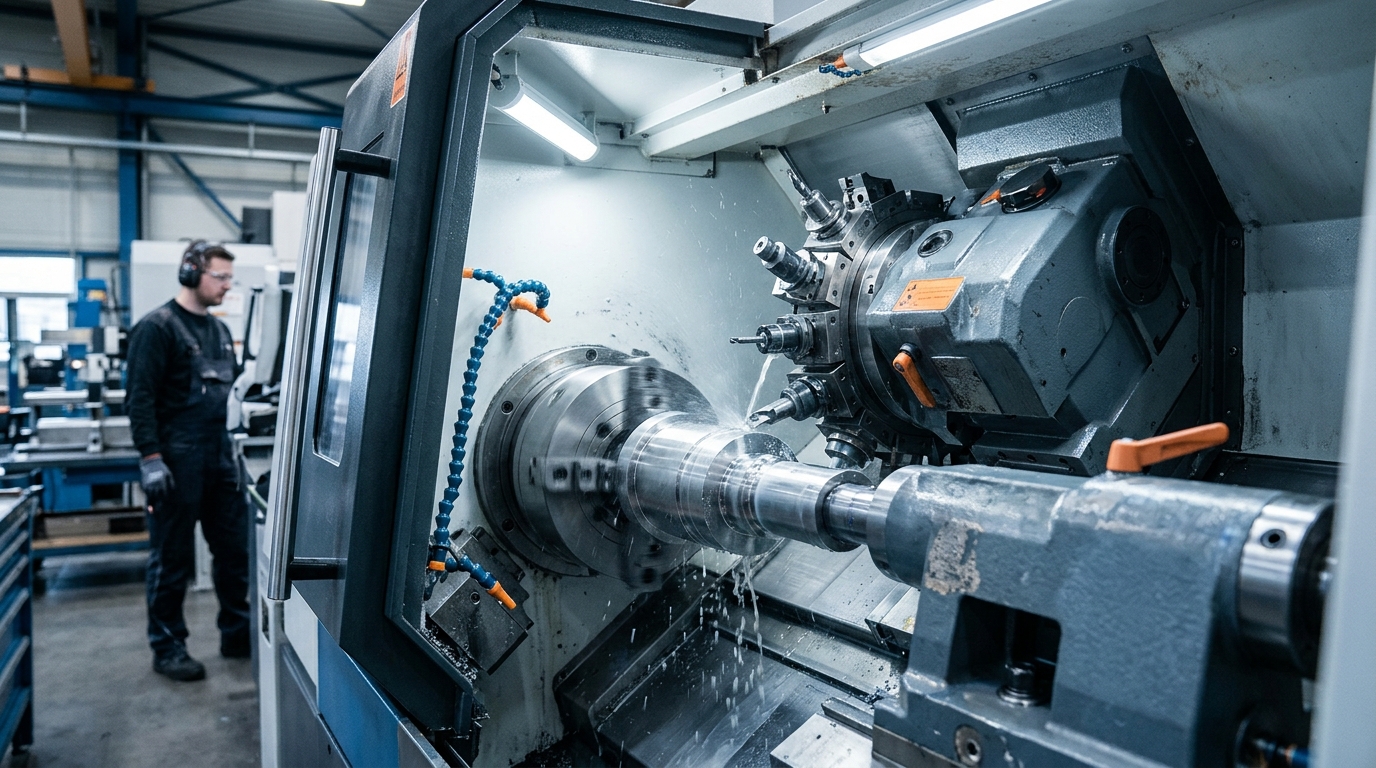
A CNC lathe is a machine tool in which the workpiece rotates and a computerized numerical control (CNC) executes the tool movements according to a program. Anyone looking to buy a CNC lathe therefore does not compare data sheets in general, but machines against their own part spectrum. This article classifies machine types, equipment, German manufacturers and programming routes. Milling machines and 5-axis centers are covered in separate articles.
What types of turning are there?
Turning is a machining process that, according to DIN 8580, belongs to the material-removal processes; the subdivision is governed by DIN 8589-1, currently in the 2003-09 edition.[1] Based on the shape of the surface produced, the manufacturing technology department of TU Dresden distinguishes cylindrical turning, facing, thread turning, skew rolling, non-circular turning, profile turning and form turning; based on feed direction, a distinction is made between longitudinal turning and facing.[2]
| Process | Surface produced | Typical example |
|---|---|---|
| Cylindrical turning | cylindrical external or internal surface | bearing seat on a shaft |
| Facing | flat surface perpendicular to the axis of rotation | end face of a flange |
| Thread turning | thread | external thread on a bolt |
| Profile turning | contour that mirrors the tool profile | groove for a retaining ring |
| Form turning | arbitrary contour via controlled feed motion | radius and cone on a turned part |
For a purchase decision, the classification is practical because it shows what the machine must be able to do. Form turning of complex contours requires a contouring control that moves at least two axes simultaneously. Threads demand a feed axis synchronized with the spindle rotation. Today's CNC lathes can do both; the differences lie in accuracy, rigidity and tooling equipment.
Machine types of CNC lathes
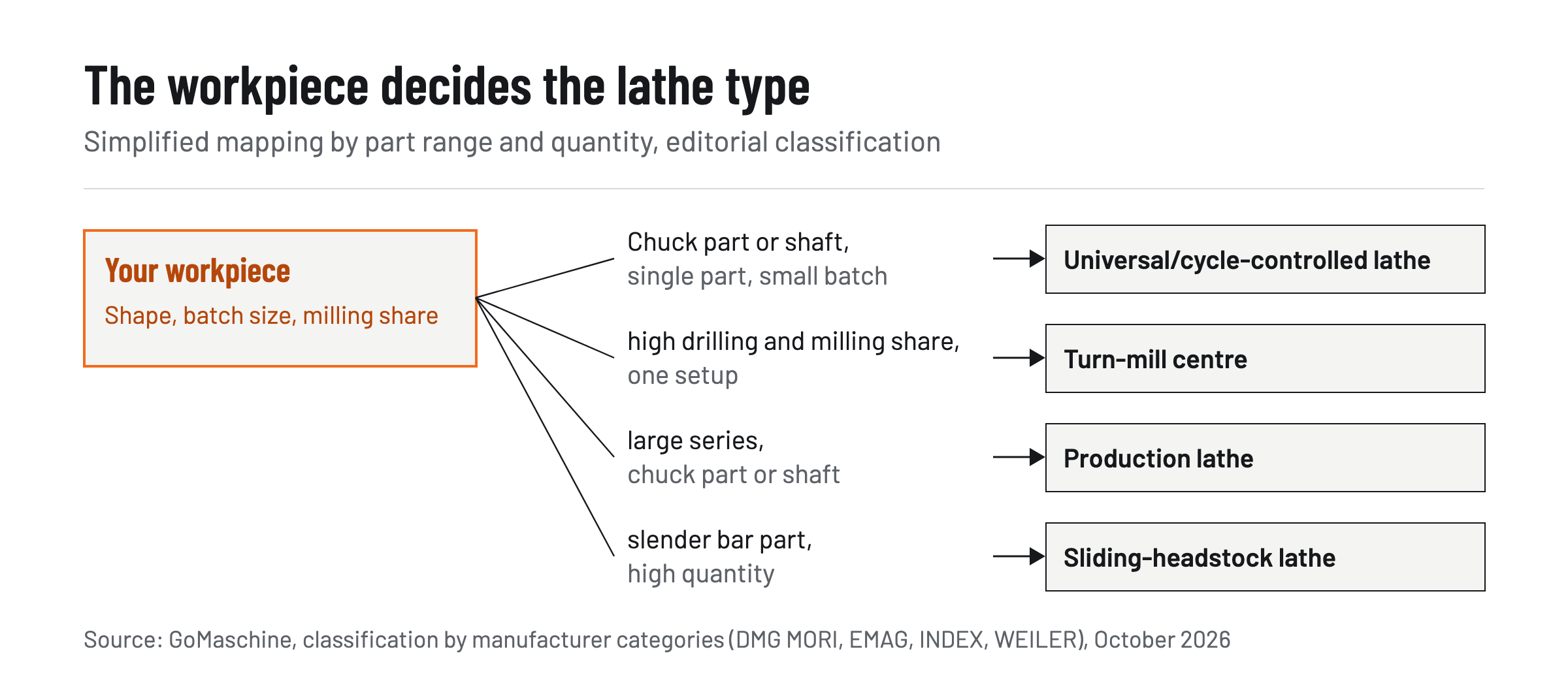
The machine type follows the workpiece and the production volume. Manufacturers structure their product ranges differently; DMG MORI, for example, names the categories universal turning, turn-milling and horizontal production turning, while EMAG divides its series by chuck parts and shafts (manufacturer specifications).
| Machine type | Suitable for | Limitation |
|---|---|---|
| Universal or cycle lathe | single parts, small batches, training | little automation |
| Turn-mill center | complete machining including milling and drilling | higher price and programming effort |
| Production lathe, horizontal or vertical | large volumes of chuck parts and shafts | changeover only pays off in series production |
| Sliding-headstock automatic lathe | slender bar-fed parts in high volume | small diameters |
What does a CNC machine do?
A CNC machine executes movements of axes, spindles and tool changes according to a program that defines paths, spindle speeds and feeds as numerical values. In Germany, DIN 66025-1 "Program structure for numerically controlled machines; General" (edition 1983-01) governs this format.[3] Programs in this format, often called DIN/ISO code, consist of path and switching commands, the G and M codes.
On a lathe this means: in its basic configuration, the control moves the X-axis (diameter) and the Z-axis (length). Equipment that goes beyond turning extends this:
- C-axis: the main spindle becomes positionable, so that drilling and milling on the face or the cylindrical surface become possible.
- Driven tools: turret stations with their own drive for drilling and milling operations.
- Y-axis: milling off-center relative to the turning axis, for example for flat surfaces and slots.
- Sub-spindle: takes over the part for back-side machining, so that it leaves the machine finished.
- Bar feeder and part removal: prerequisites for unmanned shifts.
Each of these options costs money and programming time. It only makes sense if it saves an operation on another machine or a second setup.
Which German lathe manufacturers are there?
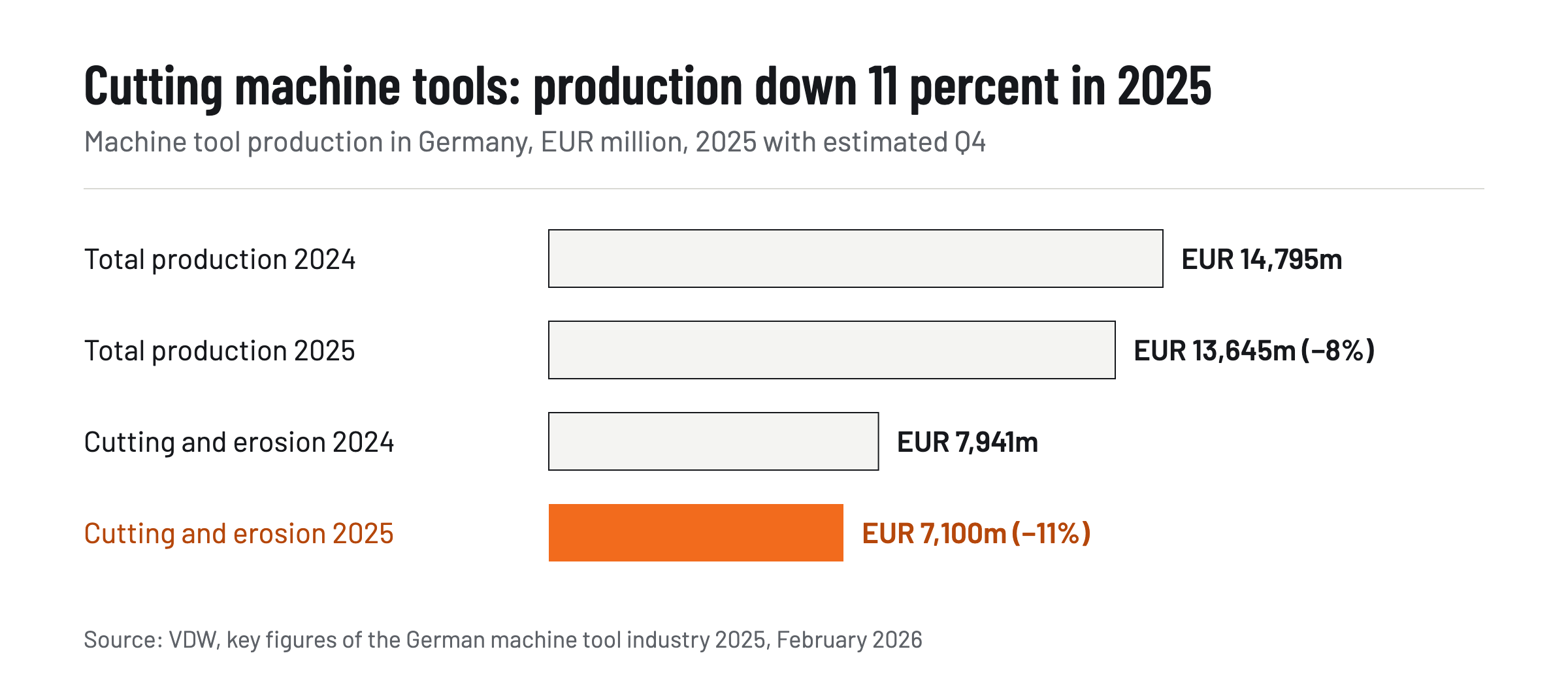
German manufacturers of CNC lathes include, among others, INDEX with the TRAUB brand, EMAG, WEILER and DMG MORI; this selection is an editorial overview, not a ranking. The market is export-driven. According to the German Machine Tool Builders' Association (Verein Deutscher Werkzeugmaschinenfabriken, VDW), German machine tool production in 2025 stood at 13,645 million euros, 8 percent below the previous year's value of 14,795 million euros.[4] Of this, 7,100 million euros was attributable to cutting and erosion machines, down from 7,941 million euros in 2024.[4] The export ratio was 70.7 percent; the fourth quarter is estimated.[4] The table reflects the information on the manufacturers' websites at the time of publication.
| Manufacturer | Location | Turning focus (manufacturer's specification) |
|---|---|---|
| INDEX-Werke (brands INDEX and TRAUB) | Esslingen | Production automatic lathes, turn-mill centers, TRAUB sliding-headstock lathes for workpieces up to 32 mm diameter |
| EMAG | not stated on the homepage | Lathes for chuck parts and shafts, model series MSC, USC/HSC, VL/VM, VT |
| WEILER | main plant in Emskirchen | Cycle-controlled precision lathes and CNC lathes, also for training |
| DMG MORI | not stated on the product page | Universal turning, turn-milling, horizontal production turning |
For procurement, more important than the country of origin is the service network in your region, the delivery time for spare parts, and the control with which the machine is delivered. A manufacturer based in Germany can offer service and training closer to your site; the same applies to dealers of international brands with their own service technicians. In the quotation, ask about response times and the number of service technicians in your area.
Which CNC programming methods are there?
There are three programming routes for CNC lathes: programming in DIN/ISO code, dialog-guided programming with cycles directly at the control, and program creation in a CAM system on a PC. Which route fits depends on the part spectrum and the control; well-known control manufacturers include Siemens (SINUMERIK), HEIDENHAIN and FANUC.
| Programming route | How it works | Best suited for |
|---|---|---|
| DIN/ISO code (G-code) | Path and switching commands per DIN 66025, written or adapted by hand | simple parts, optimization at the machine |
| Shop-floor programming with cycles | the control queries contour and technology values in a dialog | single parts and small batches, operator programs it themselves |
| CAM system | program generated from the 3D model, output via post-processor | complex turn-mill parts, many variants |
According to WEILER, cycle-controlled machines offer "machining steps as cycles" that simplify metalworking.[5] This lowers the entry barrier in workshops without their own programming department. Turn-mill centers with a sub-spindle and Y-axis, by contrast, can hardly be run without CAM and a matching post-processor that translates the program into the language of the respective control.
Is there a free CNC turning program?
Free programs for CNC turning are mainly available as learning and simulation software from control manufacturers and as open-source controls; a free production CAM solution for turn-mill centers, by contrast, is the exception. Three examples, as of 26 October 2026:
- SinuTrain for SINUMERIK Operate (Siemens): Siemens offers SinuTrain for SINUMERIK Operate in version V4.95 (Edition 2) for download, including a Basic package.[6] License packages for school pupils, students, training and commercial full versions are distributed by Christiani. Whether and for what purpose the Basic package can be used free of charge is governed by the license terms; check them before using it in your operation.
- DataPilot CP 640 (HEIDENHAIN): HEIDENHAIN lists a demo version of the PC programming station for lathes with CNC PILOT 640 and MANUALplus 620 (ID 737139); availability and conditions are handled via a request form.[7]
- LinuxCNC: free control software under the GPL which, according to the project, controls milling machines, lathes and other machines, currently in version 2.9.10 dated 9 July 2026.[8] It is aimed at conversions and custom builds, not at programming a purchased industrial control.
For a purchase, a free simulation version of the control that runs on the machine is useful: your staff can prepare programs and learn the operation before the machine is delivered.
Is CNC programming difficult?
CNC programming can be learned, but it requires manufacturing knowledge: anyone who cannot assess cutting data, workholding and tools will not write safe programs even with good software. The fundamentals are part of the dual vocational training system. According to the Federal Institute for Vocational Education and Training (BIBB), machining technicians learn over 42 months, among other things, how to create, optimize and set up programs for numerically controlled production systems; lathe systems are one of the fields of application.[9]
The level of difficulty depends on the programming route. A contour with dialog cycles on a two-axis lathe is manageable for experienced turners after a manufacturer training course. A turn-mill center with sub-spindle, Y-axis and bar feeder, by contrast, requires knowledge of CAM, collision checking and process reliability. So plan training days into your quotation, and ask whether the training takes place on the control of your machine.
Which CNC lathe is the best?
The best CNC lathe is the one that produces your part spectrum in the required accuracy and quantity most economically; there is no universally valid ranking. Offers only become comparable once you define your requirements in advance and have every vendor answer the same points:
| Criterion | What to define | Why it matters |
|---|---|---|
| Working space | maximum turning diameter, turning length, bar passage | permanently limits the part spectrum |
| Spindle | power, torque, speed range | material and diameter determine the requirement |
| Tools | turret stations, driven tools, Y-axis | complete machining instead of a second machine |
| Automation | sub-spindle, bar feeder, part removal, robot interface | unmanned shifts, throughput time |
| Control | manufacturer, programming route, CAM post-processor | training effort and programming time |
| Accuracy | required tolerances, acceptance test on your own test part | manufacturer specifications apply under defined conditions |
| Service | response time, spare parts stock, training | downtime costs often exceed the price difference |
On price: there are no reliable list prices for CNC lathes, because equipment and automation determine the amount; you receive quotations on a project basis. Whether buying, leasing or hire-purchase pays off is shown by the comparison in leasing or buying a machine. If an existing machine is still mechanically sound, it is worth looking at a control retrofit; milling work follows its own criteria, covered in buying a CNC milling machine for metal. If you verify accuracy on your own test part, you will find background on the coordinate measuring machine.
Buy when the part spectrum, batch size and programming route are settled and at least two quotations are based on the same list of criteria. Further context can be found in the Machining section and the Industry section on GoMaschine.
Frequently asked questions
What is the difference between a CNC lathe and a turning center?
In its basic configuration, a CNC lathe works with two axes. A turning center or turn-mill center adds driven tools, a C-axis and often a Y-axis and sub-spindle, so that drilling and milling operations become possible in the same setup.
Is a used CNC lathe worth it?
A used machine can pay off if the mechanics and guideways are in good condition and spare parts for the control are still available. Have the condition checked before purchase on a test part and against the maintenance history.
Which control is common for a CNC lathe?
Well-known control manufacturers include Siemens, HEIDENHAIN and FANUC. What matters is which control your staff already know and which one your CAM system supports via a post-processor.
Sources
Related reading
All Manufacturing →Buying a CNC Milling Machine for Metal: What SMEs Should Look For
Buying a CNC milling machine for metal: number of axes, costs, manufacturers and the market explained, so manufacturers can make a sound decision.
Metal 3D Printing for Small Series: When Does It Pay Off?
Metal 3D printing for small series: cost per hour, powder prices, post-processing and break-even against CNC, with the calculation assumptions and sources disclosed.