TPM: Introducing Autonomous Maintenance in Production
TPM in maintenance: what the method is, how autonomous maintenance is introduced in seven steps and how OEE measures the progress.
In this article9
What is the TPM method?
The TPM method is a maintenance approach that aims to systematically eliminate breakdowns, quality losses and accidents on production equipment. To do so, it involves every employee, from the operator to plant management. The German-language Wikipedia describes TPM as a comprehensive production system meant to run as free of disruption as possible, with the goal of zero defects, zero downtime, zero quality losses and zero accidents.[1]
TPM originated in Japan and was developed by Seiichi Nakajima between 1950 and 1970.[2] After Nippondenso received the PM Prize in 1971, the Japan Institute of Plant Maintenance (JIPM) expanded TPM into eight activities.[2] The core has stayed the same: a machine loses output not only through major breakdowns but also through short stops, reduced speed and scrap. The operator sees these losses first, so TPM starts with the operator.
For maintenance managers, TPM is therefore above all a question of organisation. The method shifts routine work into production and so frees capacity for planned maintenance and for improvements to the equipment.
What maintenance strategies are there?
In Germany, the terms for types of maintenance are defined in DIN EN 13306, currently in the 2018-02 edition.[3] Broadly, the strategies differ in when someone intervenes:
| Strategy | Trigger | Typical use |
|---|---|---|
| Corrective (breakdown) maintenance | failure or a detected fault | non-critical equipment, low-cost spare parts |
| Preventive, time-based maintenance | fixed interval (time, operating hours, units produced) | wear parts with a known service life |
| Condition-based maintenance | measured or inspected condition | bearings, drives, hydraulics with measurable wear |
| Predictive maintenance | forecast from condition data | critical bottleneck equipment with sensors |
TPM is not a fifth row in this table. The method defines who in the plant does which work, and it combines the strategies: operators check the condition every day, and maintenance plans the intervals and fixes weak points. Which strategy pays off for a given machine is a separate question; software that manages intervals and work orders is compared in the article on maintenance software for SMEs.
What is autonomous maintenance?
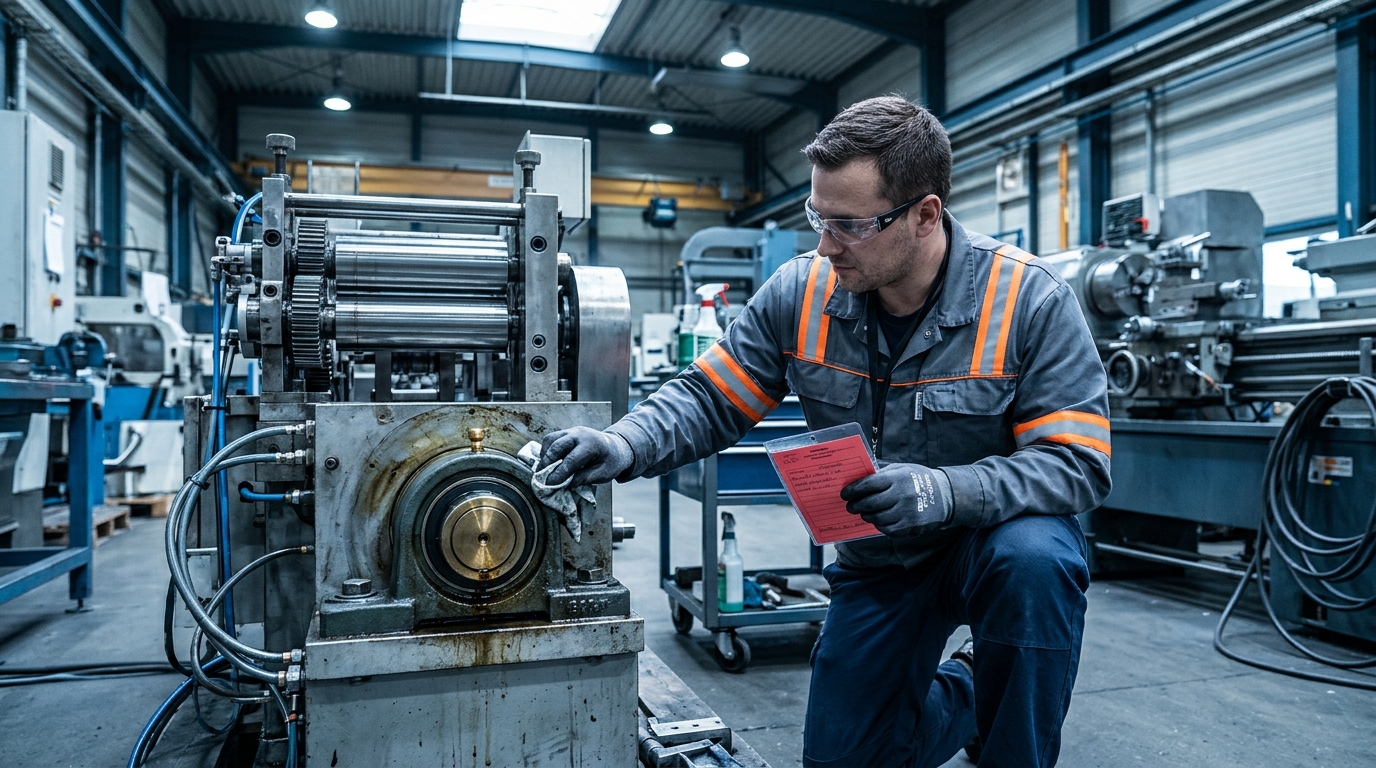
Autonomous maintenance (Japanese: Jishu Hozen) is the TPM pillar in which machine operators carry out cleaning, inspection and lubrication on their own. In later steps, they also take over minor maintenance work.[1] The reason is simple: someone who runs a machine every day hears a change in the running noise or sees a leak earlier than a technician who only comes when there is a breakdown.
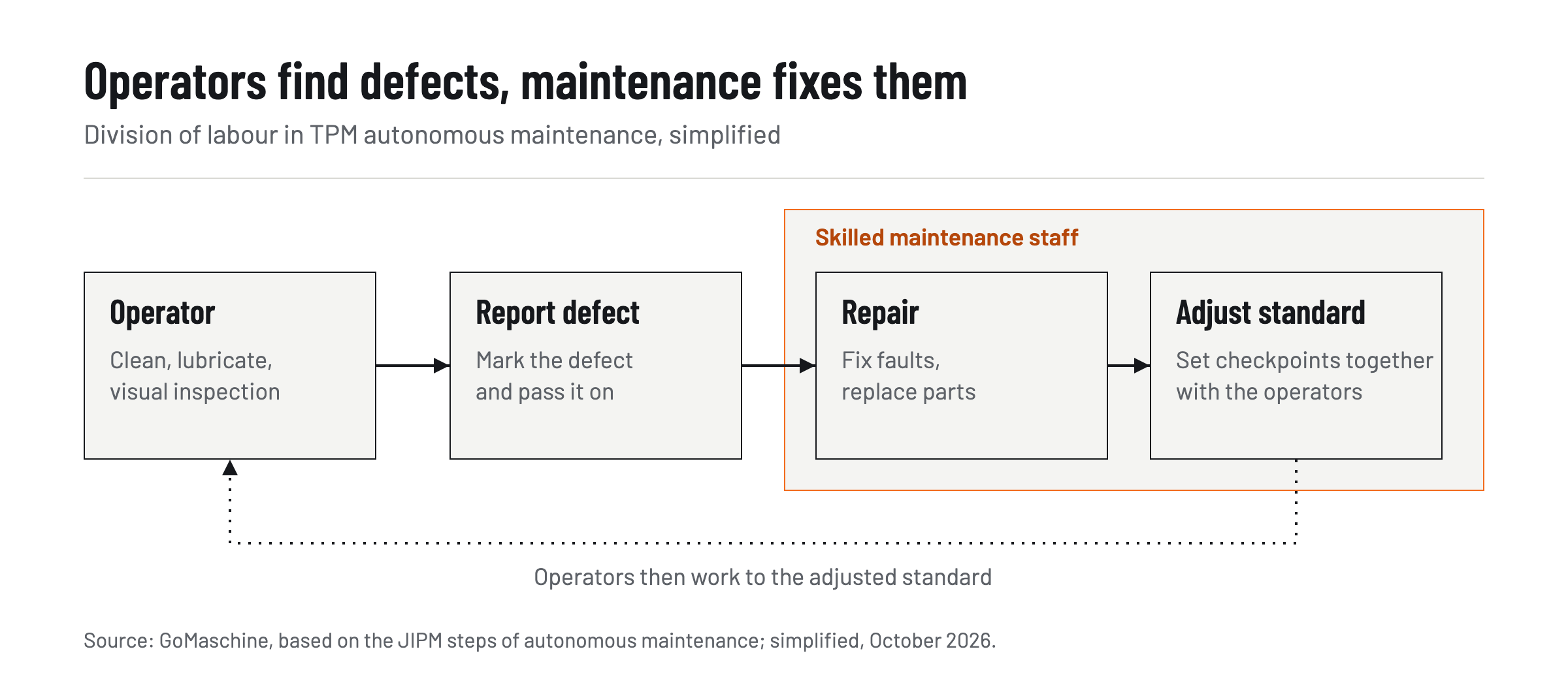
Autonomous does not mean that production manages without maintenance. The operator takes over basic care and visual checks according to standards worked out together with maintenance. Work on controls, safety devices or safety-relevant components stays with skilled professionals.
Introduction in seven steps
Autonomous maintenance is introduced in seven steps defined by the JIPM.[4] Each step ends with an audit before the team moves on to the next. According to the trade portal Reliamag, the audit is done by the team itself, the area manager and an experienced auditor, often the TPM coordinator.
| Step | Content | What the operator can do afterwards |
|---|---|---|
| 1 | Initial cleaning and inspection | find and tag hidden defects while cleaning |
| 2 | Eliminate sources of contamination, improve hard-to-reach areas | reduce cleaning effort for good |
| 3 | Provisional standards for cleaning, lubrication and inspection | work through defined checkpoints in a defined time |
| 4 | General inspection training | understand assemblies and classify deviations |
| 5 | Autonomous inspection | carry out and maintain inspection plans independently |
| 6 | Standardisation | keep the workplace and processes in order permanently |
| 7 | Autonomous management | manage the equipment condition independently and initiate improvements |
For a single production line, Reliamag estimates about 12 to 36 months in total, including six to twelve months for the training in step 4 alone.[4] That is the portal's estimate, not a standard value. For planning, this means: one pilot line first, then roll-out to further equipment once the first three steps run stably there.
In practice, three points decide whether the introduction holds:
- Time in the shift plan: cleaning and inspection need fixed minutes per shift. If they come on top of the output target, they are the first thing to be dropped.
- Defects get fixed: the initial cleaning turns up many tagged defects. If they are left lying, the team loses its motivation for step 2.
- Standards written together: operators and maintenance define checkpoints, lubrication points and intervals together. A standard handed down without involvement is rarely followed.
What are the 8 pillars of TPM?
The eight pillars of TPM are the fields of work into which the JIPM structured the method; originally there were seven.[5] The German-language Wikipedia lists them as follows:[1]
- Continuous improvement
- Autonomous maintenance
- Planned maintenance
- Training and education
- Early equipment management
- Quality management
- TPM in administrative areas
- Occupational safety, environmental and health protection
For maintenance, pillars 2 and 3 are the pair that belongs together. Autonomous maintenance takes routine work off maintenance, and planned maintenance uses the time this frees for intervals, spare parts planning and weak-point analysis. Pillar 4 is the precondition for both, because operators without training do not recognise a deviation. The naming varies between sources: early equipment management is also called start-up management, and quality management is also called quality maintenance.
What is TPM in maintenance?
TPM in maintenance means a new division of labour: maintenance changes from the fire brigade called out to breakdowns into the planner and trainer. It trains the operators, writes the standards for autonomous maintenance with them, and takes over the work that needs specialist knowledge or tools.
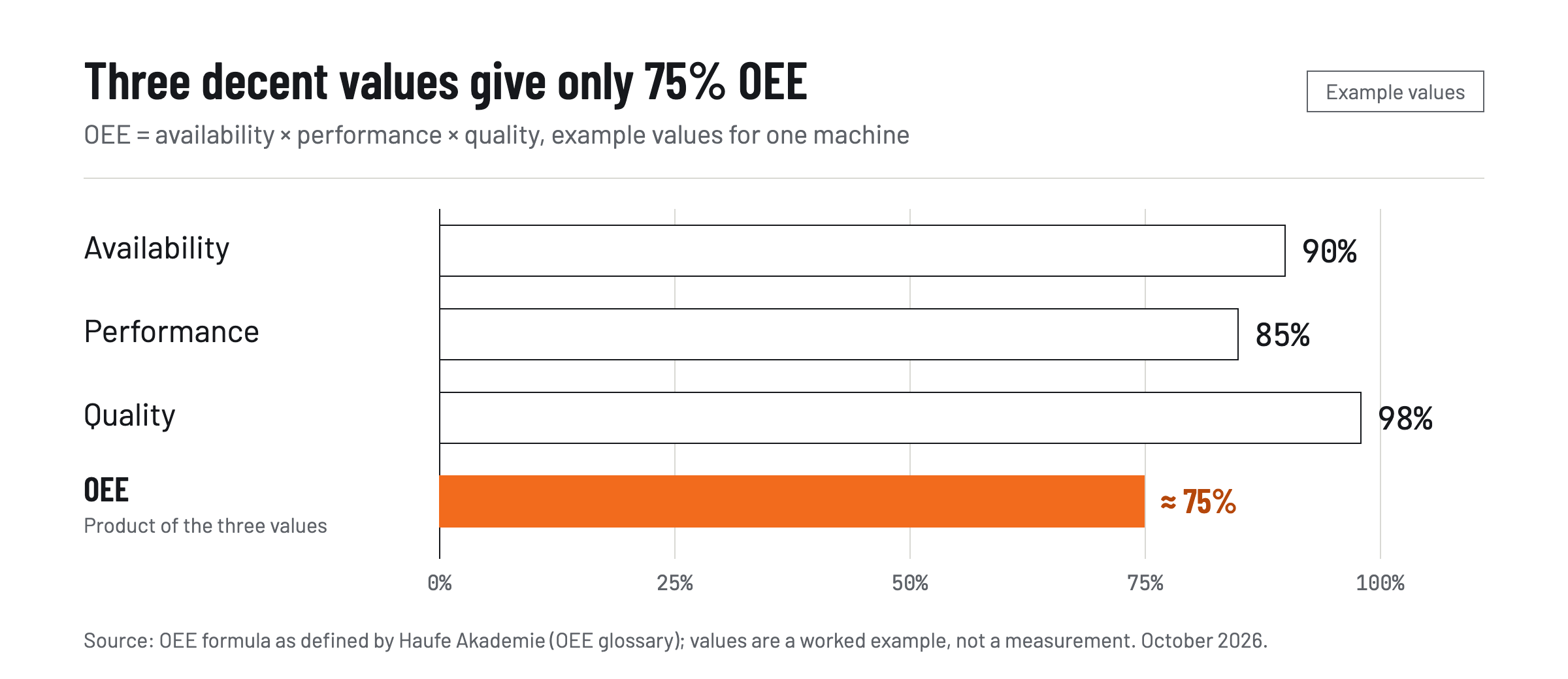
This change is measured by overall equipment effectiveness (OEE). It is calculated as the product of three factors: OEE = availability × performance × quality.[6]
- Availability: actual run time relative to planned production time, i.e. the share without downtime.
- Performance: actual production speed relative to the maximum speed.
- Quality: share of good parts in the total quantity.
A worked example shows why the multiplication matters. A machine with 90 % availability, 85 % performance and 98 % quality reaches an OEE of 0.90 × 0.85 × 0.98 ≈ 75 % (example values, not a measurement). Three individually decent values together lose a quarter of the possible output. Autonomous maintenance targets availability and performance above all, because operators spot short stops and creeping wear earlier.
An OEE figure alone does not say where the losses arise. Only a breakdown by downtime cause shows which step of autonomous maintenance helps where. How machine data can be captured for this is described in the article on energy monitoring for machines, using a measurement concept as the example.
What does the abbreviation TPM stand for?
TPM stands for Total Productive Maintenance. In German it is usually rendered as "umfassende produktive Instandhaltung", but in practice the English abbreviation is the common term. "Total" refers to the involvement of all employees and to the entire life cycle of the equipment, "Productive" to the link with production output rather than only with the technology.
What are the four pillars of maintenance?
The four pillars of maintenance are the basic measures under DIN 31051 (2019-06 edition): servicing, inspection, repair and improvement.[7] TPM redistributes these measures without replacing them:
| Basic measure under DIN 31051 | Who mainly takes it over in TPM |
|---|---|
| Servicing | operators (cleaning, lubrication to standard), larger servicing by maintenance |
| Inspection | operators (visual check, steps 4 and 5), measurements by maintenance |
| Repair | maintenance; operators report and tag defects |
| Improvement | operators and maintenance together (step 2, continuous improvement pillar) |
How the four terms are delimited exactly is covered in a separate article; how servicing and repair work together in a modernisation is shown in the article on machine retrofits. If you want to introduce TPM, start with a pilot machine, measure its OEE before the initial cleaning and compare it after step 3. More on production, maintenance and quality is in the Industry section of GoMaschine.
Frequently asked questions
How long does it take to introduce autonomous maintenance?
For a single line, the trade portal Reliamag gives about 12 to 36 months to reach the seventh step. The figure is an estimate and depends on how much shift time is planned for cleaning, training and fixing defects.
What is the difference between autonomous and planned maintenance?
In autonomous maintenance, operators care for and check their equipment according to defined standards. Planned maintenance is a separate TPM pillar in which skilled professionals plan intervals, spare parts and weak-point analyses; the two pillars complement each other.
May operators carry out any maintenance themselves under TPM?
No. Operators take over cleaning, lubrication and visual checks according to standards defined together. Work on controls, safety devices and safety-relevant components stays with skilled maintenance professionals.
What is a good OEE value?
There is no generally valid target, because cycle times, changeover shares and quality requirements differ from machine to machine. What is meaningful is a comparison of the same machine before and after a measure, broken down by downtime cause.
Is TPM only for high-volume manufacturers?
TPM comes from Japanese series production, but autonomous maintenance works on any machine with permanent operators. Small companies sensibly start with one bottleneck machine rather than the whole plant.